
Hemlock sawfly
Neodiprion tsugae
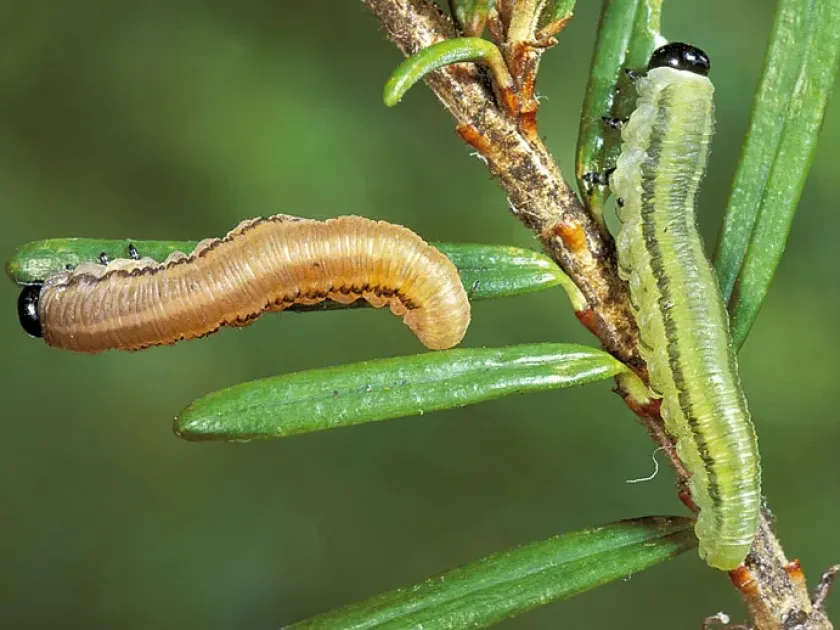
Description
How to identify
The hemlock sawfly (Neodiprion tsugae) is a member of the Diprionidae family, belonging to the order Hymenoptera. Although often mistaken for flies due to their appearance, these insects are distinct sawflies characterized by their specific abdominal anatomy.
The larvae of this species are caterpillar-like but differ from lepidopteran larvae in the number of abdominal prolegs. They typically display yellowish-green or brownish patterns, which serve as camouflage against the hemlock needles on which they feed.
The life cycle involves complete metamorphosis: egg, larva, cocooned pupa, and adult (imago). Females use their ovipositor to insert eggs directly into the needles, protecting their offspring from predators and environmental stress.
Most populations are univoltine, meaning there is one generation per year. However, favorable climate conditions can lead to sudden population explosions, which can devastate large areas of hemlock forests within a short period.
Adults emerge in early summer to mate and lay eggs, while the larval feeding stage occurs during the peak of the growing season. Early detection during this period is essential for effective pest management in commercial forests.
What it damages
The primary host for this pest is the hemlock tree (Tsuga), particularly the western hemlock. The larvae feed externally on the needles, causing significant reduction in the tree's photosynthetic capacity by removing the canopy foliage.
In cases of severe infestation, trees can be stripped of their needles in a single season. This drastic defoliation weakens the host, leads to reduced growth rates, and makes the trees susceptible to secondary diseases and pests.
Repeated defoliation over several years can result in crown dieback and tree mortality. While mature trees may survive single outbreaks, continuous attacks significantly lower their resilience and overall timber quality.
Young hemlock trees are particularly vulnerable, often facing mortality due to the high energy demand required to regenerate foliage. Stunted growth in young plantations can lead to long-term economic losses in forestry.
Beyond the direct impact on the trees, the accumulation of larval excrement (frass) under the canopy can create unsightly conditions and foster the growth of sooty mold, which further affects the tree's physiological function.
Signs of infestation
The first sign of an infestation is the presence of larval colonies on the branches. Larvae often feed in groups, making them easy to spot during regular tree health inspections in the early summer months.
Another clear symptom is the specific feeding pattern on the needles. Larvae typically consume the softer tissues first, leaving the needles looking ragged, brownish, and withered before they eventually fall off prematurely.
Large quantities of granular frass accumulating on the needles, branches, or the ground beneath the tree provide strong evidence of high larval activity. This accumulation is usually proportional to the severity of the infestation.
During the pupation stage, small, oval-shaped cocoons can be found on branches, in the needle litter, or within the bark crevices. These cocoons are cryptic and often require close attention to be identified by field scouts.
Thinning of the crown is a progressive sign of damage. As defoliation continues, the tree canopy loses its density, appearing sparse and unhealthy, which contrasts sharply with the appearance of non-infested neighboring trees.
Control measures
Management strategies for the hemlock sawfly focus on integrated pest management (IPM) to minimize chemical reliance while protecting tree health. Monitoring serves as the foundational step in deciding if action is necessary.
Mechanical control is effective for isolated infestations or small ornamental trees. Manually removing larvae or pruning infested branches can significantly reduce the local population if the activity is caught in the early stages.
Biological control involves the use of microbial insecticides, such as those derived from Bacillus thuringiensis (Bt). These products are highly selective, targeting sawfly larvae while preserving natural enemies like parasitic wasps.
Chemical control with systemic or contact insecticides may be necessary during severe outbreaks. Applications should be timed precisely with the larval feeding period to ensure maximum contact and efficacy while respecting environmental safety.
Promoting a healthy environment by improving tree vigor through proper irrigation and soil care helps trees recover from defoliation. Encouraging natural predators, such as birds and beneficial insects, can also help keep sawfly populations below damaging levels.
Taxonomy
- Latin name
- Neodiprion tsugae
- Order
- Hymenoptera
- Family
- Diprionidae
- EPPO code
- NEODTS
Discussion
No discussions yet — be the first.