
Swaine jack pine sawfly
Neodiprion swainei
Description
How to identify
The Swaine jack pine sawfly, scientifically known as Neodiprion swainei, is a member of the Diprionidae family. Adults are small insects, with females measuring approximately 7–9 mm in length and displaying an ochre-yellow coloration with dark markings.
Males are generally smaller, darker in color, and possess feathery, serrate antennae, which are highly efficient at detecting pheromones released by females for mating purposes.
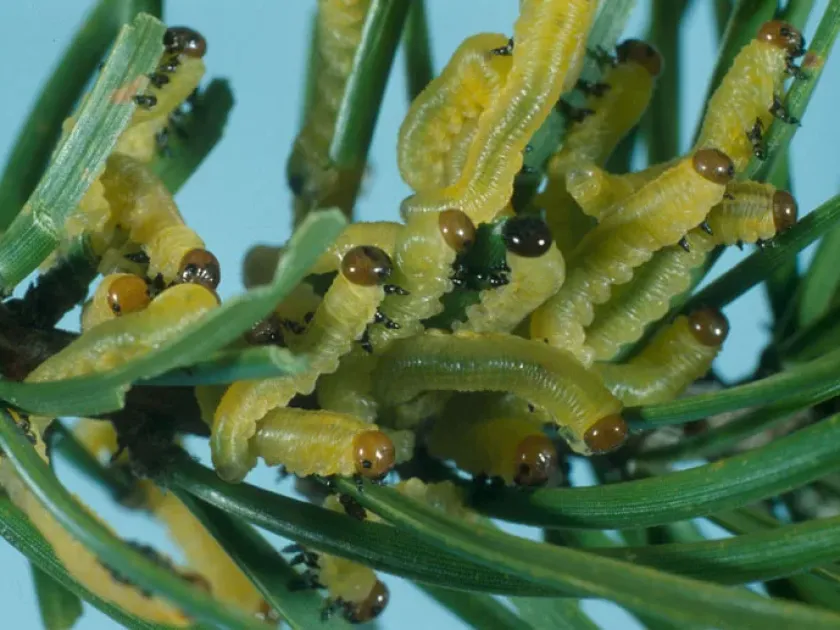
The larvae, or false caterpillars, undergo several developmental instars. Once fully grown, they measure about 20–25 mm, characterized by their grey-green bodies and distinctive black heads.
Females lay their eggs inside the pine needles, using their saw-like ovipositor to create small, precise slits. A single female can deposit up to 20 eggs within a single needle, effectively shielding them.
Pupation occurs within firm, cylindrical cocoons. These cocoons are typically found in the needle litter or organic debris beneath the host tree, providing a stable environment for metamorphosis.
What it damages
The primary host for this pest is the jack pine (Pinus banksiana), though it has been known to infest other pine species within its geographical range in North America.
Larvae exhibit a preference for older foliage, which they consume in large groups. However, during outbreaks, they will also consume current-year needles, leading to significant defoliation.
Severe defoliation causes the tree to lose its photosynthetic capacity, resulting in significant growth reduction and predisposing the tree to secondary infections and infestations.
If the tree is defoliated for consecutive years, it often leads to mortality. This poses a major threat to commercial timber plantations and natural forest regeneration efforts.
Economic damage is substantial, as weakened trees are susceptible to bark beetle attacks and wood-boring insects, further diminishing the value of the timber harvest.
When it appears
The Swaine jack pine sawfly completes one generation per year. Adult emergence typically occurs in late summer, marking the beginning of the reproductive cycle.
Overwintering occurs in the egg stage, embedded securely within the needles. This strategy allows the pest to survive harsh winter conditions until the onset of spring.
Larval hatch coincides with the bud break of the host pine trees. This precise synchronization ensures that the young larvae have immediate access to their preferred food source.
The larval feeding period spans from late spring through mid-summer. After completing their growth, larvae drop to the ground to spin their cocoons and pupate.
Environmental factors, particularly spring temperatures, significantly dictate the timing of larval emergence and development rates, which is critical for planning management.
Signs of infestation
The most evident sign of an infestation is the presence of groups of larvae feeding on the needles, often causing branches to look thin or entirely defoliated.
Large amounts of larval frass (excrement), appearing as fine dark pellets, accumulate beneath the infested branches, serving as a warning of high pest density.
Careful inspection of the needles reveals subtle brown scarring along the edges, which indicates the sites where eggs were deposited by the female sawfly.
When disturbed, the larvae exhibit a unique defensive behavior by lifting their heads and tails simultaneously, which is a classic diagnostic feature of this species.
As the season progresses, yellowing and browning of the remaining foliage become prominent, eventually leading to a characteristic unhealthy appearance of the tree canopy.
Control measures
Biological control using the nuclear polyhedrosis virus (NPV) is a highly effective, species-specific method for suppressing populations during outbreaks.
Pheromone monitoring programs are essential for forest managers to track adult population trends and determine the precise timing for intervention strategies.
Chemical control measures involve the application of selective insecticides, timed specifically to target early larval instars before extensive foliage damage occurs.
Conservation of natural enemies, including parasitic wasps and predatory bugs, plays a vital role in maintaining the population below the economic threshold in stable forests.
- Removing excessive ground debris to limit suitable pupation sites.
- Selecting resistant pine varieties during reforestation projects.
- Regular health monitoring of forest stands to detect early signs of infestation.
Taxonomy
- Latin name
- Neodiprion swainei
- Order
- Hymenoptera
- Family
- Diprionidae
- EPPO code
- NEODSW
Discussion
No discussions yet — be the first.