
European pine sawfly
Neodiprion sertifer
Description
How to identify
The European pine sawfly belongs to the order Hymenoptera, family Diprionidae. Despite the name, they are not true flies, but closer relatives of bees and wasps.
Adult females are typically 8–10 mm long with a yellowish-brown abdomen, while males are smaller, about 7 mm, and generally black with feathery antennae.
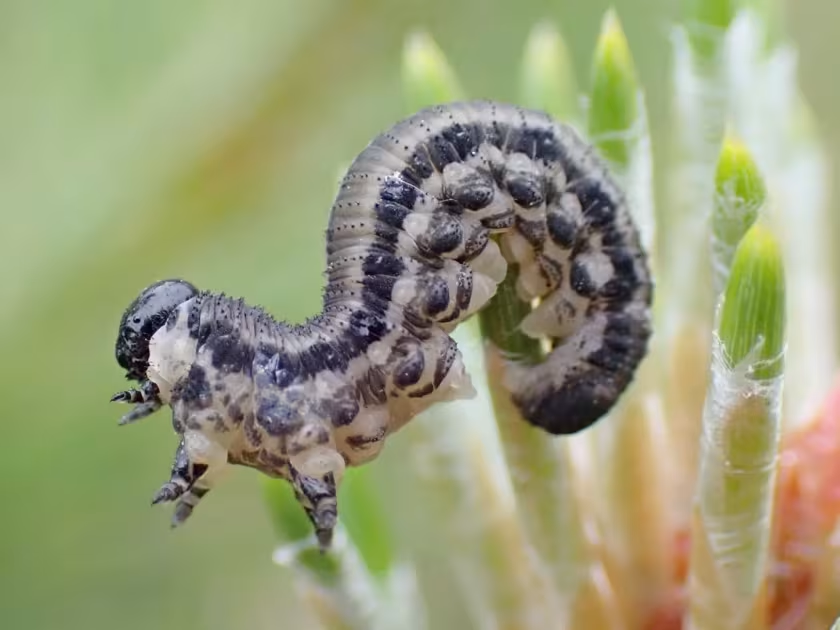
The larvae, known as false caterpillars, are gregarious and possess a grey-green body with a longitudinal white stripe and a shiny black head.
Larvae are easily identified by their social behavior, as they cluster in groups of dozens or hundreds while feeding on the needles of host trees.
Pupation occurs in tough, papery cocoons that are light brown or yellowish, often attached to the foliage or found in the litter beneath the tree.
What it damages
The primary hosts for this pest are various pine species, including Scots pine, lodgepole pine, and others commonly found in temperate forests.
Larvae consume older needles first, leaving the current season's growth until last, which causes the tree to lose its canopy density rapidly.
Severe infestations can lead to total defoliation of the tree, which significantly reduces growth and makes the tree susceptible to secondary attacks.
While mature trees can often survive a single season of defoliation, repeated attacks over several years often lead to tree mortality or stunted growth.
The economic impact is significant in forestry, as trees lose timber value and their ability to sequester carbon is severely hampered during outbreaks.
When it appears
The European pine sawfly typically completes one generation per year, with the species overwintering in the egg stage inside pine needles.
Larvae hatch in the spring, usually aligning their emergence with the warming weather and the early development of pine buds and new shoots.
The feeding stage of the larvae lasts for several weeks, spanning late spring to early summer, which is the period of highest risk for the host trees.
After reaching maturity, the larvae move to protected areas to spin their cocoons and pupate, with adults emerging in late summer or autumn.
Adults live for a short period, during which mating occurs and females lay eggs in slits cut into the needles of the current year’s pine growth.
Signs of infestation
The most prominent sign is the presence of groups of larvae feeding in unison, which can make the branches look like they are covered in spikes.
Needles that have been partially eaten turn yellow or reddish-brown, giving the tree a sickly, scorched appearance that is visible from a distance.
- Evidence of needles being chewed from the edges inward, leaving only the central vascular strand.
- Accumulation of small, dark, granular droppings (frass) under the infested branches.
- Presence of empty, papery cocoons hidden among the needles or in the bark crevices.
Severely infested trees show thin, transparent crowns and lack the healthy deep green color expected during the active growing season.
Closer inspection of the needles may reveal the oviposition slits, which look like tiny rows of brown spots along the surface of the needle.
Control measures
For small ornamental trees in gardens, physical removal of larval colonies by hand is highly effective and avoids the need for chemical intervention.
Biological control using microbial insecticides, such as those based on nucleopolyhedrovirus or bacteria, is widely used to manage population outbreaks.
Chemical control with systemic or contact insecticides is recommended only when infestations reach economic thresholds and mechanical control is impossible.
Promoting a healthy ecosystem by encouraging native predators and parasitoids can help maintain low sawfly populations naturally over the long term.
Regular monitoring during the autumn months helps identify branches with egg-laden needles, allowing for pruning before the eggs hatch in the spring.
Taxonomy
- Latin name
- Neodiprion sertifer
- Order
- Hymenoptera
- Family
- Diprionidae
- EPPO code
- NEODSE
Discussion
No discussions yet — be the first.