
Redheaded pine sawfly
Neodiprion rugifrons
Description
How to identify
The redheaded pine sawfly is a member of the Hymenoptera order, belonging to the family Diprionidae. These insects exhibit significant sexual dimorphism: females are larger with reddish-brown coloration, while males are generally black with yellow abdominal markings.
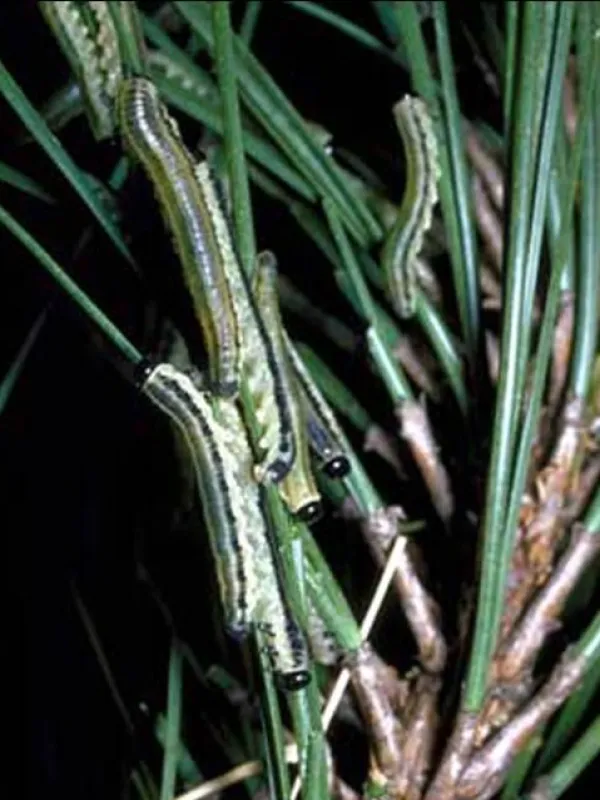
The larvae, often referred to as false caterpillars, grow up to 25 millimeters in length. They are characterized by a gray-green or yellow-green body with a dark stripe down the back and a shiny black head, which is a primary diagnostic feature.
Females deposit their eggs directly into the tissue of the pine needles. This process creates small slits in the needles, which often lead to subsequent yellowing and bending, making the egg-laying sites nearly invisible to the untrained eye.
The pupae develop within dense, brown cocoons that are attached to twigs or hidden in the leaf litter. This cocoon stage provides robust protection against harsh weather conditions and various predators.
The lifecycle is tightly synchronized with the phenology of pine trees. It is essential to note that populations can explode during hot, dry years, leading to mass outbreaks that threaten entire forest stands.
What it damages
The primary hosts for the redheaded pine sawfly are various species of pine, particularly Pinus sylvestris. The pest affects stands of all ages, ranging from young nursery saplings to mature forest trees.
Older larvae are capable of completely stripping needles from both current and previous years' growth. Under high population density, a tree may lose almost all its foliage within a single growing season.
Defoliation significantly reduces the photosynthetic capacity, which weakens the tree's immune system. Consequently, the stressed trees become susceptible to secondary infestations, such as bark beetles and wood-boring insects.
Beyond direct foliage loss, the feeding activity leads to stunted shoot growth and reduced wood volume. Chronic infestation over several consecutive years often results in tree mortality or severe dieback.
The pest poses a particular threat to nurseries, where heavy defoliation can kill young seedlings entirely. Economic losses are manifested in decreased timber quality and the necessity for costly salvage logging.
When it appears
Adult emergence typically occurs in the autumn, at which time females lay eggs for the following year's generation. This timing is critical for predicting potential population density for the upcoming season.
Larvae appear in the spring, initiating active feeding once the average daily temperatures remain consistently above freezing. The larval development stage generally lasts between one and one and a half months.
The peak feeding activity occurs during late spring and early summer. Larvae feed in groups, a behavioral trait that allows them to efficiently and rapidly consume needles on specific branches.
After completing their development, the larvae descend to the ground litter to pupate or remain attached to the foliage. The resting stage within the cocoon allows the insect to survive summer heat and other environmental stressors.
While the number of generations can vary depending on regional climates, a univoltine cycle (one generation per year) is the most common. Understanding these phenological windows is crucial for timing control operations.
Signs of infestation
The first visual sign of infestation is the presence of yellowish slits on the needles where eggs have been deposited. Careful inspection reveals the slight curvature of the needles at these specific sites.
The gregarious feeding behavior of the larvae makes them easily detectable on branches. Young individuals remain in clusters that stand out against the green pine needles.
The presence of fine, dark granular frass (excrement) beneath the tree canopy indicates active feeding by larvae in the upper crown. This is one of the most reliable methods for rapid detection of an infestation hotspot.
Skeletonization of the needles is a hallmark of the damage. Larvae consume the foliage from the edges, leaving only the central vascular bundle, which eventually dries out and falls off, causing the canopy to appear thin.
In later stages, empty cocoons may be found attached to the branches or hidden in the debris. Finding these confirms the completion of a developmental cycle and helps in scheduling monitoring efforts for the following year.
Control measures
For population monitoring, the use of pheromone traps is highly recommended. These tools allow foresters to assess adult numbers and forecast the risk of outbreaks well in advance.
In nursery and young plantation settings, mechanical removal of egg-laden needles and manual collection of larval clusters are effective if the infestation is localized to small areas.
Biological control includes the application of nucleopolyhedrovirus-based products or bacterial agents like Bacillus thuringiensis, which selectively target the larvae without harming beneficial natural predators.
When the damage threshold is exceeded, chemical insecticides with systemic or contact action may be employed. It is vital to apply these treatments when larvae are in their younger, more vulnerable stages.
Maintaining forest health by encouraging insectivorous birds and preserving natural enemies, such as ants and predatory bugs, serves as the foundation for a sustainable long-term management strategy.
Taxonomy
- Latin name
- Neodiprion rugifrons
- Order
- Hymenoptera
- Family
- Diprionidae
- EPPO code
- NEODRU
Discussion
No discussions yet — be the first.