
Pine sawfly
Neodiprion pratti
Description
How to identify
The pine sawfly (Neodiprion pratti) belongs to the order Hymenoptera, family Diprionidae. The adult insect has a stout body reaching up to 10 mm in length, typically colored in reddish-brown shades with darker patterns.
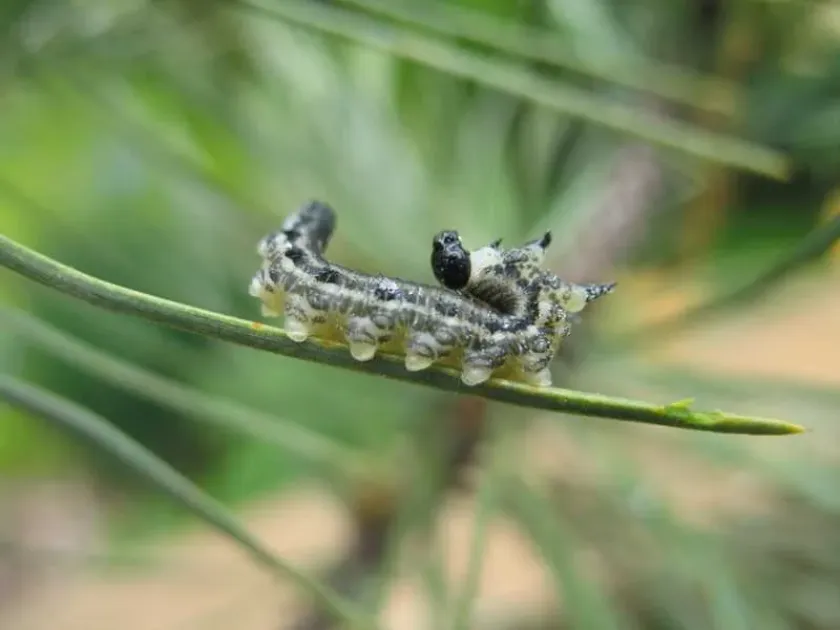
The larvae resemble caterpillars but are distinguished by the number of abdominal prolegs. Their bodies are grayish-green or yellowish-green with dark longitudinal stripes, and they always possess a distinct, dark-colored head capsule.
The life cycle involves complete metamorphosis. Females lay eggs inside the pine needles by using their saw-like ovipositor to make incisions. A single female can deposit up to 100 eggs, leading to high population densities.
The species primarily overwinters in the egg stage inside the needles, providing protection against harsh winter temperatures. Larvae emerge in the spring to begin their feeding cycle.
Pupation occurs in tough, oval-shaped cocoons, which the larvae spin within the forest floor litter or bark crevices after finishing their larval development.
What it damages
The primary hosts for this pest are various pine species, with a strong preference for Scots pine (Pinus sylvestris). Under high population pressures, they may occasionally infest other coniferous species.
The pest causes damage in both forest nurseries and mature pine stands. Outbreaks are particularly dangerous as they can weaken large forest areas and lead to widespread tree mortality.
Feeding on needles disrupts photosynthesis, causing significant physiological stress to the tree. This loss of vigor makes the pines susceptible to secondary infestations by wood-boring beetles.
Repeated defoliation over several consecutive years leads to a loss of aesthetic value and permanent reduction in timber growth, resulting in economic losses for forestry.
Young pines are especially at risk, as mass defoliation can kill the entire tree within one or two seasons if control measures are not implemented promptly.
When it appears
Adult flight typically occurs in the autumn months, which is when mating and egg-laying take place. This is a critical period that determines the population size for the following spring.
Larvae appear in the spring, synchronized with the start of the pine growing season. The peak feeding activity usually occurs during May and June.
Typically, there is one generation per year, although environmental factors and temperature can slightly influence the rate of larval development.
By mid-summer, larvae finish their feeding stage and descend to the ground to pupate. During this time, they are rarely seen on the branches.
The emergence of the new adult generation usually happens in late summer or early autumn, completing the annual biological life cycle of the species.
Signs of infestation
The first indicator of an infestation is the presence of gregarious larvae on young pine shoots. They often feed in clusters, covering the needles entirely.
Characteristic damage includes partially or fully consumed needles. The affected foliage turns yellow, dries out, and falls off, creating a scorched appearance on the branches.
The presence of frass (larval excrement) on the branches or litter below the tree is a clear sign of active feeding. These small dark pellets are easily identifiable upon inspection.
Careful examination of needles may reveal small, brownish slits where the female deposited eggs, which are a precursor to larval emergence.
- Yellowing of needles in late spring.
- Clusters of larvae feeding on new growth.
- Premature needle drop.
- Reduced vigor and stress symptoms in branches.
Control measures
Biological control strategies include encouraging natural predators, such as insectivorous birds and parasitic wasps (egg parasitoids) that target the sawfly population.
Chemical control using systemic insecticides is most effective when applied during the early larval stages, as young larvae are more susceptible to these treatments.
In forest nurseries, regular monitoring of needle condition is vital for early detection of hotspots, allowing for targeted local interventions rather than broad applications.
Manual removal and destruction of egg-laden needles on small or ornamental trees can be highly effective in managing minor infestations.
Maintaining proper tree health through appropriate irrigation and soil nutrition helps increase the resilience of pines, allowing them to recover more effectively from defoliation.
Taxonomy
- Latin name
- Neodiprion pratti
- Order
- Hymenoptera
- Family
- Diprionidae
- EPPO code
- NEODPB
Discussion
No discussions yet — be the first.