
Red-headed pine sawfly
Neodiprion pinetum
Description
How to identify
The red-headed pine sawfly is a member of the Diprionidae family, known for causing significant defoliation in pine forests. Adult females are about 8 mm long with a distinctive reddish-orange head.
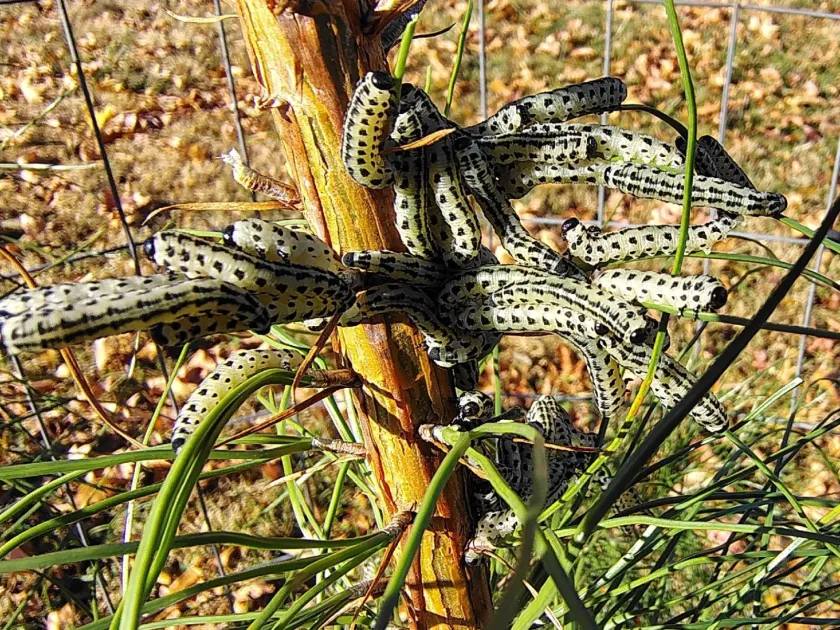
The larvae are easily identified by their bright yellow bodies and rows of black spots, topped with a dark red or orange head. They typically feed in groups, which makes their presence noticeable on pine needles.
Adult females use a saw-like ovipositor to insert eggs into the needles. This behavior leaves characteristic scarring on the foliage, which can be observed during the early stages of infestation.
After reaching maturity, larvae drop to the ground and spin tough, papery cocoons in the soil or needle duff. This is where they undergo pupation and survive during dormant periods.
When disturbed, the larvae exhibit a unique communal behavior, arching their bodies backward to ward off predators, a trait that helps in their field identification.
##damage##This pest primarily attacks various species of pine trees. It is particularly damaging to young saplings, though mature trees can also suffer from repeated yearly infestations.
Larvae consume the needles with high efficiency. Younger larvae feed on the edges, causing them to wither, while older larvae devour the entire needle, leaving only the central vascular tissue.
Heavy defoliation weakens the tree's immune system, making it susceptible to secondary invaders such as bark beetles, which can eventually lead to the death of the tree.
The aesthetic value of pine plantations is severely compromised when branches become bare, leading to thin crowns and reduced growth rates over multiple seasons.
Economic impact is significant in commercial forestry, as reduced photosynthetic capacity leads to lower timber volume and potential mortality of young plantations.
When it appears
Adult sawflies emerge in the spring or early summer to mate and lay eggs. The timing is often synced with the development of new pine needles, which serve as the primary food source.
Larvae hatch within a few weeks and begin their gregarious feeding. The period of active larval damage typically peaks during the warm summer months, depending on the latitude.
Some populations may produce two generations per year, with the second generation often causing the most significant damage to the host trees before winter sets in.
The species overwinters as a prepupa inside its cocoon. This stage is highly resistant to environmental stressors and allows the population to survive harsh winter conditions.
Temperature and humidity fluctuations play a critical role in the synchrony of adult emergence and larval survival, often determining the severity of an outbreak year.
Signs of infestation
Early warning signs include the yellowing of needles that have been partially eaten. A closer inspection will reveal the characteristic saw-tooth edges on the needles.
Clusters of larvae feeding together on the same branch are the most obvious sign of infestation. They often leave a trail of dark, pellet-like frass on the needles and the forest floor.
Bare branches or sections of the canopy missing needles are indicators of advanced infestation. In heavy outbreaks, the entire tree may appear thin or scorched due to defoliation.
The presence of empty cocoons in the soil or duff around the base of the tree confirms that the larvae have completed their development and the next cycle is imminent.
Visible scarring on needles where eggs were inserted can be seen upon close examination of the current year's growth during the spring season.
Control measures
Integrated pest management is the most effective approach to handle sawfly populations. It combines monitoring, cultural practices, and selective intervention strategies.
Chemical control is reserved for major infestations, utilizing systemic or contact insecticides during the early larval stages when they are most vulnerable to treatment.
Biological controls, such as the use of nuclear polyhedrosis viruses or entomopathogenic fungi, are becoming increasingly popular for sustainable forest management.
- Regular inspection of young pine stands during the spring.
- Mechanical removal of small larval colonies by hand.
- Encouraging natural predators like parasitic wasps and birds.
- Use of pheromone traps to monitor adult population levels.
- Removing leaf litter under heavily infested trees to destroy cocoons.
Promoting healthy forest ecosystems through proper thinning and species diversity helps create a natural buffer against large-scale sawfly outbreaks.
Taxonomy
- Latin name
- Neodiprion pinetum
- Order
- Hymenoptera
- Family
- Diprionidae
- EPPO code
- NEODPI
Discussion
No discussions yet — be the first.