
Merkel's pine sawfly
Neodiprion merkeli
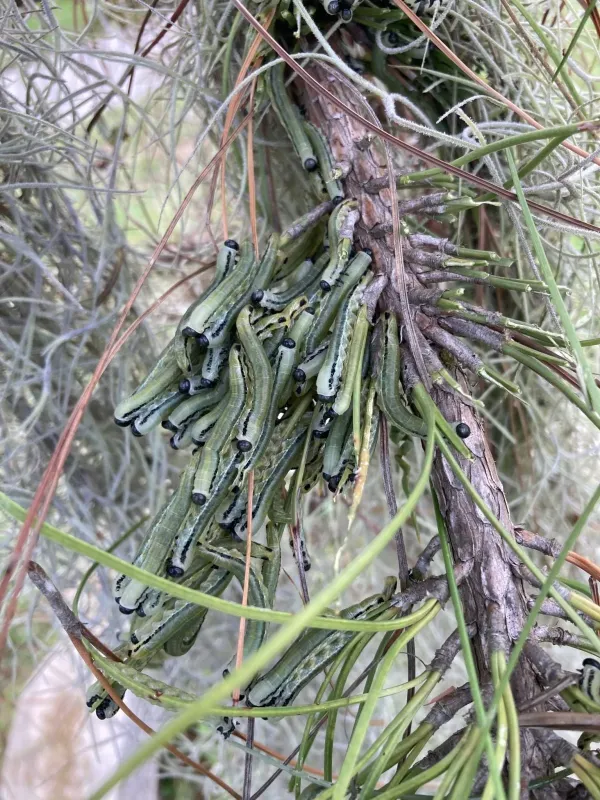
Description
How to identify
Merkel's pine sawfly (scientific name Neodiprion merkeli) belongs to the order Hymenoptera, specifically the family Diprionidae, also known as the conifer sawflies. Adult sawflies resemble small, robust wasps but lack the narrow "waist" characteristic of the Vespidae family.
The larvae, often mistaken for moth caterpillars, are distinct in their morphology. They typically possess a greater number of abdominal prolegs compared to lepidopteran larvae, which helps them maintain a secure grip on pine needles while feeding.
Adult females are generally larger than males and possess specialized ovipositors, which they use to saw slits into the pine needles to deposit their eggs. Males are typically smaller, darker, and have feathery antennae used to detect female pheromones.
The life cycle involves four distinct stages: egg, larva, pupa, and adult. They are known for their gregarious behavior, especially during the early larval stages, where they feed in large groups on the same needle or twig.
Overwintering occurs primarily at the egg stage. The eggs are embedded within the tissue of the pine needles, providing a sheltered environment against winter temperatures until the following spring.
##damage##This pest is highly host-specific, feeding almost exclusively on pine species. It poses a significant threat to young plantations, nurseries, and managed forest stands where pine is the dominant species.
Larvae consume the foliage, starting by skeletonizing the edges of the needles before eventually consuming the entire needle length. In cases of high infestation, the larvae strip the tree of its needles, leaving only the central vascular bundles or completely bare branches.
The loss of foliage leads to a drastic reduction in the tree's photosynthetic capacity. This causes stunted growth, weakened root systems, and a lack of vigor, which can persist for several growing seasons after the infestation occurs.
Repeated defoliation by Neodiprion merkeli can result in total tree mortality. Even if the tree survives, the resulting stress makes it highly susceptible to attacks by secondary wood-boring insects and pathogenic fungi.
The economic impact is substantial, particularly in timber-producing regions where the loss of annual growth and potential tree death reduces the long-term yield and market value of the forest stand.
##season##The phenology of Merkel's pine sawfly is strictly dictated by seasonal temperatures. The eclosion of larvae from eggs typically aligns with the flushing of new needles in the spring, providing the larvae with high-quality food.
Peak larval activity generally occurs in late spring to early summer. During this timeframe, the larvae grow rapidly through several instars, causing the most severe damage to the tree's foliage within a span of just a few weeks.
Once the larvae reach maturity, they descend from the canopy to the ground or the base of the tree. They spin protective, oval-shaped cocoons in the soil or under leaf litter, where they undergo pupation.
Adult emergence typically takes place in late summer or early autumn. This is the period when mating occurs and the next generation of eggs is deposited into the foliage, ensuring the survival of the species throughout the winter months.
While typically univoltine (having one generation per year), environmental factors can occasionally lead to shifts in development cycles, especially in regions with longer growing seasons.
##signs##The most reliable sign of a Merkel's pine sawfly infestation is the presence of gregarious larvae feeding on the branches. Their habit of feeding in clusters, often in a "U-shape" or circular pattern, is a distinct behavioral identifier.
Visible damage includes needles with notched or jagged edges, eventually leading to thin, "see-through" crowns. As the larvae consume the older needles first and then move to younger growth, the discoloration of the foliage becomes obvious.
Large amounts of larval frass (droppings) accumulate at the base of the tree or on the branches below the feeding site. This dark, granular material is an early indicator of infestation that can be spotted before the crown damage becomes severe.
In mature trees, the affected sections of the crown will appear stunted and brown. In severe cases, the entire tree may look scorched, which is a symptom of extensive needle loss and associated stress.
The presence of silk threads, which larvae use to prevent falling or to move between branches, can also be noted during a close inspection of the infested foliage and tree bark.
##control##Monitoring is the cornerstone of management. Pheromone-baited traps are highly effective for detecting adult populations and predicting the timing of larval emergence to optimize intervention windows.
Biological control agents, such as the application of Bacillus thuringiensis (Bt) or entomopathogenic nematodes, offer a targeted approach that reduces population levels without significantly impacting non-target species.
Chemical control involving systemic or contact insecticides may be necessary during severe outbreaks. Treatments must be timed carefully during the early larval stages to achieve maximum efficacy before substantial needle loss occurs.
Silvicultural practices play a vital role in long-term management. Promoting stand diversity, ensuring tree health through proper spacing, and preserving habitats for natural predators like birds and parasitic wasps helps regulate sawfly populations naturally.
- Pheromone trap-based population monitoring
- Application of Bacillus thuringiensis (Bt)
- Targeted systemic insecticide treatments
- Conservation of natural predators and parasitoids
- Improving stand health through silvicultural thinning
Taxonomy
- Latin name
- Neodiprion merkeli
- Order
- Hymenoptera
- Family
- Diprionidae
- EPPO code
- NEODME
Discussion
No discussions yet — be the first.