
Redheaded pine sawfly
Neodiprion lecontei
Description
How to identify
The redheaded pine sawfly belongs to the order Hymenoptera and the family Diprionidae. Despite the name, they are not true flies, but rather related to bees and wasps.
Adult females are approximately 7–9 mm long with a reddish head and thorax, while males are smaller, black, and possess feathery antennae, which help them locate females for mating.
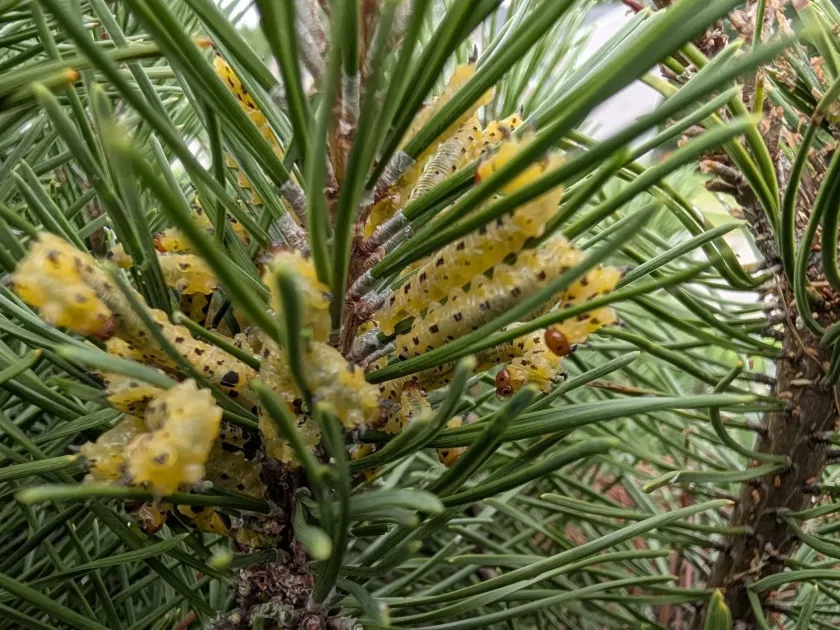
The larvae are the primary damaging stage and are often confused with moth caterpillars. However, they can be distinguished by having at least 6 pairs of abdominal prolegs.
Larvae typically display a pale yellow to white body marked with rows of black spots, paired with a distinct, shiny reddish-orange head, which gives the species its common name.
The life cycle involves overwintering as eggs within needles, followed by a larval development phase that occurs in dense feeding colonies on pine branches.
What it damages
The redheaded pine sawfly primarily targets pine species, with a strong preference for Pinus sylvestris and other soft-needled pines. It poses a significant threat to young plantations.
Larvae consume both current-season and older needles. A large colony can completely defoliate a small tree in a short period, which severely stresses the plant.
While a single defoliation event does not always kill a tree, repeated attacks significantly weaken the plant, leading to stunted growth and reduced vigor.
Severely weakened trees become susceptible to secondary infestations by bark beetles and wood-boring insects, which are often the actual cause of death for the trees.
In forest management, the impact is measured by timber volume loss and the reduction of aesthetic value in parks, nurseries, and ornamental landscape plantings.
When it appears
Adults emerge in the spring, with females using their saw-like ovipositor to insert eggs into the tissues of pine needles, usually in groups along the branch.
The larvae emerge later in the spring or early summer, depending on regional temperatures, and immediately begin feeding in social groups.
Feeding activity is most intense during the summer months when the larvae grow rapidly through several instars before completing their development.
Once mature, larvae drop to the soil or leaf litter to spin tough, brown cocoons. They spend the rest of the year and winter in these cocoons, protected from environmental extremes.
Depending on the latitude and climate, there may be one or two generations per year, with the second generation often causing more visible damage during mid-to-late summer.
Signs of infestation
The earliest signs of infestation are the yellow or tan notches on needles, which are the sites where females have laid their eggs inside the pine foliage.
The presence of larvae feeding in large, conspicuous clusters is the most obvious sign. They often feed synchronously, stripping needles down to the sheath.
Fine, dark granular frass (excrement) piling up on lower branches or the ground underneath the tree is a clear indicator that a colony is active in the canopy above.
As feeding progresses, the canopy will show thin or ragged patches where the needles have been partially or completely eaten, leading to a scorched appearance.
If you observe a tree with bare branches or missing needles in specific sections while the rest of the tree remains green, it is highly likely a sawfly colony is present.
Control measures
For small trees or garden settings, physical removal is highly effective. Simply prune off the infested branches or manually knock the larvae into a bucket of soapy water.
Biological control using microbial insecticides, specifically those containing Bacillus thuringiensis (Bt), is effective against young larvae without harming beneficial insects.
Chemical control using systemic or contact insecticides is recommended when larval populations reach economic injury levels, typically in large-scale nursery or forest operations.
Encouraging natural predators such as parasitic wasps, tachinid flies, and predatory beetles helps keep sawfly populations in check naturally within a balanced ecosystem.
Maintaining tree health through proper irrigation, fertilization, and selecting diverse pine species for planting reduces the risk of mass outbreaks in managed landscapes.
Taxonomy
- Latin name
- Neodiprion lecontei
- Order
- Hymenoptera
- Family
- Diprionidae
- EPPO code
- NEODLE
Discussion
No discussions yet — be the first.