
Red-headed pine sawfly
Neodiprion fulviceps
Description
How to identify
The red-headed pine sawfly (scientific name Neodiprion fulviceps) is a species of sawfly belonging to the family Diprionidae. Despite the common name "fly", they are actually related to wasps and bees.
The adult insect is small, with the female typically measuring around 7–9 mm. Females have a distinct reddish-orange head, while males are generally darker, often black, and smaller in body size.
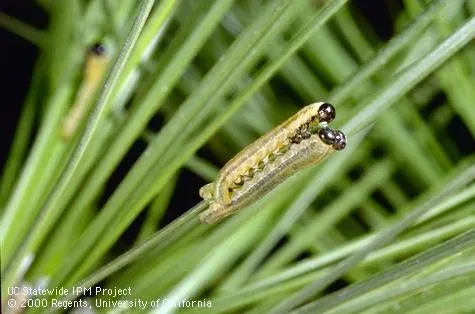
The larvae, known as false caterpillars or sawfly larvae, are the life stage that causes damage. They have dark heads and green-gray bodies, often with lateral stripes that provide camouflage among the needles.
The life cycle typically includes one generation per year. They go through several larval instars, growing significantly in size before spinning a protective cocoon for the pupal stage.
Adult sawflies possess a saw-like ovipositor used to cut into pine needles, where they deposit their eggs. This unique biological trait allows them to safely place eggs inside the plant tissue.
What it damages
The primary hosts for the red-headed pine sawfly are various species of pine (Pinus). The larvae are gregarious feeders, meaning they feed in groups, which leads to rapid defoliation.
During the feeding phase, the larvae consume needles, starting with the older growth before moving to younger needles. This behavior can quickly leave a tree looking thin and sickly.
Heavy defoliation causes significant stress to the host tree, reducing its growth rate and weakening its immune system against diseases and secondary insect attacks like bark beetles.
In forest plantations, a massive outbreak can result in the mortality of young trees and significant economic loss. Even if the trees survive, their aesthetic and commercial value is severely compromised.
Repeated defoliation over consecutive years is particularly dangerous, as it depletes the tree's energy reserves, often leading to total tree failure or death.
When it appears
Adult emergence generally occurs in the late spring or early summer. Following emergence, mating takes place and females begin laying eggs immediately after.
Eggs are inserted directly into the needle tissue. They overwinter in the egg stage or within the pupal cocoon, depending on the specific environmental conditions of the region.
Larvae usually begin to appear and feed from mid-summer. This is the period when they are most vulnerable to predation and where management efforts are most effective.
The larval feeding stage lasts for about 3 to 4 weeks. Once fully grown, they crawl or drop to the ground or remain on the branches to spin a tough, brown, paper-like cocoon.
Monitoring for this pest is most successful during the early larval development phase or by checking for the presence of empty cocoons on branches after the adult emergence.
Signs of infestation
The most obvious sign of an infestation is the presence of partially eaten needles. The larvae consume the needle tissue but often leave the tough, fibrous outer edges, which turn brown and drop off.
Groups of larvae clustered on a branch are easy to spot once you know what to look for. When disturbed, they perform a synchronized thrashing motion, which is a classic behavior of the Diprionidae family.
Significant amounts of frass (droppings) accumulate beneath the infested branches. These small, dark pellets are a reliable indicator of active larval feeding occurring in the canopy above.
The appearance of brown, oval-shaped cocoons on needles or in the leaf litter at the base of the tree confirms the completion of a generation and potential for future outbreaks.
Visible thinning of the tree's crown, especially if patches of needles appear shorter than others, is a strong indicator of historical or current sawfly activity.
Control measures
Effective management begins with monitoring population density. If numbers are low, natural predators like parasitic wasps, birds, and small mammals often keep the population under control.
For ornamental trees or small plantations, manual removal of larval clusters can be highly effective. This should be done carefully to ensure all larvae are removed from the branch.
Biological insecticides, specifically those containing Bacillus thuringiensis (Bt), are very effective against sawfly larvae while remaining safe for most beneficial insects and wildlife.
Chemical control using systemic insecticides is generally reserved for large-scale outbreaks in commercial forests where manual or biological methods are not feasible.
Promoting a diverse forest ecosystem with mixed tree species and healthy bird populations is the best long-term preventive strategy to discourage massive sawfly infestations.
Taxonomy
- Latin name
- Neodiprion fulviceps
- Order
- Hymenoptera
- Family
- Diprionidae
- EPPO code
- NEODFU
Discussion
No discussions yet — be the first.