
European pine sawfly
Neodiprion exitans
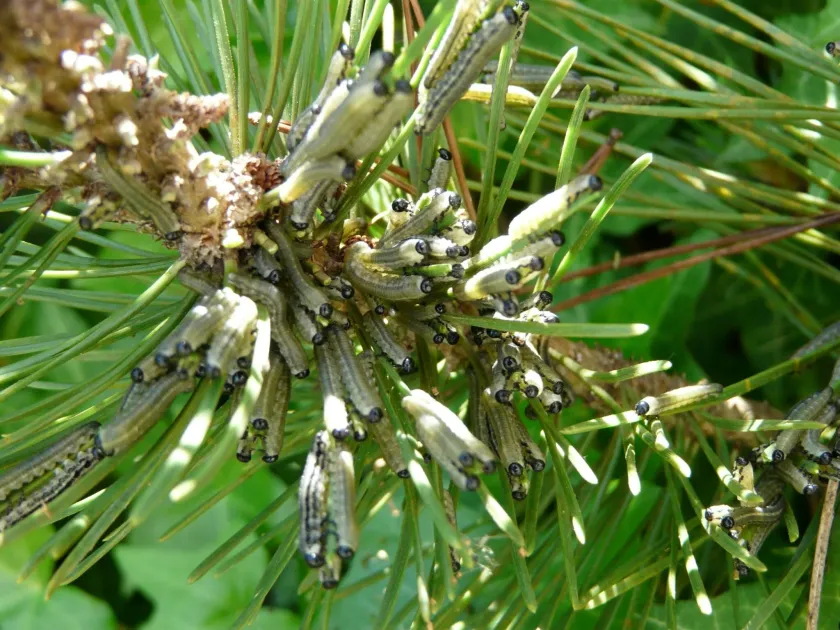
Description
How to identify
The European pine sawfly (Neodiprion sertifer) is a common pest affecting various pine species. Adults are small, wasp-like insects; females are about 8–10 mm long with a yellowish-brown color, while males are slightly smaller and darker, featuring feathery antennae.
The larvae, often called false caterpillars, are grayish-green with a prominent dark stripe down their backs and black heads. A key behavioral trait is that when disturbed, they bend their bodies into a distinctive U-shape to deter predators.
The life cycle is univoltine, meaning there is one generation per year. They overwinter as eggs embedded within the needles of the host tree. Larvae emerge in the spring, coinciding with bud break, and feed gregariously on the foliage.
After reaching maturity, larvae spin tough, golden-brown, cylindrical cocoons in the soil or forest litter to pupate. Adults emerge in late summer or autumn to mate and lay eggs for the next cycle.
Because they feed in colonies, a single cluster can rapidly defoliate significant portions of a tree's crown, making them highly visible and potentially destructive pests in forest nurseries and young plantations.
What it damages
The primary hosts for this sawfly are various pine species, with Scotch pine being particularly susceptible. Young trees under 30 years of age are most frequently affected, suffering reduced growth and vigor due to foliage loss.
Young larvae feed on the edges of needles, causing them to wilt and turn straw-colored. Older larvae consume entire needles, leaving behind only the stumps. This feeding pattern significantly reduces the photosynthetic capacity of the tree.
Heavy defoliation over consecutive years can lead to the death of young saplings or severe weakening of older trees. Once weakened, these pines are highly susceptible to secondary infestations by bark beetles and wood-boring insects.
The loss of needles impacts the overall health and aesthetics of the tree, which is a major concern for park management and ornamental landscaping. A decline in tree health often results in a long-term loss of timber quality and market value.
In addition to physiological damage, the accumulation of frass (larval excrement) under the tree canopy is a nuisance and indicates an infestation that requires immediate attention to prevent further spread.
Signs of infestation
The earliest sign of an infestation is the presence of yellowed, drooping needles in early spring. These needles often look withered or partially consumed, indicating the initial feeding activity of early-instar larvae.
Colonies of larvae are the most obvious sign. You will often see them clustered together on branches, moving in unison as they consume the foliage. If the colony is large, they can strip a branch of its needles in a very short time.
Dark, granular droppings on the ground or on lower branches are clear indicators of larval presence. As the larvae grow larger, the volume of frass increases, making the infestation easy to spot from the ground.
Empty cocoons may be found attached to needles or tucked into bark crevices and forest litter in the autumn. Finding these confirms that the population has completed a developmental cycle and is preparing to overwinter.
Finally, a thin, sparse crown with many missing needles is a hallmark of a long-standing sawfly infestation. If the damage is extensive, the affected branches may eventually dry out and die back completely.
Control measures
Biological control is highly effective for the European pine sawfly. Nucleopolyhedrovirus (NPV) sprays are available, which target the sawfly specifically without harming beneficial insects, making them ideal for forest settings.
Chemical control using registered insecticides may be necessary during outbreak years. Applications should be timed to target young larvae (early instars) when they are most vulnerable and before they have caused significant damage.
Conservation of natural enemies is essential for long-term management. Parasitic wasps and predatory insects play a crucial role in suppressing sawfly populations naturally when their habitats are protected and diverse.
Silvicultural management, such as maintaining healthy tree stands and avoiding overly dense monocultures, helps reduce the impact. Timely monitoring and sanitation thinning can prevent small outbreaks from becoming widespread.
- Monitor for egg clusters on needles during winter or early spring.
- Apply virus-based bio-pesticides when larvae are in early developmental stages.
- Use contact insecticides if monitoring thresholds are exceeded.
- Promote biodiversity to support natural predator and parasitoid populations.
Taxonomy
- Latin name
- Neodiprion exitans
- Order
- Hymenoptera
- Family
- Diprionidae
- EPPO code
- NEODEX
Discussion
No discussions yet — be the first.