
Burke's pine sawfly
Neodiprion burkei
Description
How to identify
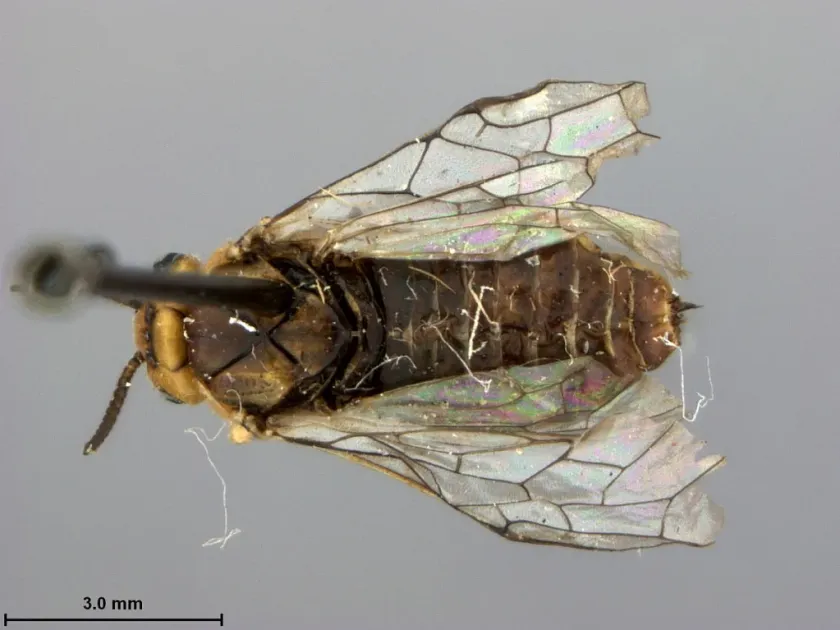
The Burke's pine sawfly (Neodiprion burkei) is a member of the Diprionidae family within the order Hymenoptera. Adult sawflies are small, wasp-like insects that play a significant role in coniferous ecosystems.
Larvae, commonly known as false caterpillars, are easily distinguished from moth caterpillars by their distinct head capsules and specific leg arrangement on the thorax and abdomen.
Females are equipped with a specialized saw-like ovipositor, which they use to make incisions in pine needles to deposit eggs. This adaptation allows the eggs to be protected within the plant tissue.
The life cycle often involves a period of diapause, during which the insects remain in the soil or undergrowth inside tough, protective cocoons until the next favorable season.
Proper identification of this species often requires professional entomological examination, as many sawfly species share similar morphological traits during the larval stages.
What it damages
This pest is a specialist herbivore that primarily targets pine species, particularly lodgepole pine (Pinus contorta), causing damage through foliage consumption.
Young larvae feed on the current year's needles, while older larvae can consume both old and new needles, leading to severe defoliation of the host tree.
Severe outbreaks often result in reduced growth rates, branch dieback, and in extreme cases, the mortality of weakened trees due to stress and secondary infections.
The economic impact involves timber volume loss and the degradation of forest stands, necessitating vigilant monitoring to prevent widespread damage across commercial forests.
Stressed trees are particularly vulnerable, and repeated defoliation events significantly lower the tree's resilience against drought and disease pathogens.
When it appears
The development of Neodiprion burkei is highly synchronized with the growing season of its host pines, ensuring that larvae have an abundant food source.
Adult emergence usually occurs in the spring or early summer, depending on the local climate and temperature gradients, followed by immediate mating and egg-laying.
The larval feeding stage typically peaks in mid-summer, making it the most critical time for field observations and management interventions.
As autumn approaches, larvae complete their development and form cocoons in the soil, entering a dormant state to survive the winter months until the cycle restarts.
Monitoring programs use pheromone traps to detect the flight of adults, providing early warnings for foresters to assess the risk of upcoming larval infestation.
Signs of infestation
Early indicators of infestation include minute light-colored slits or scars on the needles, caused by the female sawfly's oviposition activities during the spring.
Defoliation patterns are often visible as partially consumed needles, where larvae have stripped the tissue, leaving behind skeletal remains of the pine needles.
The presence of abundant frass (larval waste) accumulating on the ground beneath infested trees serves as a clear indicator of a high-density population in the canopy.
In cases of heavy infestation, the crown of the tree may appear thinning and reddish-brown, which can be seen from a distance as a sign of significant stress.
- small scars on needles;
- skeletized or partially eaten needles;
- frass accumulation under the canopy;
- discolored and thinning needles.
Control measures
Biological control remains a priority, utilizing naturally occurring viruses or bacterial agents that target sawfly larvae without harming beneficial forest insects.
Chemical intervention is considered a last resort, usually reserved for young plantations or high-value forest stands where significant economic loss is expected.
Conservation of natural parasitoids, such as ichneumonid wasps, is vital for maintaining natural population checks on sawfly populations over the long term.
Silvicultural strategies, such as promoting mixed-species stands, can disrupt the sawfly's ability to find host trees, thereby reducing the risk of massive outbreaks.
Regular forest health assessments are necessary to monitor populations and identify infestation "hot spots" early, allowing for targeted management rather than broad-spectrum treatments.
Taxonomy
- Latin name
- Neodiprion burkei
- Order
- Hymenoptera
- Family
- Diprionidae
- EPPO code
- NEODBU
Discussion
No discussions yet — be the first.