
Fir sawfly
Neodiprion abietis
Description
How to identify
The fir sawfly (Neodiprion abietis) is an insect belonging to the order Hymenoptera and the family Diprionidae. This species is a well-known defoliator of fir trees across various regions.
Adult sawflies are small, wasp-like insects. Females are generally larger and more robust, equipped with a specialized ovipositor used to deposit eggs directly into the needles of host trees.
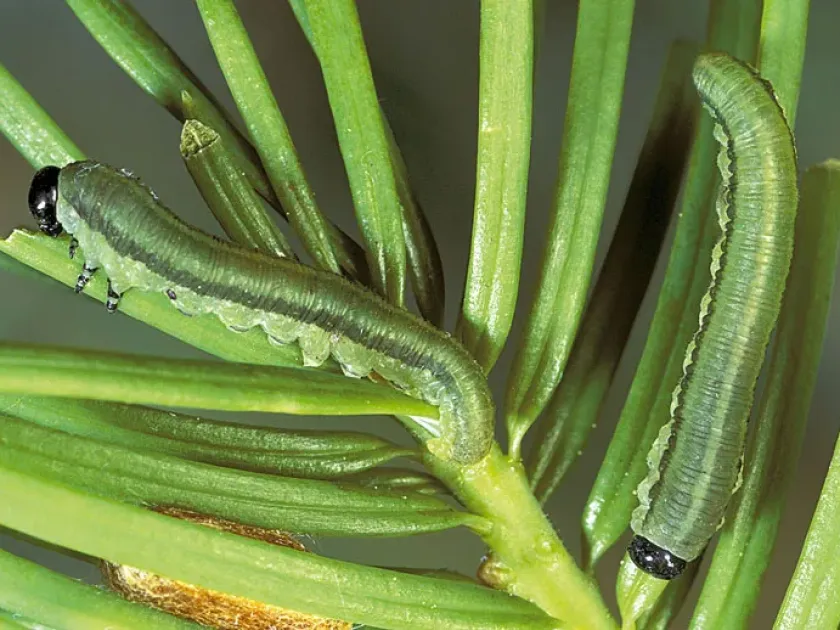
Larvae, often referred to as false caterpillars, are the primary stage causing damage. They exhibit a characteristic grayish-green or striped pattern that helps them blend into the foliage.
The life cycle is typically univoltine, meaning there is one generation per year. They overwinter as eggs embedded within the needle tissue, which provides significant protection against harsh winters.
Pupation occurs in resilient, papery cocoons. These cocoons can be found attached to the needles or hidden within the crevices of the tree bark or forest litter.
What it damages
The primary host for this pest is the Fir (Abies). While they exhibit a preference for specific fir species, they can occasionally be found on other coniferous hosts in mixed forests.
Larvae feed gregariously, meaning they gather in groups to consume foliage. This feeding pattern causes rapid defoliation of the branches they inhabit, starting from the outside in.
The destruction of both old and current-year needles significantly impacts the tree's ability to perform photosynthesis, leading to substantial stress and reduced annual growth.
Persistent infestations result in stunted growth and a thinning crown, which detracts from the tree's overall aesthetic and ecological health in parks and gardens.
Severe defoliation over several consecutive years can lead to branch dieback and, in extreme cases of drought or secondary pest pressure, the mortality of the entire tree.
When it appears
Adult emergence typically occurs in late summer or early autumn. During this window, mating takes place, and females carefully select suitable needles to lay their eggs.
The eggs remain dormant throughout the winter season. This developmental strategy ensures that larvae hatch exactly when the fresh foliage begins to emerge in the spring.
Larval hatching usually coincides with the bud break of the fir trees. The active feeding stage lasts for several weeks, covering the late spring and early summer months.
As the larvae reach maturity by mid-summer, they spin their cocoons and pupate. This timing is critical for planning any necessary management interventions.
Variations in local climate and elevation can slightly influence the timing of these stages, making local phenological observation essential for effective pest management.
Signs of infestation
The most recognizable sign is the presence of partially eaten or "stripped" needles. Larvae often leave the central vein of the needle intact, creating a shredded appearance.
Small, dark, pellet-like frass (excrement) accumulating on lower branches or the ground underneath the tree is a strong indicator of active larval feeding in the upper canopy.
Clusters of larvae feeding together on individual shoots are easy to spot during regular inspections of the tree crowns, especially during the peak feeding season.
Yellowing or browning of the foliage in specific areas of the tree indicates that the needles have been damaged and are beginning to desiccate.
The presence of cocoons on the needles or twigs confirms the life stage and indicates that the pest has successfully completed its cycle in that location.
Control measures
Early detection is vital for controlling fir sawfly populations. For smaller ornamental trees, manual removal of larval clusters can be highly effective if done promptly.
Biological control methods, including the application of specific nucleopolyhedroviruses (NPVs), are used in forest management to suppress populations without harming beneficial insects.
- Use pheromone traps for monitoring adult population levels.
- Apply contact or systemic insecticides during the early larval stage.
- Encourage natural predators such as birds and parasitic wasps.
Maintaining tree vigor through appropriate fertilization and adequate watering helps the firs recover from light defoliation and resist secondary infections.
In large-scale infestations, professional forestry services may employ aerial spraying of biological pesticides to mitigate damage and prevent widespread tree loss.
Taxonomy
- Latin name
- Neodiprion abietis
- Order
- Hymenoptera
- Family
- Diprionidae
- EPPO code
- NEODAB
Discussion
No discussions yet — be the first.