
Abbot's pine sawfly
Neodiprion abbotii
Description
How to identify
Abbot's pine sawfly (Neodiprion abbotii) is a member of the Diprionidae family. Although they resemble flies, they are distinct due to their specific biological cycle and the saw-like ovipositor found in females, used for cutting into pine needles to deposit eggs.
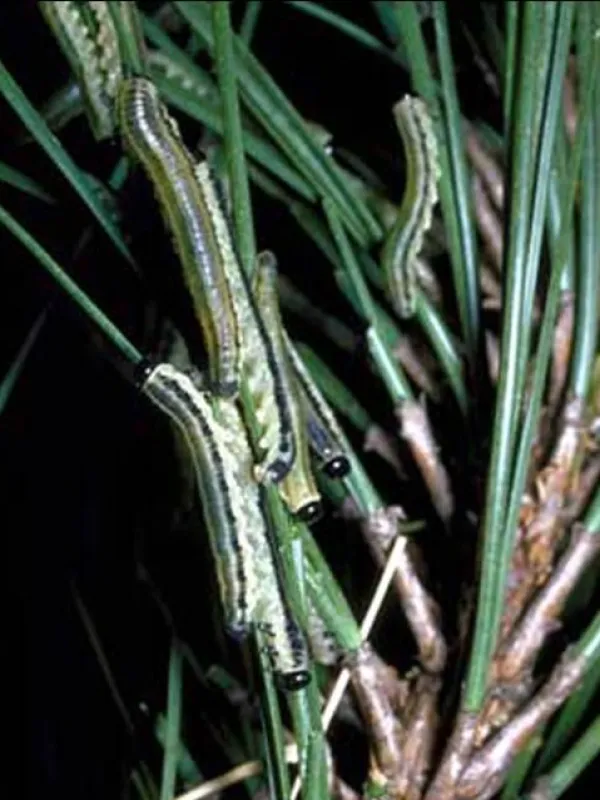
The larvae are often mistaken for moth caterpillars but can be identified by their distinctive behavior and physical structure. They typically have a greyish-green or yellowish body with longitudinal stripes, providing camouflage against the pine needles.
Adults exhibit two pairs of membranous wings. Males are usually smaller than females and possess feathery antennae, which help them locate the pheromones released by females during the mating season.
The insect undergoes complete metamorphosis: egg, larva (which goes through several instars), pupa, and adult. The pupal stage occurs within a tough, protective cocoon, often found in the leaf litter near the host tree's base.
Life cycle duration varies depending on environmental conditions and geography, with some regions experiencing multiple generations in a single growing season, which significantly increases the risk of infestation.
What it damages
This pest exclusively targets pine trees, showing a preference for young stands and ornamental varieties. The primary damage is caused by the larvae, which consume the pine needles during their active growth phase.
Young larvae typically feed on the edges of the needles, leaving characteristic notches. As they grow into later instars, they become increasingly voracious, eventually stripping the needles down to the central sheath.
Severe infestations can lead to massive defoliation of the tree. When a pine tree loses a significant portion of its needles, its ability to photosynthesize is severely compromised, leading to stunted growth and weakened defenses.
Weakened trees are highly susceptible to secondary attacks from bark beetles and other wood-boring insects. Over several seasons, persistent defoliation by sawflies can result in branch dieback or tree mortality.
In nurseries, the presence of Abbot's pine sawfly causes substantial economic loss, as damaged seedlings often lose their market value or fail to survive the transplanting process into reforestation areas.
Signs of infestation
The earliest signs of an infestation include small, chewed notches on the edges of pine needles. These are caused by young larvae and are often overlooked until the damage becomes more widespread.
Colonies of larvae feeding together on a single branch are a major indicator. If disturbed, these larvae often perform a synchronized movement, arching their heads and tails, which is a classic defensive behavior for this species.
Accumulated frass, which looks like small, dark pellets, at the base of the tree is a strong indicator of heavy feeding in the upper canopy. This buildup is often visible long before the damage to the needles is spotted.
Browning or "scorched" appearance of the foliage is a late-stage sign of infestation. This occurs when the larvae have consumed the majority of the needles, leaving only the dried remnants on the branches.
The presence of empty or intact cocoons in the soil or needle duff around the base of the pine tree signifies that the current generation has completed its development and a new cycle may be imminent.
Control measures
Integrated Pest Management (IPM) is the most effective approach. This includes encouraging natural predators like parasitic wasps, birds, and small mammals that feed on larvae and cocoons.
Chemical control via insecticides should be targeted during the early larval instars. Using systemic or contact-based products when larvae are small is crucial for maximum efficacy and minimal environmental impact.
Biological pesticides, such as those containing Bacillus thuringiensis, offer an eco-friendly alternative by specifically targeting the digestive systems of the sawfly larvae while remaining harmless to beneficial insects.
For ornamental trees or small-scale infestations, mechanical control such as physically removing and destroying branches containing larvae can be highly effective without the need for chemical intervention.
- Monitoring: Use pheromone traps to detect the arrival of adult sawflies.
- Sanitation: Remove heavily infested trees to reduce the overall population pressure.
- Vigor: Maintain tree health through proper watering and fertilization to improve resistance.
Taxonomy
- Latin name
- Neodiprion abbotii
- Order
- Hymenoptera
- Family
- Diprionidae
- EPPO code
- NEODBB
Discussion
No discussions yet — be the first.