
Neocapritermes opacus
Neocapritermes opacus
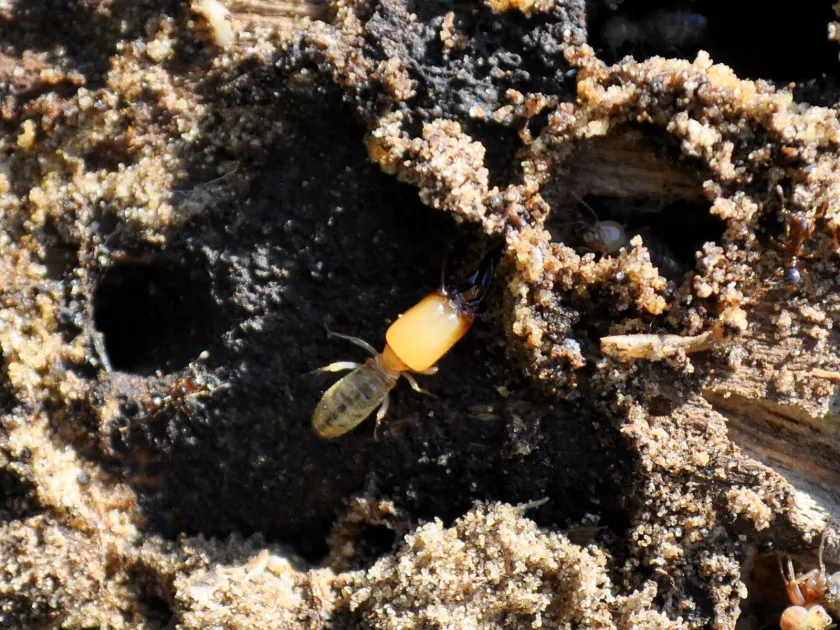
Description
How to identify
Neocapritermes opacus is a species of termite belonging to the family Termitidae within the order Blattodea.
These insects exhibit high levels of social organization, living in colonies composed of distinct castes including workers, soldiers, and reproductives.
Soldiers are highly specialized, characterized by unique mandibular structures designed for aggressive colony defense.
Workers are light-colored and soft-bodied, primarily responsible for foraging, tunnel construction, and maintenance of the nesting site.
Accurate species identification usually requires microscopic analysis of soldier morphology, as external appearances can be deceptive due to evolutionary similarities.
What it damages
These termites are primarily cellulophagous, feeding on wood, plant roots, and organic matter present in the soil environment.
In agricultural settings, they can cause significant economic losses by attacking the root systems of fruit trees and woody shrubs.
Root system destruction leads to nutrient transport failure, causing wilting, reduced vigor, and the potential death of the entire plant.
Nurseries are particularly susceptible, as delicate seedlings cannot withstand the damage caused by termite tunneling through their root zone.
Termite activity also creates pathways for secondary fungal infections, which further degrade the overall health of the agricultural plot.
When it appears
The activity patterns of Neocapritermes opacus are heavily influenced by environmental temperature and moisture levels.
Foraging and construction activities typically peak during warm, humid conditions that favor colony expansion.
During extreme heat or drought, the colony retreats into deeper soil layers to maintain the optimal humidity required for survival.
Swarming events occur periodically, often triggered by rainfall, allowing new colonies to establish themselves in previously unoccupied areas.
Within protected greenhouse environments, these termites can remain active year-round if proper soil moisture is maintained.
Signs of infestation
The most reliable field indicator is the appearance of earthen shelter tubes or tunnels constructed on the stems and bases of plants.
Affected plants often display signs of malnutrition, such as chlorosis, even when irrigation and fertilization are sufficient.
Small holes or entry points near the base of the plant often reveal the location of tunneling and internal colony expansion.
- Accumulated wood debris and soil near the plant base
- Sudden structural weakness in young trees
- Discovery of termite soldiers while digging in the rhizosphere
Detection is confirmed by finding workers or shelter tubes during a physical inspection of the root collar area.
Control measures
Managing this pest requires a combination of chemical barriers and targeted baiting systems that deliver insecticides directly into the colony.
Integrated Pest Management (IPM) practices focus on reducing organic waste that provides food sources for the termites near the crop.
Biological control methods involving entomopathogenic fungi have proven to be an environmentally friendly way to reduce termite populations.
Regular monitoring using detection stations helps to identify infestation hotspots before significant root damage occurs.
Maintaining optimal irrigation and preventing excess moisture around plant bases can help minimize the attractiveness of the soil environment to termites.
Taxonomy
- Latin name
- Neocapritermes opacus
- Family
- Termitidae
- EPPO code
- NCPTOP
Discussion
No discussions yet — be the first.