
Red-legged ham beetle
Necrobia violacea
Description
How to identify
The red-legged ham beetle (Necrobia violacea), despite its common name often overlapping with related species, is a member of the Cleridae family. It typically measures 3 to 5 mm in length.
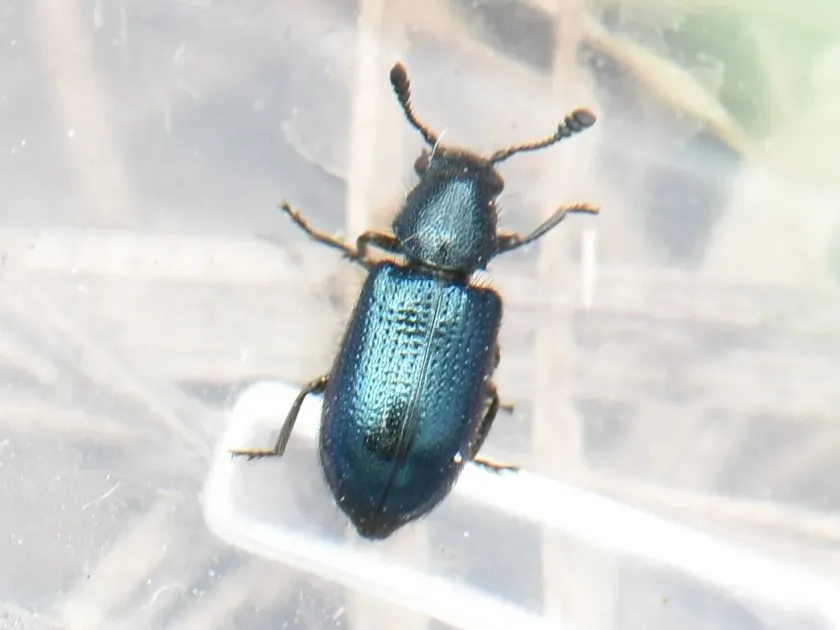
The adult beetle is recognized by its vibrant metallic blue or blue-green color, which is a key identification feature for warehouse inspections.
Its body is oval-shaped and slightly convex, with the surface of the elytra exhibiting distinct, fine punctured striae and fine pubescence.
The larvae are creamy-white or pale with a darkened head capsule and are highly active throughout their development cycle.
These insects are photophobic, meaning they prefer dark environments and are commonly found hiding in cracks, crevices, and deep within stored stock.
What it damages
Although primarily known as a pest of animal products, Necrobia violacea is a significant threat to various stored protein-rich commodities.
In the agricultural sector, they may infest oilseeds and stored grains that have been previously damaged by fungi or other primary pests.
The larvae cause direct damage by tunneling through the commodities, which compromises the nutritional value and marketability of the stored goods.
Waste products left behind by the beetles, including frass and cast skins, serve as contaminants that can lead to total loss of the infested batch.
Heavy infestations are often linked to poor storage hygiene and the presence of rotting or improperly handled organic material in the facility.
When it appears
This pest is a major problem in year-round warehouse settings, especially in heated facilities where temperatures remain conducive to development.
Optimal development occurs in environments ranging from 20°C to 30°C, where the species can complete multiple generations annually.
Activity levels fluctuate with ambient warehouse temperatures; warmer seasons often trigger rapid population growth across stored stockpiles.
The lifecycle includes egg, larval, pupal, and adult stages, with the duration of these stages depending heavily on food availability and local climate.
During colder months, adults and larvae may survive in diapause or reduced metabolic states within building structures.
Signs of infestation
One of the earliest signs of an infestation is the presence of fine powder or debris found underneath storage pallets or near bags.
Adult beetles can often be spotted on the surface of containers, especially during evening hours or after disturbing the stored product.
Visible holes in the commodity and a musty or spoiled smell often indicate that the internal structure of the product is being consumed by larvae.
The presence of exuviae (cast larval skins) near the base of storage areas is a strong indicator of an established colony.
If products appear "webbed" or clumped together due to larval waste and structural damage, it is a sign that the infestation is well-advanced.
Control measures
Effective management requires a combination of sanitation, monitoring, and, when necessary, chemical interventions.
- Implement strict warehouse sanitation to remove food residues that attract pests.
- Use sealed, insect-proof packaging to protect commodities from infestation.
- Employ pheromone or sticky traps to monitor for the presence of adult beetles early.
- Maintain cool storage temperatures to inhibit rapid reproduction and larval development.
- Conduct professional fumigation for serious outbreaks, adhering to local safety and environmental regulations.
Taxonomy
- Latin name
- Necrobia violacea
- Order
- Coleoptera (beetles)
- Family
- Cleridae
- EPPO code
- NECRVI
Discussion
No discussions yet — be the first.