
Red-legged ham beetle
Necrobia rufipes
Description
How to identify
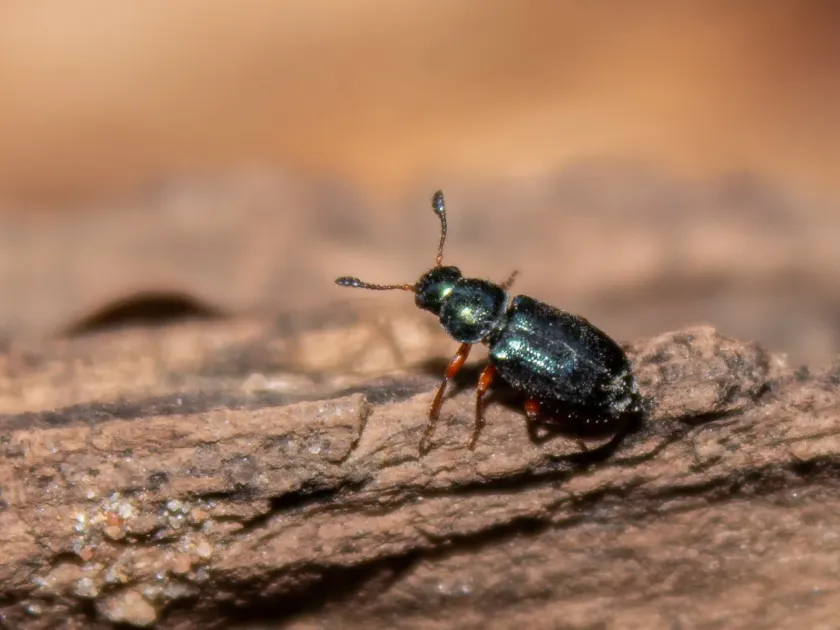
The Red-legged ham beetle (Necrobia rufipes) is a member of the Cleridae family within the order Coleoptera. Adult beetles are small, typically ranging from 3.5 to 7 mm in length, and are easily recognized by their metallic blue or green coloration.
As their common name suggests, their legs and the base of their antennae exhibit a distinct reddish-brown hue. Their body is oval-shaped and covered with fine, sparse hairs, making them appear somewhat shiny under direct light.
The larvae of this species are creamy-white with a darker head and are covered in fine setae. They possess two small, curved appendages called urogomphi at the tip of their abdomen, which are a diagnostic feature for identification.
These insects are highly mobile and capable of flight, allowing them to disperse quickly throughout storage facilities. They are known for being shy, often hiding in narrow crevices, corners, or deep within stacks of stored products.
The species is a cosmopolitan pest, meaning it is found globally in warm climates, often hitchhiking in international trade shipments of food products, hides, and other dried organic materials.
What it damages
The Red-legged ham beetle is a notorious pest of stored goods, particularly those of animal origin. It has a specific preference for high-fat content products, making it a primary threat in warehouses storing cured meats, dried fish, and dairy.
Beyond animal products, it also damages cereals, legumes, dried fruits, nuts, and cocoa beans. In grain storage environments, it often acts as a secondary pest, colonizing grain that has already been breached by other insects.
Feeding damage occurs as both adults and larvae bore into the product, causing weight loss, physical destruction, and a significant reduction in market value. The larvae are particularly voracious feeders.
Infestation leads to widespread contamination via larval skins, frass (excrement), and dead insects. This biological debris can trigger mold growth and introduce unpleasant odors to the stored stock, rendering it unfit for consumption.
Large-scale infestations can cause severe economic losses for exporters and manufacturers, as contaminated batches must often be destroyed or subjected to expensive decontamination processes.
When it appears
Development is heavily influenced by temperature and humidity. The Red-legged ham beetle thrives in warm conditions, with optimal reproduction occurring between 25°C and 30°C, where the life cycle can be completed in about one month.
In temperature-controlled storage facilities, breeding can occur year-round. A single female can lay up to 2,000 eggs throughout her lifespan, depositing them in small batches within cracks or directly on the surface of the food source.
The egg stage usually lasts for 4 to 7 days, followed by the larval phase, which varies in length based on temperature and food availability. In cooler temperatures, development slows down significantly.
Pupation takes place inside protective cocoons made of chewed food particles or other materials. This pupal stage typically lasts about two weeks, during which the insect is highly resilient to external environmental stresses.
The total life cycle, from egg to adult, typically ranges from 30 to 50 days in ideal conditions. In colder, unheated warehouses, they may overwinter as larvae or adults, awaiting the return of warmer weather to resume activity.
Signs of infestation
The presence of adult beetles crawling on the surface of bags, warehouse walls, or equipment is a primary indicator of an established infestation, particularly during warmer months.
Damage to products is characterized by small, irregular holes or pitted surfaces. On packaged goods, one might observe tiny exit holes where larvae have emerged or entered the packaging material.
Accumulation of "dust," which is actually a mixture of food particles and beetle waste, is a clear sign of active infestation. Searching near these piles of debris often reveals the presence of larvae.
Small, dirty-looking cocoons hidden in the seams of bags, floor cracks, or warehouse fixtures indicate that the population is actively breeding. These cocoons are often overlooked during casual inspections.
- Beetles caught in light-based insect traps.
- Unusual, sweet-smelling odors emanating from storage bins.
- Localized heating in grain piles due to insect activity.
Control measures
The primary control measure is rigorous sanitation. Removing food spills, dust, and debris from warehouse corners and storage areas reduces the resources available for the beetles to survive and multiply.
Maintaining a dry, cool storage environment is essential. Keeping temperatures below 15°C slows the metabolic processes of the beetles and significantly hinders their reproductive potential.
Empty warehouses should be thoroughly cleaned and treated with approved residual insecticides before receiving new stock to eliminate overwintering populations hidden in crevices.
Using sealed, pest-proof packaging prevents entry. Regular monitoring with pheromone or sticky traps allows warehouse managers to detect the arrival of the pest early, before it can establish a large colony.
For severe infestations, whole-facility fumigation is often necessary to reach insects hidden deep within stored products or inside building infrastructure, effectively killing all life stages, including eggs.
Taxonomy
- Latin name
- Necrobia rufipes
- Order
- Coleoptera (beetles)
- Family
- Cleridae
- EPPO code
- NECRRU
Discussion
No discussions yet — be the first.