
Red-shouldered ham beetle
Necrobia ruficollis
Description
How to identify
The red-shouldered ham beetle (Necrobia ruficollis) is a small beetle belonging to the Cleridae family, known for infesting high-protein food products.
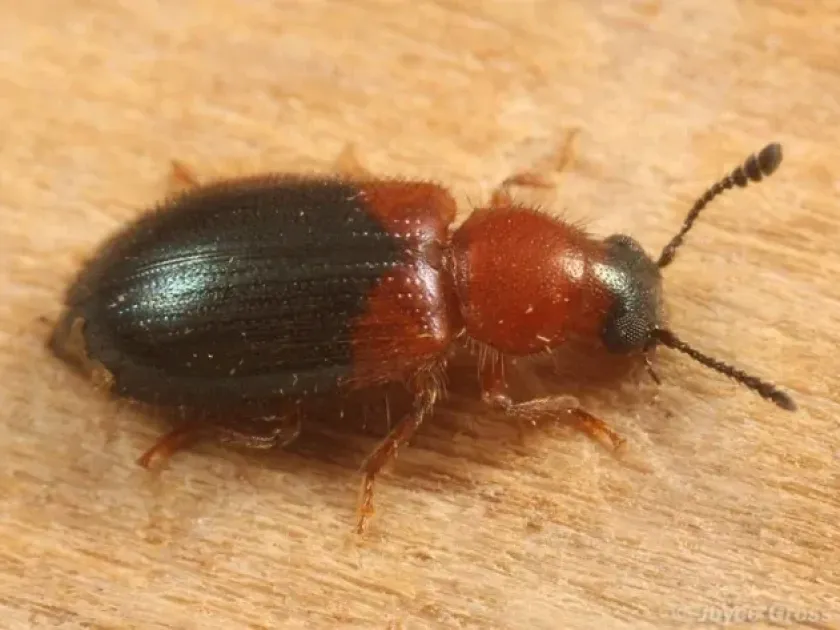
Adult beetles are typically 3.5 to 5 mm long, characterized by a bright red or reddish-brown head and pronotum, contrasted by shiny metallic blue-green elytra.
The body is covered with fine, dense hairs, and the antennae possess a distinct three-segmented club at the tips, which helps in identifying the species.
Larvae are whitish or cream-colored, tapering towards the head, with two dark, curved, horn-like structures on the final abdominal segment.
The life cycle stages include egg, larva, pupa, and adult; the beetle is highly mobile and thrives in warm, humid storage environments.
What it damages
This beetle is primarily a scavenger of animal-based products, including dried meats, smoked products, cured fish, and animal skins or bones.
In agricultural storage, it can severely infest stored seeds and legumes, particularly those with a higher oil and protein content.
Both adults and larvae cause economic damage by boring deep tunnels into the stored goods, consuming them from within.
The presence of high moisture levels in a facility often leads to exponential population growth, as the insect exploits the breakdown of stored organic matter.
Infestation results in heavy loss of product volume, contamination with frass, larval skins, and webbing, rendering the goods unusable for industry or trade.
Signs of infestation
Evidence of infestation usually starts with visible tiny entrance holes on the surface of stored food items, accompanied by powdery residue.
Adult beetles are often spotted crawling quickly across floors, walls, or the surfaces of bags and bins in the storage area.
Larval activity can be confirmed by finding protective gray, paper-like cocoons constructed from food debris in dark corners or fissures.
A foul, musty odor is often associated with heavy infestations, caused by the decay of the material being consumed by the larvae.
Regular inspections of storage containers often reveal scattered larval cast skins, which serve as a clear sign of an active pest population.
Control measures
Sanitation is the cornerstone of control; facilities must be kept clean, with all spilled material and organic waste removed immediately to prevent breeding.
Empty warehouses should be treated with residual insecticides or aerosol fogs to eliminate hiding adults before new inventory is introduced.
Integrated Pest Management (IPM) programs should include the use of sticky monitoring traps to detect early signs of infestation.
For existing infestations, professional fumigation using phosphine-based treatments is the most effective method for total pest eradication.
Controlling environmental factors such as humidity and temperature in warehouses is essential to create a less hospitable environment for this beetle.
Taxonomy
- Latin name
- Necrobia ruficollis
- Order
- Coleoptera (beetles)
- Family
- Cleridae
- EPPO code
- NECRRF
Discussion
No discussions yet — be the first.