
Nasutitermes corniger
Nasutitermes corniger
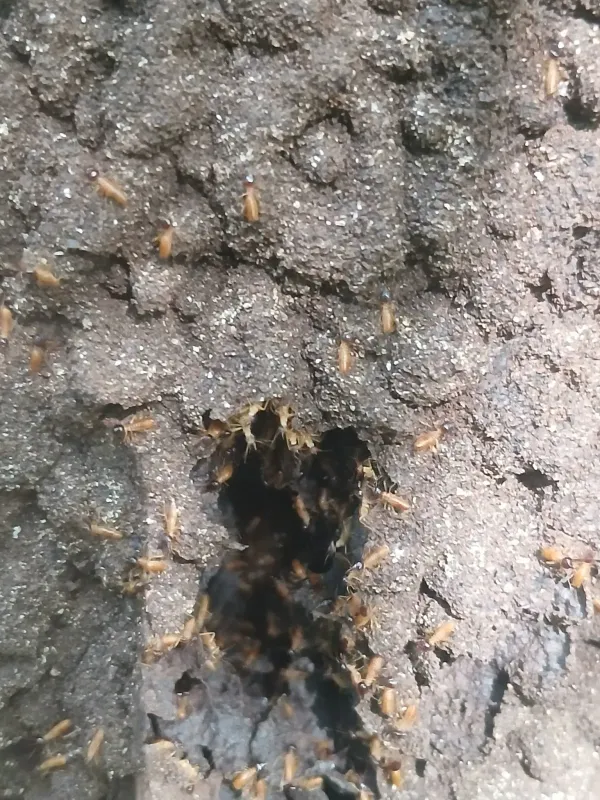
Description
How to identify
Nasutitermes corniger is a species of termite belonging to the family Termitidae within the order Isoptera. These social insects operate in complex colonies consisting of workers, soldiers, and reproductive individuals.
The soldiers of this species are easily identified by their unique, pear-shaped heads with a prominent cone-like projection called the "nasus." This structure allows them to squirt a defensive glue-like secretion at predators such as ants.
Worker termites are light-colored and are responsible for colony maintenance, nest construction, and foraging for food sources. The queen and king remain deep within the nest to ensure the continuous growth of the colony.
Colonies build large, carton-like nests made of wood particles and fecal matter. These nests are often attached to tree trunks or tree branches and appear as dense, dark-brown globular structures.
Foraging workers are known to construct elaborate, covered soil galleries that run along tree bark, protecting them from predators and sunlight as they move between the nest and their food source.
What it damages
This pest poses a significant threat to forest trees, cocoa plantations, citrus orchards, and various other fruit crops. They feed on bark and wood, boring galleries that undermine the structural integrity of the plant.
Beyond living trees, these termites feed on decaying wood, fence posts, wooden stakes used for plant support, and various timber structures. Such activity significantly weakens trees, often leading to total collapse.
In many regions, this species impacts agricultural yields by attacking the roots and lower stems of young saplings. Infested plants are also more susceptible to secondary fungal and bacterial infections.
The destruction of internal woody tissues disrupts the flow of water and nutrients within the tree. This results in wilted leaves, premature shedding, and the eventual death of the affected parts of the plant.
Significant infestations can lead to substantial economic losses in plantations, as the termites are capable of hollow-out stems to the point where the tree can no longer support its own weight.
Signs of infestation
The most visible sign of an infestation is the presence of brown, hardened mud tunnels or galleries running along the bark of the host tree. These are the defensive tunnels used by workers for safe travel.
The discovery of large, dark-brown termite nests on tree trunks or branches is a clear indicator of a well-established colony. These nests are hard to the touch and difficult to remove.
When inspecting trees, one may observe areas where the wood appears thin or damaged. Tapping on these areas often reveals hollow galleries hidden beneath the surface, confirming termite activity.
The emergence of winged termites, known as alates, during specific seasons is a sign that a mature colony is nearby. They are often drawn to lights at night during their swarming phase.
Secondary indicators include sudden leaf drop and the presence of dead branches on a tree that otherwise looks healthy, suggesting that internal damage is blocking the plant's vascular system.
Control measures
Mechanical destruction of the nest is the first line of defense. The entire nest should be carefully removed and incinerated to ensure that the queen and the rest of the colony are destroyed.
The application of insecticidal barriers around the base of the trees can prevent termite access to the upper branches. Products containing fipronil or imidacloprid are effective in creating these protective zones.
Sanitation is crucial: clearing the area of rotting wood, old stumps, and dead debris removes natural nesting sites and reduces the likelihood of new colonies establishing themselves near crops.
For established infestations, systemic insecticides can be applied to the tree. These chemicals are absorbed into the vascular system, making the wood toxic to the termites that feed on it.
- Routine scouting for soil tunnels on tree trunks.
- Application of biological control agents like entomopathogenic fungi.
- Deployment of bait stations with slow-acting insecticides to eradicate the entire nest.
Taxonomy
- Latin name
- Nasutitermes corniger
- Family
- Termitidae
- EPPO code
- NASUCN
Discussion
No discussions yet — be the first.