

Pest · Hemiptera (bugs, aphids, leafhoppers)
Lettuce aphid
Nasonovia ribisnigri
Description
How to identify
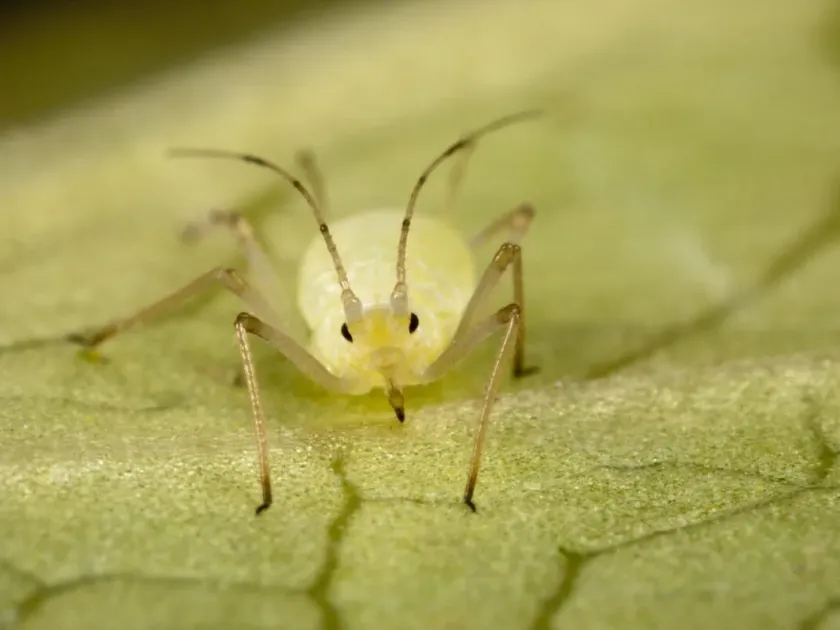
The lettuce aphid belongs to the order Hemiptera and the family Aphididae. Adult individuals are small, with body colors ranging from green to yellowish-green or reddish-brown.
A key diagnostic feature is the presence of long siphunculi (tubes) on the rear of the abdomen. The insect has long antennae, often reaching the length of its body, which is easily visible under a magnifying glass.
Nymphs resemble adults but are smaller and have a paler coloration. Their development goes through several instars, involving molting and a gradual increase in body size.
Reproduction occurs both sexually and parthenogenetically. Colonies are often found on the undersides of young leaves, where they live a cryptic lifestyle within the foliage.
This species is migratory: its primary host is the currant bush, while the secondary hosts include various plants from the Asteraceae family, most notably lettuce.
What it damages
The main damage is inflicted on lettuce crops, as the aphid prefers to settle inside the hearts of heading varieties. This makes the pest extremely dangerous, as chemical sprays often fail to penetrate the dense leaves.
Besides lettuce, the aphid damages currants in the spring, causing leaf curling and deformation of terminal shoots. On currants, the aphids form dense colonies and feed on the sap of young stems.
On secondary hosts like chicory and lettuce, insects concentrate in the center of the rosette. This results in stunted growth and a significant reduction in market value before harvest.
The pest is an active vector of various plant viruses, including lettuce mosaic virus. Virus infection often causes more economic damage than direct sap-sucking by the aphids.
Damaged plant tissues often undergo necrosis, creating entry points for secondary bacterial infections and soft rots, which can lead to the total loss of the commercial part of the crop.
When it appears
The life cycle begins in early spring, when nymphs emerge from eggs that overwintered on currant bushes. The first generations develop on the bushes during April and May.
In early summer, winged individuals migrate from currant bushes to secondary hosts such as lettuce and endive. During this time, the population on currants declines sharply.
Throughout the summer, several generations develop on lettuce. Warm weather accelerates reproduction, leading to colonies numbering hundreds of insects on a single plant.
In the autumn, with dropping temperatures and shorter daylight hours, specialized winged forms appear and return to currants to lay overwintering eggs.
The overwintering stage is an egg, laid under the bark or near the buds of currant bushes. This stage allows the species to survive winter frost until the next season begins.
Signs of infestation
The first sign of infestation on lettuce is the curling and yellowing of internal leaves in the center of the head. Splitting the head open reveals clusters of small insects.
On currants in the spring, look for characteristic leaf curling on shoot tips. The leaves become distorted and may change color to a reddish or yellowish hue.
The appearance of honeydew (sticky secretions) on the surface of lettuce leaves is evidence of active aphid feeding. These secretions serve as a substrate for sooty mold growth.
Gradual stunting of the plants, general weakness, and delayed head formation are also indirect indicators of a high aphid population density in the field.
- Presence of colonies inside the lettuce head.
- Sticky honeydew residue on foliage.
- Curling and distortion of leaf edges.
- Increased ant activity near the plants.
Control measures
Agronomic control includes the removal of weeds from the Asteraceae family in and around fields, as these serve as secondary reservoirs for the pest during summer.
Maintaining spatial isolation between currant plantations and lettuce production fields is crucial to interrupt the migration cycle of the aphid.
Biological control involves the use of natural enemies such as lady beetles, lacewings, and hoverflies, which actively prey on aphid colonies in nature.
Chemical control requires careful application; because the aphids are hidden inside lettuce heads, systemic insecticides should be applied early, before the heads begin to close.
Monitoring with yellow sticky traps allows farmers to detect the arrival of winged migrants early and implement protective measures before the infestation becomes widespread.
Reference
Connections · Lettuce aphid
Most often together:
Marketplace
Products · 1
Biology
Taxonomy
- Latin name
- Nasonovia ribisnigri
- Order
- Hemiptera (bugs, aphids, leafhoppers)
- Family
- Aphididae
- EPPO code
- NASORN
Community
Discussion
No discussions yet — be the first.