
Mediterranean mussel
Mytilus galloprovincialis
Description
How to identify
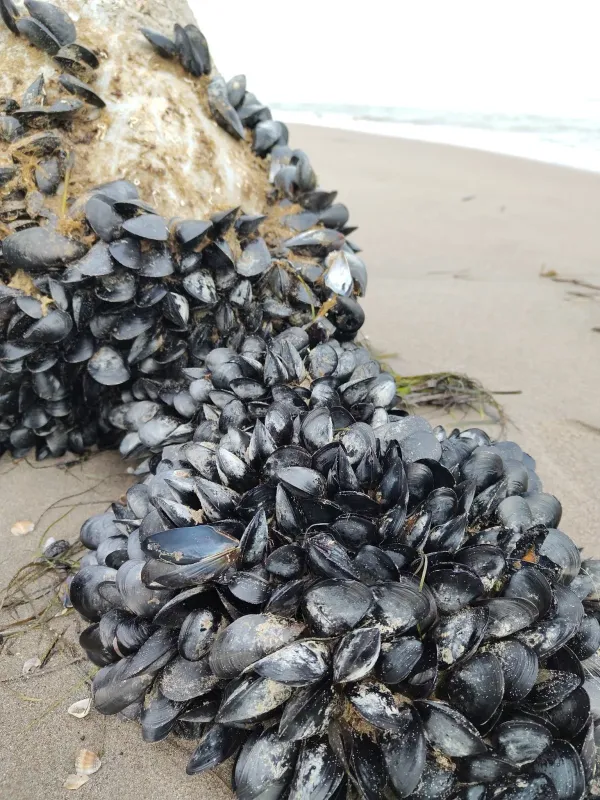
The Mediterranean mussel (Mytilus galloprovincialis) is a member of the Mytilidae family. It is a filter-feeding bivalve mollusk that has spread globally via maritime traffic and infrastructure development.
The shell is wedge-shaped, smooth, and typically dark blue to black. Adults reach 10–12 cm in length, often clustering together to form dense, heavy layers known as mussel beds.
They attach to hard surfaces using byssus threads, which are extremely strong protein-based fibers. This allows them to thrive in high-flow environments like pipes and pumps.
Their life cycle includes a planktonic larval stage called a veliger. These larvae are transported by water currents, allowing them to rapidly colonize any suitable surface they encounter.
They exhibit high phenotypic plasticity, allowing them to adapt to fluctuating salinity, temperature, and pollution levels, making them a major nuisance in industrial water systems.
What it damages
This species is a significant pest for agricultural water infrastructure. While not a direct plant pest, it causes immense economic damage by obstructing irrigation systems.
Colonization inside irrigation pipelines restricts water flow by reducing the effective pipe diameter. This leads to increased friction, pressure loss, and reduced water availability for crops.
Mussel clusters frequently clog valves, nozzles, and pump intake screens. This results in costly maintenance, system downtime, and increased wear on pumping machinery.
Uneven water distribution caused by biofouling can lead to irrigation inefficiency, stressing sensitive crops and negatively impacting overall farm yield and quality.
Furthermore, the decay of dead mussels within pipes introduces harmful organic matter and pathogens into the irrigation water, potentially threatening soil and crop health.
When it appears
The primary colonization period coincides with warmer months. Higher water temperatures trigger spawning and increase the survival rate of veliger larvae.
Settlement occurs throughout the growing season. As irrigation demand increases, the constant flow of water often introduces new larvae into internal agricultural systems.
During the winter, adults enter a reduced metabolic state. However, they remain securely attached, maintaining physical obstructions within the infrastructure throughout the off-season.
Rapid population growth is often observed in late spring when water temperatures reach optimal levels for larval development and attachment.
The duration of the warm season directly influences the thickness and density of the mussel beds, with longer summers leading to severe infrastructure blockage.
Signs of infestation
A primary indicator of infestation is a gradual decrease in water output despite the pump operating at full power. This suggests internal pipe constriction due to mussel buildup.
Audible vibrations or irregular pump noise often signal that the internal geometry of the pipes has been altered by thick mussel layers.
Discovery of shell fragments or byssus threads in sprinkler heads or drip irrigation filters serves as definitive proof that the infestation has reached the end-user points.
Foul odors, such as hydrogen sulfide, during system startup indicate decomposing mussel biomass within dead-end pipes or stagnant sections of the system.
Visual inspection of the main water intake or upstream reservoirs often reveals dense layers of mussels covering all submerged surfaces, indicating high colonization pressure.
Control measures
Mechanical cleaning remains the standard procedure. This involves using pigging tools, scrapers, or high-pressure water jets to remove mussel biomass from pipes.
Preventive measures include the application of anti-fouling coatings to internal pipe surfaces to disrupt the attachment of byssus threads.
Chemical control via chlorination or molluscicide application is effective for killing larvae and small juveniles before they form substantial colonies.
Optimizing flow velocities is an effective design strategy. High-velocity water makes it difficult for veligers to settle and successfully attach to pipe walls.
- Routine inspection of filtration and intake screens.
- Periodic flushing of irrigation lines under high pressure.
- Implementation of ultrasonic deterrents near intakes.
Taxonomy
- Latin name
- Mytilus galloprovincialis
- Family
- Mytilidae
- EPPO code
- MYTUGA
Discussion
No discussions yet — be the first.