
Golden mussel
Limnoperna fortunei
Description
How to identify
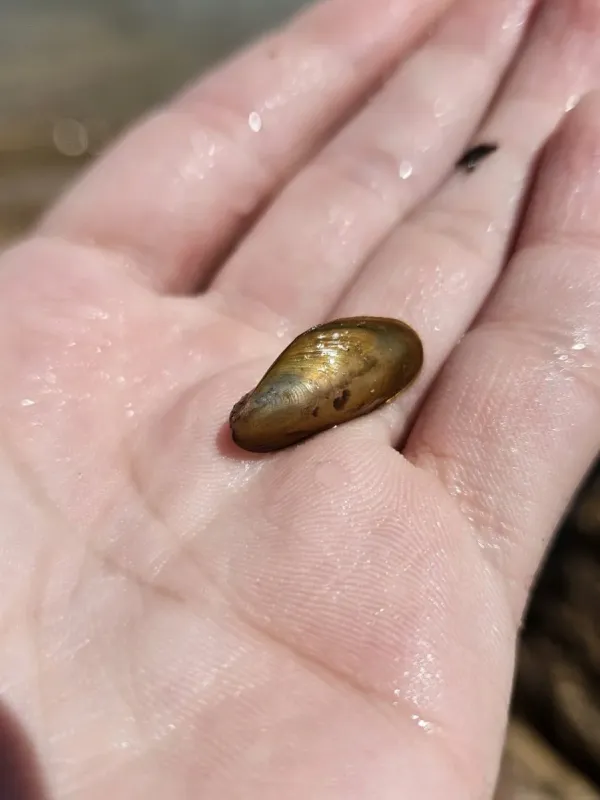
The golden mussel (Limnoperna fortunei) is a small, freshwater bivalve mollusk belonging to the family Mytilidae.
It is easily recognized by its triangular, brownish-gold shell, which usually measures between 20 and 40 mm in length.
The species is highly invasive and characterized by its ability to attach itself to hard surfaces using strong protein-based byssal threads.
Unlike many other bivalves, it can form thick, multi-layered colonies that cover almost any submerged structure, including rocks, concrete, and metal piping.
Originally native to Southeast Asia, it has rapidly spread globally, causing severe ecological and economic damage to freshwater ecosystems and industrial infrastructure.
What it damages
The primary threat of the golden mussel to agriculture is the biofouling of water infrastructure used for irrigation and land management.
By colonizing the interior of water pipes, intake pumps, and irrigation canals, they severely restrict water flow and block filtering systems.
This reduction in flow rate leads to irrigation failures, which can be devastating for crops that require precise and consistent moisture levels during growth.
In addition to blocking flows, the presence of these mussels often causes the mechanical failure of pumps and clogging of sprinkler irrigation nozzles.
The decay of accumulated mussel populations inside pipes can also degrade water quality, potentially introducing harmful substances into the soil profile during irrigation.
When it appears
The reproductive cycle of Limnoperna fortunei is highly sensitive to water temperature, with spawning activity peaking when temperatures exceed 15–18 degrees Celsius.
During the warmer months, the mussels release free-swimming larvae called veligers, which can drift long distances with the water current.
Summer is the most critical period for new infestations, as these larvae settle on surfaces and rapidly begin to grow and develop their byssal attachments.
While reproductive activity slows down during winter, the established colonies remain highly resilient and continue to pose a threat to infrastructure.
The rapid life cycle allows a single population to expand exponentially within a very short time, making early season control measures vital.
Signs of infestation
An early indication of infestation is a noticeable decline in the operational efficiency of irrigation pumps without any obvious mechanical fault.
Visual inspections of intake screens or water treatment facilities often reveal mats of golden-colored shells covering the infrastructure.
Frequent clogging of irrigation emitters and downstream nozzles by shell fragments or organic residue is a clear sign that the colony has matured.
The occurrence of foul odors in the water supply indicates the presence of decaying mussel tissue within the piping system.
Monitoring for the presence of veligers in the water column using fine mesh plankton nets is the most effective way to detect an infestation before it becomes severe.
Control measures
Mechanical removal through regular cleaning and scraping of affected surfaces is a standard but labor-intensive approach to management.
The use of oxidizing agents, such as chlorine or ozone injections, can be effective in killing larvae and preventing them from settling in closed systems.
Applying specialized anti-fouling coatings to internal surfaces can help prevent the mussels from establishing a grip on the infrastructure.
Thermal flushing, using high-temperature water (above 40 degrees Celsius), is an effective method for dislodging and killing adult mussel colonies.
Implementing effective screening and filtration systems at water intake points is crucial for preventing larvae from entering the main irrigation lines.
Taxonomy
- Latin name
- Limnoperna fortunei
- Family
- Mytilidae
- EPPO code
- LPRNFO
Discussion
No discussions yet — be the first.