
Mottled grasshopper
Myrmeleotettix maculatus
Description
How to identify
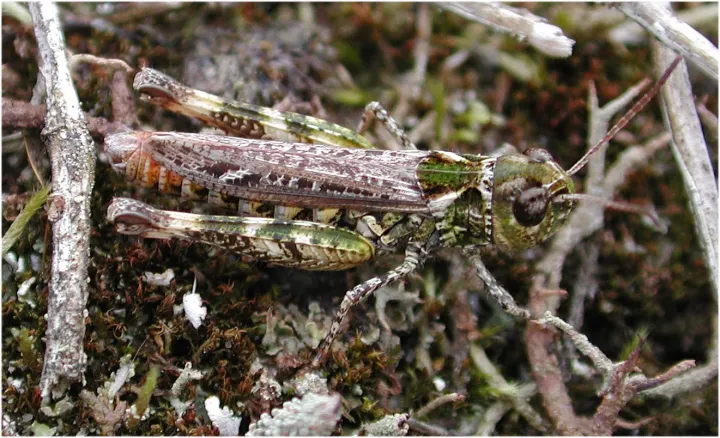
The Mottled grasshopper (Myrmeleotettix maculatus) is a small species of short-horned grasshopper belonging to the Acrididae family. Adults typically measure between 11 and 18 mm in length.
A key identifying characteristic, especially in males, is the club-shaped enlargement at the tips of their antennae. This unique feature distinguishes them from most other grasshopper species found in similar habitats.
Their coloration is highly variable, ranging from shades of grey and brown to green or yellow. This camouflage allows them to blend in perfectly with dry grass and soil, making them difficult to spot.
The species is well-adapted to open, dry environments such as grasslands, heaths, and pasturelands. They are agile insects, possessing functional wings that facilitate movement across the landscape.
While they typically lead a solitary life, their populations can grow significantly under favorable weather conditions, transforming them into a notable pest in agricultural environments.
What it damages
Mottled grasshoppers are polyphagous, feeding on a wide variety of plant species. Their primary targets are grasses, making them a significant concern for pasture and hayfield management.
In cereal crop areas, young nymphs and adults can cause damage by chewing on the foliage and stems of developing plants. Such feeding stunts growth and reduces the overall vigor of the crop.
Beyond cultivated crops, their consumption of diverse grass species leads to the degradation of pastures. When populations are dense, they significantly reduce the available biomass for livestock.
The damage is particularly severe during dry seasons when the regrowth of vegetation is slow. In these conditions, even moderate populations can cause substantial losses in forage quality and yield.
Economic damage is twofold: it includes direct losses in forage production and the subsequent costs of chemical or biological interventions to protect the remaining vegetation.
When it appears
The life cycle of the Mottled grasshopper is strictly seasonal, with overwintering occurring exclusively at the egg stage. Eggs are laid in the soil in late summer or autumn.
Nymphs emerge in the spring, typically around late April or May, as soil temperatures rise. Their development is synchronized with the flush of new grass growth.
Development proceeds through five nymphal instars, with adult emergence occurring by June or July. During this time, the insects become increasingly active and voracious in their feeding.
The peak period of damage occurs throughout the summer months. During this time, the grasshoppers focus on maturation, mating, and ensuring the success of the next generation.
By autumn, the adults die off after completing their reproductive phase, leaving the eggs in the soil to initiate the cycle once again when spring temperatures return.
Signs of infestation
The first sign of an infestation is the appearance of ragged edges on the leaves of grasses. Upon closer inspection, you may see that portions of the leaves have been eaten away.
Visual observation is effective: when walking through an infested field on a sunny day, you will notice grasshoppers leaping away from your path in significant numbers.
Over time, infested areas may exhibit patches of thinning or yellowing vegetation. If left unchecked, these patches expand, indicating the continuous feeding of the grasshopper population.
The presence of frass (insect excrement) at the base of plants is a definitive indicator of high feeding activity. This is often the most reliable way to assess local population density.
A noticeable decline in overall sward density and premature drying of the grass canopy are critical signals that the infestation has reached a level requiring immediate management action.
Control measures
Effective control of the Mottled grasshopper begins with cultural practices. Autumn discing or light tilling of the soil can destroy the egg pods, significantly reducing the spring population.
Maintaining healthy, dense swards through proper grazing and mowing schedules can minimize the attractiveness of the area to this pest and discourage mass laying of eggs.
When monitoring shows that population levels exceed the economic injury threshold, the application of registered insecticides is recommended to prevent widespread crop damage.
Encouraging natural predators, such as insectivorous birds and parasitic insects, helps keep populations in check naturally. Maintaining field margins can support these beneficial organisms.
Consistent field scouting is essential to identify hotspots of activity early in the season. Targeted spot treatments are usually more cost-effective than broad-spectrum chemical applications.
Taxonomy
- Latin name
- Myrmeleotettix maculatus
- Order
- Orthoptera (locusts)
- Family
- Acrididae
- EPPO code
- GOMPMA
Discussion
No discussions yet — be the first.