
Harlequin bug
Murgantia
Description
How to identify
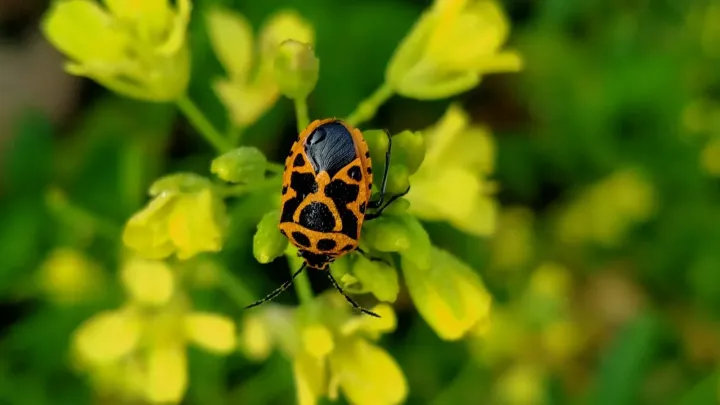
The Harlequin bug (Murgantia histrionica) is a member of the Pentatomidae family, commonly known as stink bugs. It is easily recognized by its vibrant, contrasting colors of red, orange, and yellow patterns against a shiny black shield-shaped body.
Adult bugs typically measure about 8–10 mm in length. The nymphs (immature stages) resemble the adults in shape but lack fully developed wings and are generally smaller. They undergo hemimetabolous metamorphosis, passing through five nymphal instars before reaching adulthood.
Female Harlequin bugs deposit eggs in distinctive clusters, usually consisting of 12 eggs arranged in two parallel rows. These eggs look like tiny white barrels with black bands and are typically found on the undersides of leaves.
They overwinter as adults, seeking shelter in plant debris, leaf litter, or dense weeds. As temperatures rise in early spring, they emerge, start feeding on early host plants, and begin their reproductive cycle.
The number of generations per year depends on the local climate. In warmer regions, they can produce multiple generations, leading to rapid population surges during mid-to-late summer when host crops are most vulnerable.
What it damages
Harlequin bugs are specialized pests of the Brassicaceae family. Their preferred hosts include cabbage, broccoli, cauliflower, Brussels sprouts, kale, collards, radish, turnips, and horseradish.
While they strongly favor cruciferous crops, they are known to attack other plant species, including tomatoes, potatoes, corn, beans, and asparagus, especially when their primary food sources are depleted or unavailable.
These bugs use their piercing-sucking mouthparts to penetrate plant tissues. They feed by extracting sap from leaves, stems, and seed pods, causing localized damage to the vascular system of the host plant.
When feeding, the bugs inject digestive enzymes into the plant tissue. This results in the collapse of plant cells, leading to white or yellow cloudy spots, leaf stippling, and eventual necrosis of the damaged areas.
Severe infestations often cause wilting, stunted growth, and in extreme cases, the total death of young seedlings. In mature plants, feeding damage can lead to deformed leaves and decreased yield quality, rendering the crops unmarketable.
Signs of infestation
The earliest signs of infestation are small, irregular white or yellow stippling marks on the leaves. As the bug population increases, these spots expand and coalesce, leading to large patches of chlorotic or dead tissue.
Growth distortion is a common symptom; infested plants may show twisted, curled, or crinkled foliage. If the plant is young, the entire plant may collapse or fail to develop a healthy head or root system.
Visual confirmation of the pests themselves is the most reliable sign. Checking the undersides of leaves for the characteristic barrel-shaped egg clusters and observing the brightly colored adults provides clear evidence of infestation.
The presence of fecal spots on leaves, which appear as small dark specks, often accompanies the feeding sites. These spots can serve as a diagnostic indicator of pest activity even when the bugs are temporarily hidden.
In mid-summer, a distinct "scorched" appearance on the foliage of cruciferous crops is often an indicator that a large population of nymphs and adults is actively feeding on the crop canopy.
Control measures
Cultural management is the primary line of defense. Removing and destroying all crop debris immediately after harvest eliminates the overwintering sites where the bugs survive until the next season.
Managing wild cruciferous weeds, such as wild mustard or shepherd's purse, in and around the field is critical, as these plants often serve as early-season hosts for Harlequin bug populations.
Hand-picking remains a highly effective method for small-scale gardens. Collecting and disposing of adult bugs and egg masses early in the morning, when the insects are less active, significantly reduces local pressure.
For larger infestations, targeted applications of insecticides may be necessary. It is essential to use products labeled for the specific crop and to follow all safety protocols to protect beneficial pollinators.
Biological control options, including the use of entomopathogenic fungi or encouraging natural predators like parasitic wasps, can help keep populations in check without relying solely on chemical pesticides.
Taxonomy
- Latin name
- Murgantia
- Order
- Hemiptera (bugs, aphids, leafhoppers)
- Family
- Pentatomidae
- EPPO code
- MURGSP
Discussion
No discussions yet — be the first.