
Tumbling flower beetle
Mordellistena
Description
How to identify
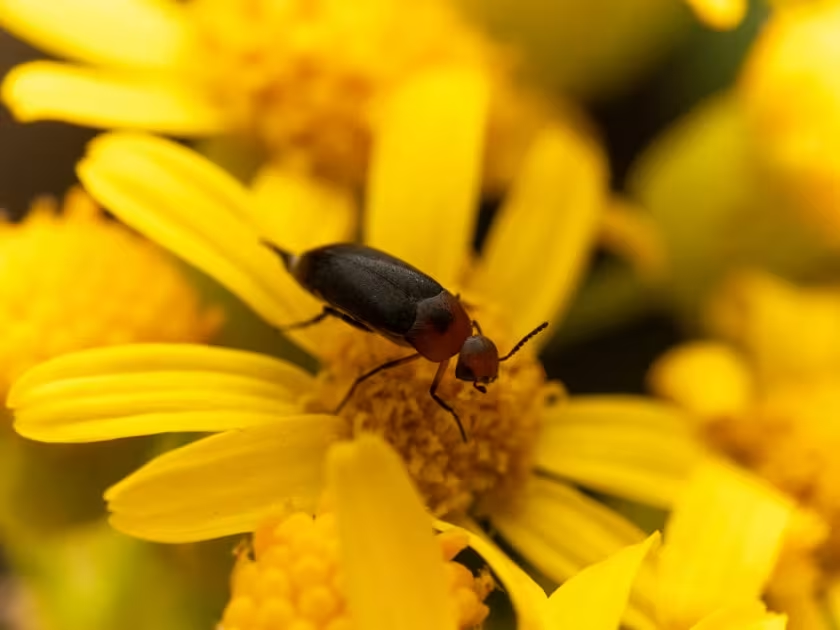
The tumbling flower beetle (genus Mordellistena) belongs to the Mordellidae family within the order Coleoptera. These beetles are easily recognized by their arch-backed body shape, which is laterally compressed and tapers sharply towards the posterior end.
Adult beetles typically range from 3 to 8 millimeters in length. Their coloration ranges from black to dark brown, often featuring a metallic or velvety sheen that provides excellent camouflage against various plant structures.
A defining characteristic of this genus is the elongated anal pygidium, which protrudes significantly beyond the wing covers. Their heads are oriented downwards, and their hind legs are robust, allowing them to jump erratically when disturbed, a behavior that earned them their common name.
Larvae are typical coleopteran grubs; they are fleshy, white or yellowish, and equipped with strong mandibles designed for boring through thick plant tissues.
Identifying specific species within the Mordellidae family can be challenging due to their diversity, but their unique stem-boring habits serve as a primary indicator for agronomists to confirm an infestation.
What it damages
The primary damage is caused by the larval stage, which lives endophytically within the stems of various herbaceous plants, including both wild species and high-value agricultural crops.
Sunflowers are particularly susceptible to Mordellistena damage, as the larvae bore complex, winding galleries through the stem core, which compromises the structural integrity of the plant.
Infestations are also recorded in cereal crops and various weeds, which serve as alternate hosts and contribute to building up the pest population in the vicinity of production fields.
The harm manifests as a disruption of nutrient and moisture transport within the plant, leading to stunted development of flower heads or grains, and a overall decrease in crop yield.
During heavy infestations, weakened stems become extremely vulnerable to mechanical stress, often snapping under the pressure of strong winds or heavy rain, leading to harvest losses.
When it appears
Adult activity typically begins in late spring and extends through the first half of summer, which usually aligns with the peak vegetative growth phase of major crops.
Females deposit eggs directly into the plant tissue by gnawing small punctures, after which the emerging larvae immediately begin their boring process into the stem parenchyma.
The complete life cycle of one generation can last between one to two months, depending heavily on the prevailing ambient temperatures and soil moisture levels.
Adults are primarily active during daylight hours, often feeding on pollen, which can incidentally cause minor damage to the reproductive parts of flowers.
Overwintering occurs primarily at the larval stage within the dried stalks and crop residues, where they remain protected until the onset of favorable conditions in the following season.
Signs of infestation
The first sign of an infestation is often the presence of wilting or prematurely yellowing leaves, even when soil moisture levels appear to be adequate for the crop.
A visual inspection of the stem may reveal small, circular entry holes made by the females for oviposition, sometimes surrounded by slight discoloration of the epidermis.
If the stem is dissected, the internal core will show evidence of galleries and significant amounts of black larval frass, appearing as dark, fine sawdust.
A major diagnostic sign is the increased brittleness of the stalks, which tend to break or lodge easily in fields that have been colonized by these larvae.
In later stages of larval development, the affected plants exhibit noticeable growth stagnation and a significant reduction in seed filling quality due to the obstructed vascular system.
Control measures
The most effective strategy is the implementation of good cultural practices, such as deep autumn plowing to bury and destroy larval populations inhabiting plant residues.
Timely field sanitation, including the removal of weeds from field margins and fence lines, is crucial to eliminate reservoirs where the pest can survive during the off-season.
Chemical control with systemic insecticides is only effective when applied during the adult flight period, before the larvae have successfully penetrated deep into the stem tissues.
Biological control agents, including entomopathogenic fungi or bacteria, may offer suppression of beetle populations when applied systematically during the active growth phases.
Effective crop rotation is a cornerstone of management, as it breaks the pest's life cycle and prevents the buildup of localized populations that would otherwise plague the same fields annually.
Taxonomy
- Latin name
- Mordellistena
- Order
- Coleoptera (beetles)
- Family
- Mordellidae
- EPPO code
- MORESP
Discussion
No discussions yet — be the first.