
Mordellid beetle
Mordellina pustulata
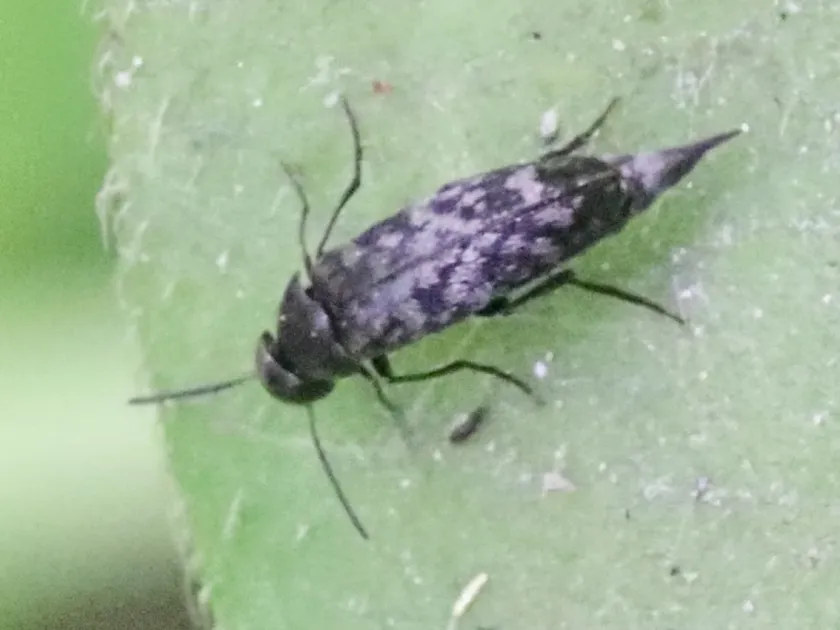
Description
How to identify
Mordellina pustulata belongs to the Mordellidae family, order Coleoptera. The adult insect has a distinctive humped body shape, compressed laterally, with an elongated posterior tip of the elytra resembling a sharp spike.
The coloration is primarily black, but the elytra exhibit specific spots or bands formed by light-colored hairs. The adult size is generally small, ranging from 3 to 6 mm in length.
A hallmark of these beetles is their ability to perform sudden, tumbling leaps when threatened or handled. The head is strongly tilted downward, giving the insect its characteristic hump-backed silhouette.
Larvae are whitish or yellowish in color, with a cylindrical body, a well-defined head, and three pairs of thoracic legs. They lead a cryptic, endophytous lifestyle within plant tissues.
Development involves complete metamorphosis. The life cycle consists of the egg, larval, pupal, and adult stages, which is typical for this family of beetles.
What it damages
Mordellina pustulata affects a wide range of plants, including herbaceous perennials, sunflower stems, various Asteraceae species, and other agricultural crops. Larvae are known to damage both stems and roots.
The primary damage is caused by larvae that tunnel into the stems, creating galleries. This disrupts the plant's vascular system and nutrient flow, significantly reducing vegetative biomass.
At the points of entry, plant tissues become loose, often resulting in premature wilting. High pest density can lead to substantial losses in both crop quality and overall yield.
Stem damage frequently invites secondary infections, as the open galleries serve as entry points for fungal and bacterial pathogens. This drastically compromises the plant's immunity.
Damage is most severe during drought periods when plants are already stressed. Affected stems are prone to breaking under wind pressure, which complicates mechanical harvesting.
When it appears
Adult activity occurs from late spring through summer months, coinciding with their mass emergence. During this period, beetles feed actively on flower pollen and nectar.
Oviposition typically begins in early summer. Females lay eggs in the tissues of young stems or petioles, selecting the most vulnerable parts of host plants.
The larval stage is the most prolonged, occurring throughout mid-to-late summer. During this time, larvae feed intensively on inner stem tissues, growing and developing rapidly.
Pupation takes place either inside the damaged plant or in the soil, depending on local environmental conditions. This stage concludes the development cycle for the generation.
The pest usually overwinters as a larva or pupa, hiding in plant debris or the upper layer of soil, which allows it to successfully survive cold winter temperatures.
Signs of infestation
The first sign of infestation is the presence of small entry holes on the stem surface. Necrotic spots or tissue deformation often develop around these openings.
Early-stage infestations can manifest as stunted growth, chlorosis of the leaves, and slight drooping of the plant canopy during the hottest hours of the day.
When the stem is opened, winding tunnels filled with larval frass can be found. The gallery is usually longitudinal, following the axis of the stem, which is characteristic of Mordellidae feeding.
- Deformation and twisting of stems.
- Premature drying of individual leaves.
- Visible boring marks on the stem surface.
- Increased brittleness of affected stems under physical stress.
If a larva is extracted from the cavity, it will exhibit energetic wriggling. In cases of severe infestation, the interior of the stem becomes hollow, eventually leading to plant death.
Control measures
Agronomic practices include the mandatory destruction of crop residues where larvae and pupae might persist. Deep autumn plowing helps reduce the population of overwintering individuals.
Crop rotation is a critical preventive measure. It is not recommended to plant susceptible crops in the same area for consecutive years to break the pest's development cycle.
Application of insecticides is advisable during the peak period of adult emergence. Targeted treatments help decrease egg-laying success and prevent infestation of young crops.
Managing weeds in fields and adjacent areas is essential, as these plants can serve as secondary reservoirs for the Mordellina pustulata population between seasons.
Timely fertilization boosts plant health and vigor, improving their resilience to damage. A healthy plant with a strong root system can compensate for minor tissue losses caused by larvae.
Taxonomy
- Latin name
- Mordellina pustulata
- Order
- Coleoptera (beetles)
- Family
- Mordellidae
- EPPO code
- MOREPU
Discussion
No discussions yet — be the first.