
Mordellina ancilla
Mordellina ancilla
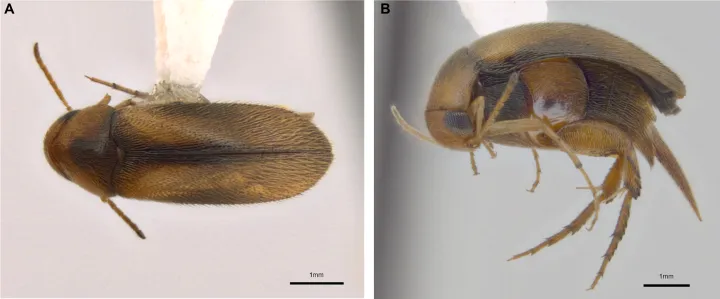
Description
How to identify
Mordellina ancilla is a species of tumbling flower beetle belonging to the family Mordellidae, order Coleoptera. Adult beetles are small, typically measuring 3–5 mm in length, and possess a distinct humped body shape that tapers toward the posterior, making them easily identifiable.
The coloration of these beetles ranges from dark brown to almost black, and their bodies are covered in fine, dense hairs. The head is bent downwards, and the elytra are wedge-shaped, a classic morphological characteristic of this family.
These beetles are highly mobile and exhibit a unique jumping behavior when threatened, which makes manual collection in the field difficult. The life cycle consists of complete metamorphosis: egg, larva, pupa, and adult.
The larvae of the beetle live inside the stems or roots of host plants, which makes early detection challenging. They have cylindrical bodies equipped with well-developed mouthparts capable of tunneling through plant tissues.
Population levels in natural environments are heavily dependent on climatic factors, with warm and moderately humid conditions favoring egg-laying within the flower heads or stems of host plants.
What it damages
The primary crops damaged by Mordellina ancilla are members of the Asteraceae family, most notably sunflowers. The pest may also be found on wild weeds from the Asteraceae and Fabaceae families.
The most significant damage is caused by the larvae, which bore into the stems or the receptacle of the sunflower head. They create extensive tunnels, disrupting the plant's internal vascular system.
As a result of stem damage, the transport of water and nutrients to the flower head is impaired, leading to shriveled seeds and an overall reduction in crop yield and quality.
Damaged stems become brittle and are prone to lodging under wind pressure, which complicates mechanical harvesting and leads to significant yield losses in the field.
During heavy infestations, plants may show signs of premature wilting and general growth retardation, which drastically lowers the weight of thousands of seeds and their oil content.
When it appears
The emergence of adult beetles typically coincides with the active flowering phase of sunflowers, during which the adults feed on pollen and nectar without causing critical damage to the flower heads.
Mass flight periods occur during the summer months when temperatures are consistently high. It is during this time that females actively lay eggs in the basal area or leaf axils of the crops.
The larval stage develops throughout the second half of the summer, gradually burrowing deeper into the stem tissue as the crop matures. The insect overwinters as a larva inside crop residues or in the soil.
In spring, as the soil warms, the larvae pupate within the old plant debris. The emergence of the new generation of beetles is synchronized with the beginning of the growing season of the host crops.
The life cycle is univoltine (one generation per year), making the destruction of crop residues immediately after harvest a critical factor in population control.
Signs of infestation
The first sign of infestation is the presence of adult beetles on sunflower heads during the flowering period. Adults are easily observed during routine field inspections of the crop.
Internal stem damage can be detected by the presence of small entry holes on the stem surface, often accompanied by localized darkening of the plant tissue surrounding the penetration site.
Splitting the stem of an infested plant reveals longitudinal tunnels filled with larval excrement and debris, providing clear evidence of the pest's long-term presence inside the plant.
A characteristic sign is patchy lodging of stems, which occurs even in the absence of strong winds because the internal structure of the stem has been hollowed out by the larvae.
Fields with high levels of infestation show non-uniform ripening of flower heads and premature browning of leaves, indicating overall plant stress and stunted seed development.
Control measures
The most important agrotechnical method for control is deep autumn plowing, which helps bury and destroy the larvae overwintering in plant debris.
Crop rotation is mandatory: sunflowers should not be grown on the same field more than once every 4–5 years to prevent the buildup of pest populations in the soil.
Controlling weeds around the perimeter of the fields, especially Asteraceae weeds, removes potential refugia and alternative food sources for the adult beetles.
If the economic threshold of damage is reached, the application of contact-stomach insecticides may be necessary during the peak flight period of the adults, prior to egg-laying.
Selecting resistant hybrids with reinforced stem structures and using early planting dates allow the crop to pass through the most vulnerable growth stages before the pest reaches its peak activity.
Taxonomy
- Latin name
- Mordellina ancilla
- Order
- Coleoptera (beetles)
- Family
- Mordellidae
- EPPO code
- MOREUS
Discussion
No discussions yet — be the first.