
Mordellina beetle
Mordellina
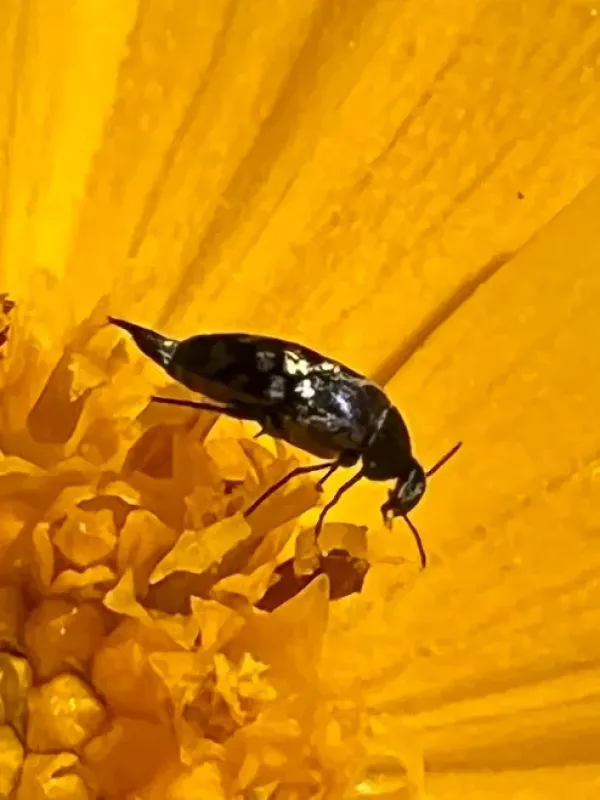
Description
How to identify
The Mordellina beetle (scientific name Mordellina) belongs to the family Mordellidae, commonly known as tumbling flower beetles, within the order Coleoptera. Adult beetles are characterized by their hunched body shape, tapering toward the posterior end, reaching a length of 3 to 6 millimeters.
The coloration of these insects varies from black to brown, often featuring a metallic sheen or fine hairs on the elytra. They possess strong hind legs, which enable them to jump abruptly when they feel threatened.
The larvae have a whitish or yellowish body, a cylindrical shape, and a well-developed head with biting mouthparts. They primarily lead a hidden lifestyle, developing inside the stems or roots of herbaceous plants.
These insects exhibit sexual dimorphism, although distinguishing males from females in field conditions is often quite difficult without specialized equipment.
In natural habitats, they are frequently found on flowering plants, feeding on pollen, but it is the larval stage that causes the most significant economic damage to crops.
What it damages
The primary crops damaged by Mordellina beetles are members of the Asteraceae family, particularly sunflowers. They can also be found on various wild weeds.
The larvae chew through the internal tissues of the stems, which disrupts the normal sap flow and nutrient transport of the plant during the growing season. This leads to a significant loss in yield and lower quality of oilseeds.
Damaged stems become brittle, causing widespread lodging of the crops during high winds, which complicates the process of mechanical harvesting.
Furthermore, the damaged plant tissues serve as entry points for secondary fungal and bacterial infections, which induce the development of stem rots.
Economic damage is determined by the insect population density per hectare; in cases of massive infestation, crop losses can reach 15-20%.
When it appears
The flight of adult beetles typically occurs in the first half of summer, coinciding with the period of active flowering for many wild and cultivated plants.
Females lay eggs directly into the stem tissues or the root zone of the host plant, selecting the most vulnerable areas to ensure immediate access to food for the emerging larvae.
The life cycle of the pest is closely linked to the phenology of agricultural crops, with overwintering usually occurring at the larval stage inside stems or in the soil.
Spring emergence of the insects begins as the soil warms up to critical temperatures, after which the larvae pupate in protected chambers.
By the end of summer, the development of the new generation is completed, and the beetles emerge to feed, mate, and search for suitable sites for egg-laying for the following season.
Signs of infestation
The first sign of the pest's presence is the appearance of small holes on the surface of the stems, through which the larvae expel their waste material (frass).
Externally, infected plants may show signs of premature wilting, leaf chlorosis, and stunted growth due to the damage to the stem's vascular system.
- Presence of holes in the stem.
- Darkening of tissues around entry points.
- Loss of turgor and wilting of the tops.
- Increased stem brittleness when tilted.
When cutting open the stem, larvae and characteristic tunnels created by them can be found inside, which confirms the infestation status of the specific field area.
In early stages, the infection can be noticed by the atypical growth lag of individual plants compared to the rest of the crop, necessitating an immediate field inspection.
Control measures
The primary method of control is the strict adherence to crop rotation, which precludes growing sunflowers on the same field for several consecutive years.
Deep autumn plowing is an important cultural practice that leads to the death of larvae overwintering in plant residues by burying them deep enough to prevent the emergence of the beetles.
Eliminating weed vegetation from the Asteraceae family around fields reduces the pest's reservoirs and prevents its migration into cultivated crops.
Chemical control using systemic insecticides is effective during the egg-laying and larval emergence periods, although it requires careful population monitoring.
The use of resistant varieties and hybrids, as well as timely harvesting followed by the shredding of stalks, significantly reduces the food supply for future generations of the pest.
Taxonomy
- Latin name
- Mordellina
- Order
- Coleoptera (beetles)
- Family
- Mordellidae
- EPPO code
- MORWSP
Discussion
No discussions yet — be the first.