
Monema
Monema
Description
How to identify
Monema belongs to the Limacodidae family, commonly known as slug moths. The caterpillars have a unique appearance, resembling small, flat slugs or leeches, which gives the family its name. Their bodies are covered in stinging hairs that cause skin irritation upon contact.
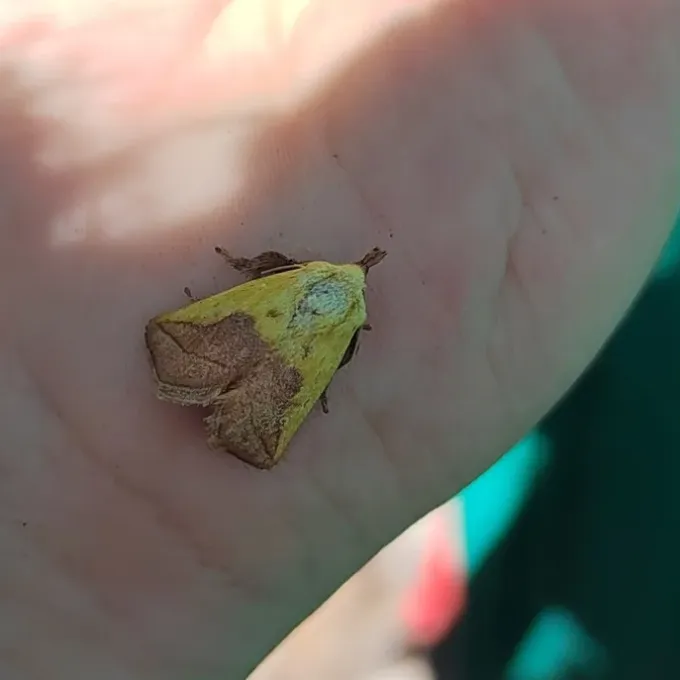
Adult moths are relatively small, with a wingspan of approximately 30–40 mm. Their coloration ranges from ochre to brown, providing excellent camouflage against the bark of trees during the day.
The larvae are characterized by the absence of visible prolegs, moving instead by using the muscular underside of their bodies. Their coloration is often vibrant, featuring contrasting stripes that serve as aposematic warning signals to potential predators.
The pest overwinters as a pupa inside a tough, spherical silk cocoon, which the caterpillar attaches firmly to twigs or bark. These cocoons are remarkably durable, allowing the insect to survive harsh winter temperatures.
The life cycle involves complete metamorphosis. Adult emergence typically occurs in early summer, followed by mating and the deposition of eggs on the foliage of host plants.
What it damages
Monema is a polyphagous pest that affects a wide variety of deciduous trees and shrubs. Both fruit-bearing orchards and ornamental plantings are at risk of infestation.
Common host plants include apple, pear, cherry, and plum trees, as well as forest species such as oak, birch, and walnut. During outbreaks, the pest can move onto young nursery saplings.
Early-instar larvae feed by skeletonizing leaves, consuming the soft tissues while leaving the major veins intact. This process significantly impairs the plant's photosynthetic capacity, leading to weakened overall vitality.
As the larvae reach later stages of development, they consume entire leaf blades, leaving behind large, ragged holes. Severe infestations can result in total defoliation, causing fruit drop and reduced harvest yields.
The damage caused by Monema leaves plants highly susceptible to secondary pathogens and further pest attacks, as the physiological stress from leaf loss compromises the tree's immune response.
When it appears
The appearance of Monema is closely linked to the climatic conditions of the spring and summer months. Caterpillar activity generally begins in late spring and continues throughout the summer.
The peak of damage occurs during July and August, when the caterpillar population reaches its maximum, and the larvae feed intensively to accumulate reserves before pupation.
First-generation moths typically emerge starting in June, depending on the geographical region. The flight period is extended, which explains why caterpillars of different developmental stages may be found on the same plant simultaneously.
Pupation occurs toward autumn as the final-instar larvae spin their protective cocoons. In this stage, the insect remains dormant through the winter, ready to emerge the following spring.
Monitoring for the pest should begin as soon as buds start to open to ensure early detection of infestation foci and to prevent rapid population spread.
Signs of infestation
The primary sign of infestation is the presence of characteristic "skeletonized" leaves, which look like a translucent mesh. This is the earliest indicator of young larvae activity.
The presence of the caterpillars themselves can be verified by inspecting the underside of leaves. Their distinct, slug-like appearance is the most reliable diagnostic feature for identification.
Hard, smooth, dome-shaped cocoons found on branches or in tree forks are strong indicators of the pest's presence, especially during the dormant winter season.
A significant amount of frass (excrement) deposited on leaves under the canopy is another indirect sign of larval activity. Larvae leave a specific dark, granular residue while feeding.
Wilting of individual branches and premature yellowing of foliage, coupled with distorted leaf blades, further confirm an intense infestation of Monema.
Control measures
Cultural control methods involve the manual collection and destruction of cocoons during winter and early spring pruning sessions to reduce the overwintering population.
The use of biological control agents, such as bacteria-based insecticides, is effective for managing younger larvae while minimizing the impact on beneficial insects and pollinators.
Chemical control is justified during severe outbreaks. Broad-spectrum insecticides registered for use on ornamental or fruit crops can be applied, strictly adhering to pre-harvest intervals.
Promoting a healthy garden ecosystem by attracting natural enemies, such as birds and predatory insects, can significantly help in keeping Monema populations below economic injury levels.
- Regularly inspect tree canopies for early signs
- Physically remove and burn infested twigs containing cocoons
- Utilize adhesive traps if necessary
- Strictly follow pesticide application labels and guidelines
Taxonomy
- Latin name
- Monema
- Order
- Lepidoptera (butterflies)
- Family
- Limacodidae
- EPPO code
- MONMSP
Discussion
No discussions yet — be the first.