

Pest · Lepidoptera (butterflies) · affects Apple, Potato, Winter wheat
Especially harmful
Leaf miner moth
Gracillariidae
Description
How to identify
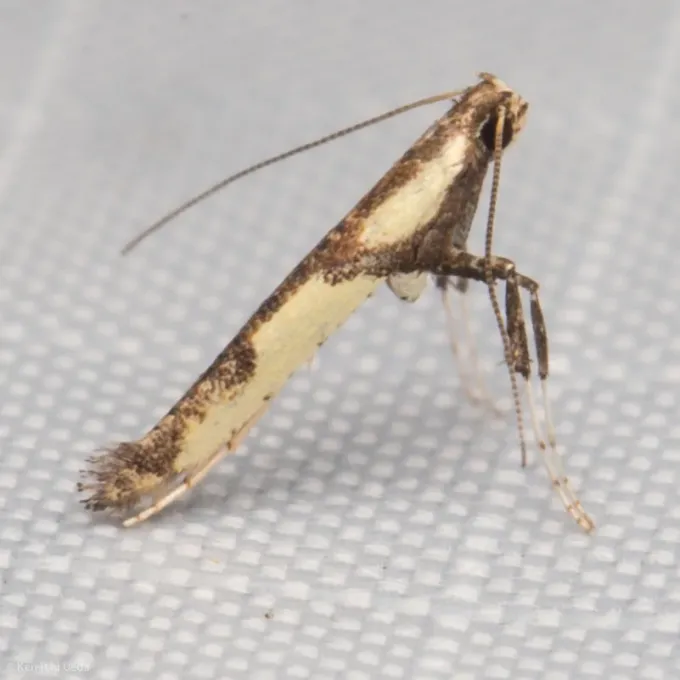
Leaf miner moths belong to the family Gracillariidae, order Lepidoptera. These are tiny moths, often with a wingspan of less than 10 mm, that are primarily active during twilight or at night.
Adult moths possess narrow wings with long fringes, often displaying camouflaged colors like gray, brown, or ochre to blend in with bark or foliage. Their lifecycle includes four stages: egg, larva, pupa, and adult.
The larvae are the primary damaging stage. They are typically flattened, which allows them to thrive inside the limited space between the leaf epidermal layers.
Depending on the species and climate, the moth can have several generations per year. Pupation usually occurs within the leaf mine, in a silk cocoon, or in crevices of bark and soil debris.
The taxonomic diversity within the Gracillariidae family is vast, with many species showing high host specificity, though some are generalists capable of attacking various commercial crops.
What it damages
The leaf miner moth is a notorious polyphagous pest capable of damaging a wide array of agricultural crops. Significant host plants include fruit trees like the domestic apple (Malus domestica).
The pest also causes economic losses in field crops such as oilseed rape, sunflower, and winter barley. Its presence can also be destructive in plantations of common hop and lucerne (alfalfa).
Vegetable and technical crops, including tobacco and fodder beet, are also frequent targets. The larvae consume the green tissue of leaves, which leads to a significant decrease in photosynthetic capacity.
In cases of severe infestation, the cumulative loss of leaf surface area can cause premature defoliation, stunted plant growth, and reduced crop yield and quality.
The damage is particularly critical during the plant's active growth stage, as the loss of leaves weakens the plant's ability to store energy for yield development.
Signs of infestation
The most distinctive sign of infestation is the appearance of "mines"—characteristic light-colored trails or blotches on leaves where the internal tissue has been consumed.
Mines often contain dark granules, which are larval frass. Depending on the species, these mines may appear as serpentine lines, blotch-like patches, or blistered areas on the leaf surface.
Affected foliage often yellows, dries out, and may eventually curl or drop. This leads to visible necrotic patches on the leaves, reducing the aesthetic and commercial value of the crop.
Upon close inspection, one may find small exit holes on the lower surface of the leaf where adult moths have emerged or where pupae were located.
Monitoring the population using pheromone traps is a key technique to detect the presence of adults before significant damage occurs to the leaf canopy.
Control measures
Integrated pest management (IPM) is essential for controlling the leaf miner moth. Cultural practices include the removal and destruction of infested plant debris, which often harbors overwintering pupae.
Deep plowing of the soil after harvest helps to bury and kill pupae overwintering in the ground or in fallen leaves, reducing the pest pressure for the following season.
Chemical control should be timed precisely. Systemic insecticides are most effective when applied during the period of egg-hatching, before the larvae successfully penetrate the leaf cuticle.
Biological control, utilizing natural enemies like parasitoid wasps (Hymenoptera), is a highly effective way to suppress populations in orchards and controlled agricultural environments.
Maintaining crop health through balanced fertilization and irrigation helps the plant withstand minor infestations and recover more effectively from pest-related stress.
In brief
15
Damages crops
Content graph
Damages crops · 15
Content graph
Connections · Leaf miner moth
Most often together:
Marketplace
Products · 57
Biology
Taxonomy
- Latin name
- Gracillariidae
- Order
- Lepidoptera (butterflies)
- Family
- Gracillariidae
- EPPO code
- 1GRACF
Community
Discussion
No discussions yet — be the first.