
Mimegralla caeruleifrons
Mimegralla caeruleifrons
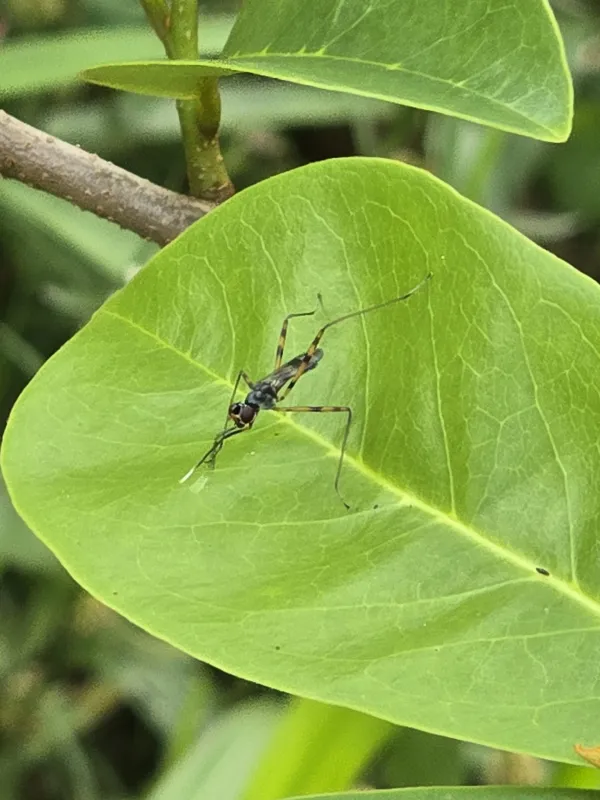
Description
How to identify
Mimegralla caeruleifrons is a species of stilt-legged fly belonging to the family Micropezidae, characterized by its remarkably long and slender legs.
The adult fly can be identified by its metallic, bluish-fronted head, which gives the species its distinctive scientific name and appearance.
The body is elongated and generally black or dark brown, with a sophisticated structure common to other members of the Micropezidae family.
The larvae are typically whitish, legless maggots that inhabit the organic environment around the root systems of host plants.
These flies are known for their specific flight patterns and behavior, often hovering around the base of plants during favorable weather conditions.
What it damages
The species is primarily recognized as a significant pest of ginger (Zingiber officinale), causing direct damage to the rhizomes.
Turmeric plantations are also frequently attacked, where the larvae tunnel into the succulent tissues of the rhizomes, leading to severe deterioration.
By consuming the internal tissues of the crop, the larvae compromise the structural integrity and nutrient storage capacity of the rootstock.
The tunnel excavations create openings for secondary pathogens, such as fungi and bacteria, which often cause rotting of the entire rhizome.
Heavy infestations lead to substantial crop losses, reduced market value of the harvested produce, and lower yield per hectare.
Signs of infestation
The primary visual sign of an infestation is the premature yellowing and wilting of leaves, which indicates that the plant's nutrient uptake is impaired.
Upon examination of the subterranean parts, growers often find small boreholes on the surface of the rhizomes made by the larvae.
Internal damage is revealed as hollowed-out channels filled with larval debris, turning the fleshy parts of the crop into a degraded mass.
The plants often show stunted growth and a general lack of vigor compared to unaffected specimens in the same field.
In advanced stages of the attack, the base of the stem becomes weak, leading to the lodging of the plant when winds or heavy rain occur.
Control measures
Effective management begins with strict crop rotation, ensuring that ginger or turmeric is not planted in the same soil for consecutive seasons.
Post-harvest hygiene is crucial; all infested crop remains must be removed and destroyed to prevent the survival of pupae in the field.
The use of soil-applied systemic insecticides at the time of planting can provide a protective barrier against larval infestation.
Improved drainage systems in the field help maintain soil conditions that are less hospitable for the moisture-loving larvae of this species.
Monitoring the population of adult flies using sticky traps during the peak activity season allows for targeted and timely insecticide applications.
Taxonomy
- Latin name
- Mimegralla caeruleifrons
- Order
- Diptera (flies)
- Family
- Micropezidae
- EPPO code
- MIMECO
Discussion
No discussions yet — be the first.