
Microtermes saltans termite
Microtermes saltans
Description
How to identify
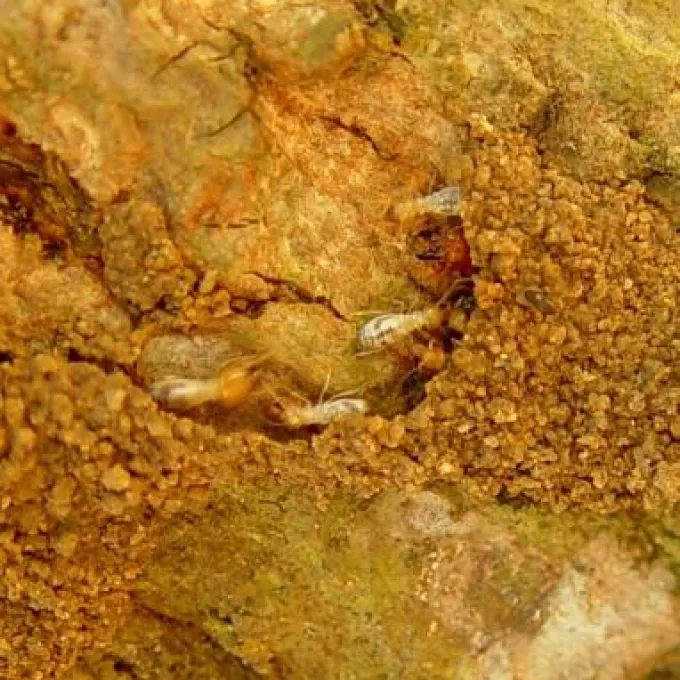
Microtermes saltans belongs to the order Isoptera and the family Termitidae. These small, cryptic insects establish complex social colonies within the soil or decaying organic matter.
The worker caste features a pale body and a chitinized, eyeless head, an adaptation to their strictly subterranean lifestyle. Soldiers are equipped with strong mandibles used to defend the colony from ants and other predators.
Reproduction is managed by a royal pair within the colony. Their nests are typically situated deep underground, providing them with significant protection against environmental fluctuations.
This species is well-adapted to arid and semi-arid climates, where it performs an ecological role in decomposition, yet acts as a major pest in agricultural environments.
Identification is challenging as they rarely surface during daylight, preferring to move through internal plant tissues or sealed earthen tubes.
What it damages
This termite species causes severe economic damage to cereal crops such as wheat, maize, millet, and sorghum, attacking both seedlings and mature plants.
Beyond cereals, the pest targets the root systems of cotton and legumes, leading to wilting and plant death due to the destruction of the vascular system.
While termites primarily consume dry cellulose (stubble), they readily switch to live plant tissue when natural food sources in the soil become scarce.
A critical issue is the damage to the root collar, which renders plants highly susceptible to secondary fungal infections and root rot pathogens.
Heavy infestations can result in yield losses ranging from 30% to 50% in regions with dry soil conditions where termite activity is intensified.
Signs of infestation
The first indicator of an infestation is sudden wilting of crops despite adequate soil moisture, which suggests significant damage to the root system.
Characteristic earthen tunnels or clay tubes can be observed on the soil surface around the plant stem, acting as protected pathways for the termites.
Examination of the roots often reveals specific grooves or the complete hollowing of the taproot, which may be packed with fecal matter and soil particles.
The internal part of the stem base is frequently hollowed out, while the outer epidermis remains intact, masking the presence of the infestation from casual observation.
Severely infested fields exhibit localized patches of stunted or lodged plants that appear to dry out unexpectedly without an obvious external cause.
Control measures
Effective management includes the use of insecticidal seed treatments, which provide a protective chemical barrier in the critical root-zone area during early growth.
Proper agronomic practice requires the immediate removal and destruction of crop residues, which otherwise serve as a primary food source for termite expansion.
Applying granular insecticides to the soil or in-furrow during planting can drastically reduce colony numbers in high-risk areas.
Implementing a strategic crop rotation system with non-host species can help disrupt the termite life cycle and reduce colony population density.
- Utilizing entomopathogenic fungi for biological suppression.
- Deep tillage to disrupt subterranean nests and foraging tunnels.
- Maintaining optimal soil moisture levels to deter foraging activity.
Taxonomy
- Latin name
- Microtermes saltans
- Family
- Termitidae
- EPPO code
- MICTSA
Discussion
No discussions yet — be the first.