
European pine sawfly
Microdiprion pallipes
Description
How to identify
The European pine sawfly (Microdiprion pallipes) belongs to the order Hymenoptera and the family Diprionidae. These insects are significant defoliators of coniferous trees in forests and nurseries.
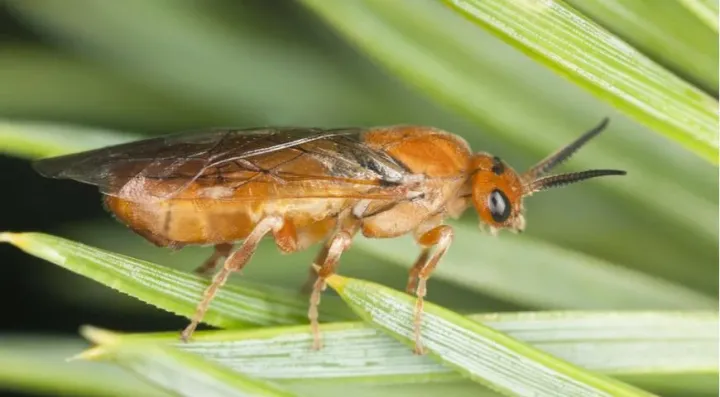
Adult insects are small, with females measuring approximately 7–9 mm in length. They display sexual dimorphism, with females having a distinct reddish-yellow coloration.
Males are generally smaller, darker in appearance, and possess feathery antennae, which help them locate females during the mating season in the spring.
The larvae are known as false caterpillars. They are grayish-green with a dark stripe along the back and a shiny black head, which makes them easily recognizable.
The life cycle typically includes one generation per year, with the insect overwintering as a prepupa inside a tough, papery cocoon in the forest litter.
What it damages
This pest primarily attacks various species of pine (Pinus). The larvae are highly voracious and feed on the needles, causing significant defoliation to the host plants.
Young larvae feed primarily on the outer tissue of the needles, while older larvae consume the entire needle, leaving only the central midrib behind.
Severe infestations can lead to the total loss of foliage, which weakens the tree's immune system and reduces its overall growth rate and timber production.
Trees that suffer repeated defoliation are highly susceptible to secondary attacks from bark beetles, wood borers, and various fungal diseases that thrive in stressed wood.
In forest nurseries and plantations, sawfly damage can lead to tree stunting or even mortality, particularly in younger specimens that lack the reserves to recover.
When it appears
Adult sawflies emerge in the spring, typically when temperatures rise consistently, which corresponds with the start of the pine growing season.
Females deposit their eggs into slits cut into the needles of the pine trees, usually targeting the previous year's growth where the needles are more mature.
Larvae typically hatch in May or June. They are gregarious feeders, often found in clusters, which allows them to strip needles from branches with remarkable speed.
The larval stage lasts for several weeks, during which they grow rapidly. As they mature, they become increasingly destructive to the host's foliage.
Once they finish feeding, the larvae descend to the ground or bark crevices to spin their cocoons and enter the pupal stage, where they stay until the next season.
Signs of infestation
The most obvious sign of an infestation is the presence of groups of larvae feeding on the foliage of pine branches, often moving in synchronization.
Affected needles appear bleached or brownish due to the feeding activity of young larvae, while older needles may be entirely consumed at the tips.
A significant accumulation of frass (larval droppings) on the ground beneath the tree or on lower branches is a strong indicator of a high population density.
Sparse, thin crowns in areas where pine needles should be lush are a clear visual signal that a defoliation event is currently occurring or has recently occurred.
Small, brown, capsule-shaped cocoons found in the soil or protected bark areas provide evidence of the presence of the sawfly in the immediate environment.
Control measures
Biological control is highly effective, utilizing virus-based sprays (specifically nuclear polyhedrosis viruses) which target the sawfly larvae while remaining safe for other species.
Chemical control involving systemic or contact insecticides is recommended only when the larval population exceeds the economic threshold to prevent major forest damage.
Manual control measures, such as removing infested branches in small nurseries or clearing ground litter, can significantly reduce overwintering success for the next year.
Promoting a healthy environment for natural predators, such as birds, parasitic wasps, and predatory beetles, helps maintain the sawfly population at a stable level.
Early monitoring using pheromone traps to catch adult males helps foresters and gardeners predict potential outbreak waves and apply timely interventions.
Taxonomy
- Latin name
- Microdiprion pallipes
- Order
- Hymenoptera
- Family
- Diprionidae
- EPPO code
- MCDIPA
Discussion
No discussions yet — be the first.