
American spider beetle
Mezium americanum
Description
How to identify
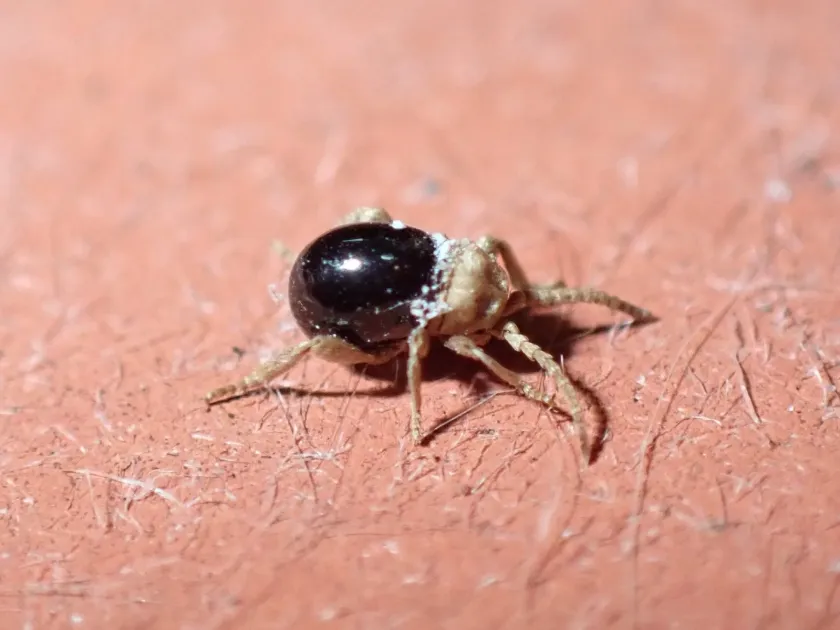
The American spider beetle (Mezium americanum) is a member of the Ptinidae family within the order Coleoptera. It is widely recognized for its striking resemblance to a small spider, featuring a globular, glossy body and long, thin legs.
Adult beetles typically measure between 2.5 and 3.5 mm in length. Their elytra (wing covers) are smooth and shiny, lacking the distinct grooves found in other related species, and are typically dark brown or nearly black.
The larvae are white and C-shaped with a distinct head capsule. They are rarely seen as they spend their entire development cycle feeding deep within the infested substrate.
The insect earns its name from its habit of "feigning death." When threatened, it folds its legs and antennae against its body, becoming completely motionless to avoid detection.
As a cosmopolitan species, it thrives in warehouses, grain stores, and even domestic environments where it can find stable temperatures and consistent food sources.
What it damages
This beetle is a generalist feeder, capable of consuming a vast array of organic materials, ranging from dry plant products to various household items.
Commonly damaged items include cereals, flour, seeds, dried fruits, and spices. In more unique scenarios, they have been known to damage museum specimens, wool, silk, and other protein-based materials.
The damage is caused by both adults and larvae feeding on the material, which creates tunnels and cavities within the food supplies, leading to significant structural degradation.
Furthermore, the pest contaminates products with frass (excrement), larval skins, and webbing, rendering the stored items completely unfit for commercial use or consumption.
Infestations often go unnoticed until the population reaches high densities, by which time a significant portion of the stored stock may already be compromised.
When it appears
In temperature-controlled storage facilities or residential buildings, the American spider beetle can breed throughout the year, provided temperatures are within their preferred range of 20–25°C.
The developmental period is highly variable and depends on environmental conditions, particularly humidity and food quality, which can accelerate the maturation of larvae.
Females deposit their eggs directly into the food source or in tiny crevices nearby, ensuring that the offspring have immediate access to nourishment upon hatching.
They are primarily nocturnal insects, displaying peak activity during the dark hours and remaining secluded in dark, undisturbed corners during the day.
Because of their secretive behavior, infestations can persist for months without detection, especially in environments where cleaning is infrequent or storage methods are inadequate.
Signs of infestation
One of the earliest indicators of an infestation is the presence of small, circular exit holes in product packaging and the accumulation of debris near storage containers.
A visual inspection of storage areas may reveal adults scurrying away when disturbed or hiding in the shadows of floor cracks and corners.
The presence of fine, silk-like webbing within grain or flour sacks is a strong indicator that larvae are preparing to pupate or have been feeding within the mass.
Infested goods often develop a musty or moldy odor, as the beetles create favorable conditions for secondary fungal growth while destroying the physical integrity of the grains.
If you see small, spider-like insects that suddenly become immobile when approached, this is a clear sign that you are dealing with a colony of these beetles.
Control measures
The foundation of effective control is stringent sanitation. Regular removal of dust, spilled grain, and other organic debris is critical to eliminating their food and shelter.
Maintaining a dry environment is essential, as these beetles thrive in humid conditions. Reducing ambient humidity can significantly lower the reproductive success of the population.
For established infestations, professional fumigation using registered products (such as phosphine-based treatments) is the most effective way to eliminate all life stages, including larvae inside the grain.
Preventative measures, such as storing goods in airtight containers, prevent initial colonization and protect stock from potential intruders.
- Regular inspection of all stored items and cleaning of warehouse shelves.
- Use of pheromone or light traps to monitor for beetle presence.
- Freezing or heat-treating infested items to kill the insects.
- Sealing cracks and crevices in storage room floors and walls to remove hiding spots.
Taxonomy
- Latin name
- Mezium americanum
- Order
- Coleoptera (beetles)
- Family
- Ptinidae
- EPPO code
- MEZIAM
Discussion
No discussions yet — be the first.