
White-marked spider beetle
Mezium affine
Description
How to identify
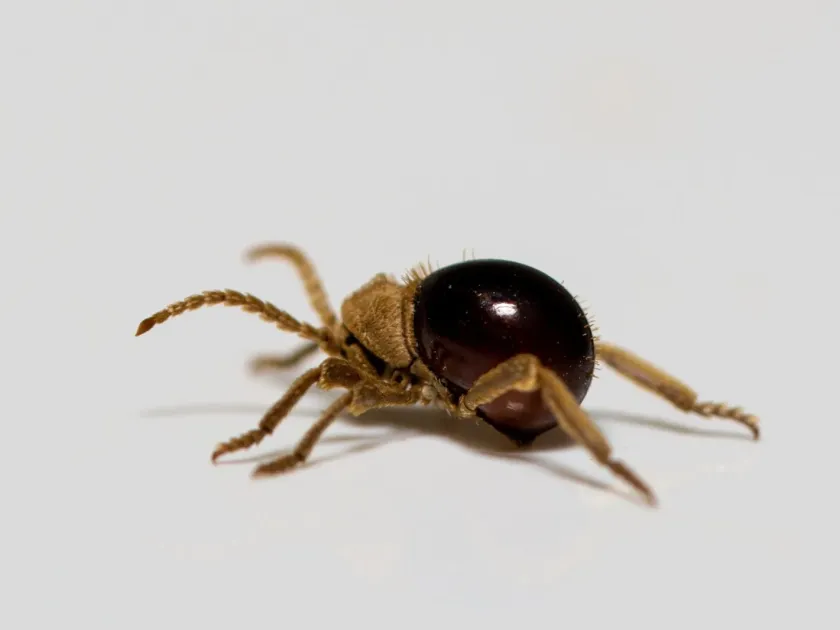
The white-marked spider beetle (Mezium affine) belongs to the Ptinidae family within the order Coleoptera. The adult insect has a characteristic globular body shape, which often leads to it being confused with small spiders.
The beetle is about 2–3.5 mm long, with a dark brown or almost black color, while the elytra are often shiny and devoid of hair. The pronotum is covered with dense, yellowish scales.
The larvae of this pest have a whitish hue, a curved body, and a well-developed head capsule. As they develop, they pass through several instars, gradually increasing in size and accumulating nutrients.
The insect is primarily nocturnal and secretive, making it difficult to detect in the early stages of infestation. Its life cycle is closely linked to anthropogenic storage conditions.
Reproduction occurs in warm environments, where the female lays eggs directly into the substrate that the larvae will feed on, providing them with immediate access to a food source.
What it damages
This pest is a polyphage that mainly damages dry products of plant and animal origin. In the agricultural sector, it poses a threat to grain elevators and food processing facilities.
Key commodities at risk include grains, flour, cereals, and seeds of various crops. The pest is capable of penetrating packaged goods, causing significant economic damage.
Larvae consume the internal parts of grains, turning them into dust, which leads to substantial loss of mass and reduced germination quality in seed materials.
In addition to cereal crops, the spider beetle can damage dried fruits, spices, cocoa products, and non-food items such as herbarium specimens or insect collections.
Damage is exacerbated by the contamination of products with excrement, larval exuviae, and silk webbing spun by larvae during pupation, rendering the entire batch unfit for use.
When it appears
The white-marked spider beetle is a typical synanthropic species whose activity depends not on natural seasons, but on the microclimate within storage facilities.
In heated warehouses, grain elevators, and storage areas, the pest can reproduce year-round if temperatures remain stable above 15–18 degrees Celsius.
The most active population development occurs during the summer or in poorly ventilated areas where substrate and ambient humidity favor larval growth.
In unheated winter storage, development slows down; however, beetles are capable of overwintering in structural crevices, feed residues, and other hard-to-reach areas.
The life cycle from egg to imago is quite long and temperature-dependent, which means new generations can appear unevenly throughout the year.
Signs of infestation
The first sign of infestation is the presence of tiny circular holes in products, left by emerging adults, or the presence of flour-like dust near grain bags.
Inspections of storage areas often reveal clusters of larval shed skins and specific silk cocoons where the pupation of the pest takes place.
A characteristic sign is the presence of adult beetles at night on walls, ceilings, or near food sources when checking storage rooms with a flashlight.
The detection of excrement in the form of small dark particles within the grain mass indicates active larval life within the commodity batch.
A reduction in grain flowability and the appearance of a characteristic musty odor in the storage area also indicate a serious level of infestation by the spider beetle.
Control measures
The foundation of protection is strict adherence to sanitary regimes: regular cleaning of facilities to remove grain residues, dust, and debris where insects may hide.
Application of disinfestation in empty warehouses using wet or aerosol treatments with registered insecticides before stocking new harvests for storage.
Ensuring optimal storage conditions: reducing grain moisture content to standard levels and regularly ventilating warehouses to create unfavorable conditions for pests.
Use of fumigation when infestation is detected in already stocked product batches, using permitted phosphine-based products under strict professional supervision.
- Sealing cracks and crevices in warehouse floors and walls.
- Regular monitoring using adhesive traps.
- Quarantine inspection of incoming stock.
- Using grain mass cooling to suppress the pest's metabolism.
Taxonomy
- Latin name
- Mezium affine
- Order
- Coleoptera (beetles)
- Family
- Ptinidae
- EPPO code
- MEZIAF
Discussion
No discussions yet — be the first.