
Mezium
Mezium
Description
How to identify
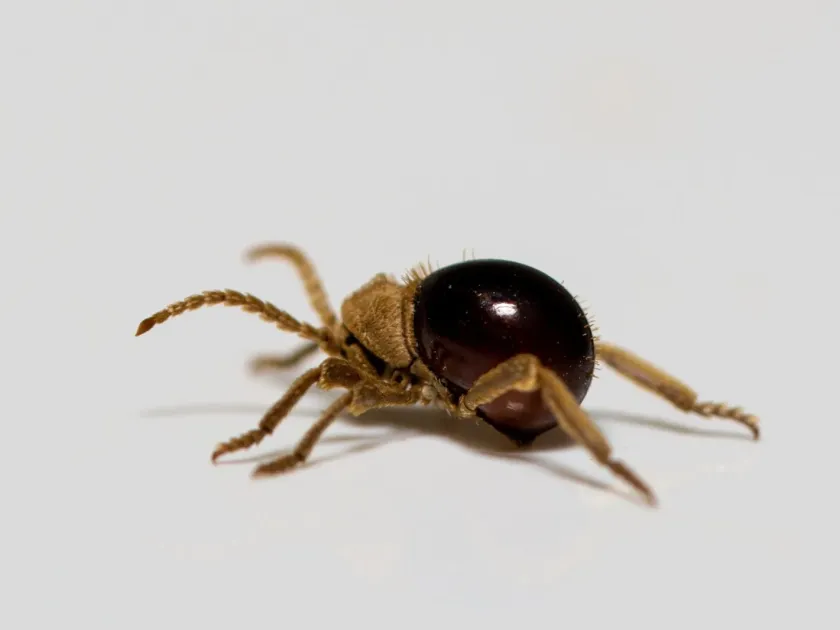
Mezium (Mezium) belongs to the spider beetle family (Ptinidae) within the order Coleoptera. These beetles have a characteristic globular body shape that resembles a spider, which often causes confusion during visual identification.
The adult insect's body is covered in dense hairs that can obscure segment outlines. The coloration varies from dark brown to almost black, with the surface of the elytra often appearing matte due to the thick pubescence.
Mezium larvae have a typical coleopteran shape: they are curved, whitish or cream-colored, with a dark head capsule and well-developed thoracic legs. They lead a secretive lifestyle inside the substrate, making them difficult to detect at early stages.
These beetles possess a high adaptability to temperature regimes, allowing them to successfully overwinter in unheated rooms. They are typical inhabitants of warehouses, barns, and residential buildings where organic residues are present.
Mezium reproduction occurs in sheltered areas such as floor cracks, behind baseboards, or inside product packaging. Females lay eggs directly into the food substrate, ensuring offspring have easy access to sustenance.
What it damages
Mezium are omnivorous stored product pests and belong to the group of polyphagous insects. They cause significant damage to dry plant and animal-derived products, lowering their commercial quality and making them unfit for use.
Primary targets for infestation include grain products: flour, cereals, animal feed, dried vegetables, and legumes. Both larvae and adult beetles cause damage by consuming the interior of the products.
In addition to plant-based food, this pest is capable of damaging animal-derived goods, including dried fish, meat, leather goods, wool, and even museum exhibits. Such versatility makes them dangerous in various storage environments.
The result of the pest's activity is the accumulation of excrement, larval skins, and exuviae, which leads to the spoilage of the entire commodity lot. Products acquire a musty odor and a specific taste that cannot be removed through processing.
The greatest economic damage is recorded in warehouses with long-term storage where regular sanitary cleaning is not performed. In these conditions, Mezium reproduces rapidly, creating constant infestation foci.
When it appears
Mezium development directly depends on ambient temperature and humidity; therefore, in heated warehouses, the pest can reproduce year-round without a distinct seasonal pattern.
Under optimal conditions (20–25 degrees Celsius), the development cycle from egg to adult takes about 3–4 months. In cold weather, metabolism slows down, and the pest enters a diapause state, waiting out unfavorable periods.
The peak of beetle activity is often observed in the spring-summer period, when rising temperatures stimulate adults to emerge from pupation sites for mating. This is when the pest spreads most intensively within premises.
High air humidity in storage areas is a favorable factor for the population, as it promotes rapid larval growth. Low humidity, conversely, inhibits the pest, although it does not eliminate the population entirely.
It is important to consider that their secretive lifestyle complicates the monitoring of seasonal activity. The use of pheromone or sticky traps is the only way to accurately determine pest numbers throughout the year.
Signs of infestation
The first sign of infestation is the presence of adult beetles on wall surfaces, floors, or near product packaging. They are particularly visible in the evening, as they exhibit crepuscular activity.
Inside sacks or boxes of products, characteristic holes gnawed by larvae are found. Upon opening infested stock, a dust-like frass consisting of pest excrement and fragments of destroyed substrate is noticeable.
Infested products often become clumpy due to particles sticking together from larval secretions. In cases of severe infestation, a heavy, characteristic odor emanates from the goods, signaling the start of organic decomposition.
Small shells left behind after larval molting can often be seen on equipment or packaging surfaces. This is a clear signal that the reproduction process is in full swing and requires immediate intervention.
Discovering pupae in web-like cocoons made of dust particles and food remnants is also reliable evidence of an active Mezium life cycle in the facility.
Control measures
The foundation of Mezium control is maintaining strict sanitation at storage sites. Regular cleaning of cracks, corners, and ventilation shafts to remove dust and spilled grain eliminates the pest's food supply.
Before storing a new batch of goods, the facility must undergo wet disinfection using approved contact insecticides. It is important to treat not only the floor but also wall surfaces.
When infestation foci are detected, warehouse fumigation must be carried out. This is the only effective method to destroy life stages hidden inside products or within hard-to-reach structural elements.
Goods should be stored in hermetic packaging to prevent beetle entry from outside. Using multi-layered bags or plastic containers significantly reduces the risk of re-infestation.
- Regular monitoring using sticky traps
- Maintaining low humidity (below 60%)
- Isolation of infested product lots
- Strict temperature control (grain cooling)
Taxonomy
- Latin name
- Mezium
- Order
- Coleoptera (beetles)
- Family
- Ptinidae
- EPPO code
- MEZISP
Discussion
No discussions yet — be the first.