
Metopoplax ditomoides bug
Metopoplax ditomoides
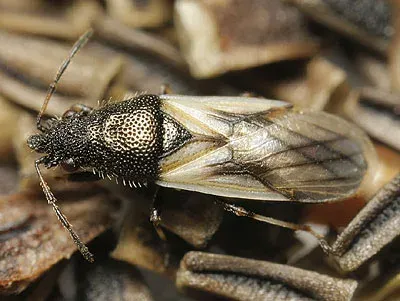
Description
How to identify
The Metopoplax ditomoides bug belongs to the family Oxycarenidae (formerly Oxycareninae within Lygaeidae), order Hemiptera. It is a small insect adapted for feeding on various plant tissues.
Adults possess an elongated body with dark or brownish coloration, which provides effective camouflage among vegetation. The head is equipped with a piercing-sucking mouthpart characteristic of the order.
Well-developed eyes allow the bug to actively move in search of food. The wings are folded flat against the body, a typical feature for this suborder of bugs.
Nymphs resemble adults but are generally smaller and lack fully developed wings, passing through several instar stages during their development.
Accurate identification of this species often requires a magnifying glass or microscope, as its morphology is similar to other members of the Oxycarenidae family common in the Palearctic region.
What it damages
This pest prefers to feed on representatives of the Asteraceae family. It causes significant damage to cereals and some industrial crops by sucking sap from vegetative and generative plant parts.
Feeding by the bug causes deformation of young shoots and hinders overall plant growth. Large populations can lead to significant yield losses due to nutrient depletion.
The damage caused by piercing the plant tissues disrupts the plant's metabolism, making it susceptible to secondary fungal and viral infections entering through the puncture sites.
Damage to seeds and inflorescences is particularly harmful, as it directly impacts the quality and quantity of the marketable agricultural product.
The pest often resides on weeds surrounding fields, which serve as reservoirs for its reproduction before migrating to crops under favorable conditions.
When it appears
The lifecycle of Metopoplax ditomoides is closely tied to local temperature conditions. Activity begins in the spring as the soil warms up and the overwintering adults emerge.
Several generations can occur during a single growing season, posing a continuous threat to crops throughout the summer months.
Peak population densities are usually observed in mid-summer when temperatures are optimal for rapid reproduction and intensive feeding.
In the autumn, as temperatures drop and day length decreases, bugs enter a state of dormancy, seeking shelter in the soil, plant debris, or under tree bark.
Population dynamics are highly dependent on weather factors, with hot and dry summers often triggering outbreaks of this pest species.
Signs of infestation
The primary sign of infestation is the observation of bugs on the undersides of leaves or within inflorescences, especially during the early morning or late evening.
Visually, damaged areas appear as yellowish or discolored spots at the puncture sites. Leaves may become curled or wither over time.
The presence of excrement on leaves and stems is another indicator of pest activity, which can be noticed during a detailed inspection of the crop field.
The premature shedding of flowers and immature seeds is a critical warning signal for agronomists, indicating a need for intervention.
A distinctive odor, typical of many bug species, can sometimes indicate a high concentration of the pest in a specific area of the field.
Control measures
Effective management begins with agrotechnical measures, such as proper soil cultivation and the elimination of weeds that serve as reservoirs around the fields.
Practicing crop rotation helps to reduce the accumulation of pests in the soil and on plant debris, simplifying control efforts for future seasons.
When the economic threshold of damage is reached, the application of systemic and contact insecticides approved for use on specific crops is recommended.
- Regular monitoring using traps and field inspections;
- Timely chemical treatment of field margins;
- Use of biological control agents where appropriate;
- Removal and destruction of plant residues after harvest.
Consistent scouting of fields during critical developmental stages, such as flowering and grain filling, allows for the timely detection of the pest and implementation of protective measures.
Taxonomy
- Latin name
- Metopoplax ditomoides
- Order
- Hemiptera (bugs, aphids, leafhoppers)
- Family
- Oxycarenidae
- EPPO code
- METXDI
Discussion
No discussions yet — be the first.