
Wheat stem fly
Meromyza saltatrix
Description
How to identify
The wheat stem fly, Meromyza saltatrix, is a small, slender dipteran insect belonging to the Chloropidae family, commonly found in cereal-growing regions.
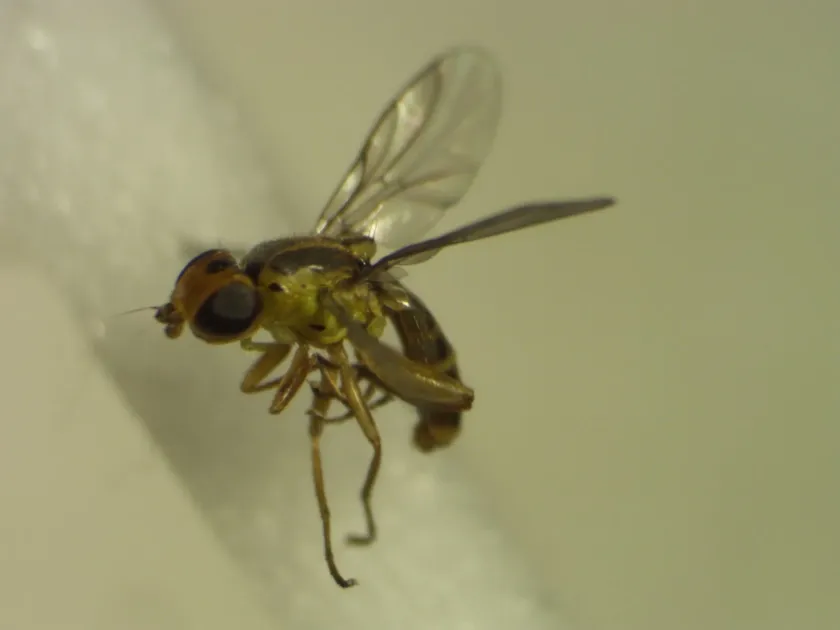
Adult flies are approximately 3 to 5 mm long. Their body color ranges from pale yellow to bright green, with three distinct dark, longitudinal stripes on the thorax.
The head is relatively large with prominent eyes. Their wings are transparent and held flat across the abdomen when the insect is at rest.
The larvae are legless, reaching up to 7 mm in length, and are usually pale white or light green, which helps them camouflage within the plant tissue.
The pupal stage occurs within a dark-colored puparium formed inside the infested plant stems, usually near the nodes.
What it damages
Wheat stem flies primarily infest wheat, barley, rye, and oats. They also utilize various wild grasses as alternative hosts throughout the growing season.
Damage is caused by larvae that feed on the internal tissues of the stem, often destroying the growing point or the base of the developing head.
This feeding activity disrupts the vascular system, preventing nutrient transport, which results in the characteristic white head symptom, often void of kernels.
Early-season infestation can kill the primary tiller, leading to significant stand thinning and forcing the plant to produce secondary tillers that may not mature in time.
Economic losses can be substantial, especially during years with warm, wet springs that favor the survival and reproductive success of the pest population.
When it appears
The insects overwinter as larvae inside the stems of winter cereals or wild grasses, surviving the winter dormancy period until spring temperatures rise.
Adult emergence typically begins in late spring. The flies are active during the day, seeking out young cereal plants to lay their eggs on the stems.
There are usually two to three generations per year. The reproductive cycle is closely synchronized with the phenological development stages of host plants.
The second generation often attacks the crop during the milk-to-dough stage of grain development, although the damage caused is typically less severe than that of the first generation.
The final generation of the year infests young autumn-sown winter crops, where the larvae feed and eventually settle in for the winter period.
Signs of infestation
The most reliable field sign is the presence of a wilted, yellowing central leaf, often called the dead-heart symptom, which is easily visible against green foliage.
As the season progresses, infected plants exhibit white, empty heads that stand out prominently against healthy, grain-filled heads in the field.
Close inspection of an infested stem reveals a small entry hole and internal tissue degradation, often accompanied by the presence of larvae or puparia.
Affected fields often show irregular growth patterns, with patches of stunted or prematurely yellowed plants appearing throughout the grain stand.
- Dead-heart symptom in young plants.
- White, sterile heads at maturity.
- Stunted plant growth.
- Larval galleries inside the stem.
Control measures
Effective management begins with cultural practices, such as choosing optimal planting dates to ensure crops grow past the susceptible stage before fly activity peaks.
Tillage practices, including the destruction of volunteer cereals and weeds, are crucial for eliminating the habitat where larvae overwinter.
Monitoring using yellow sticky traps is a recommended strategy to track adult flight activity and determine the necessity for chemical intervention.
If economic thresholds are reached, the application of systemic insecticides during the peak flight period is the most effective method for population suppression.
Crop rotation and balanced fertilization programs help ensure vigorous plant growth, which allows crops to better tolerate or recover from minor larval damage.
Taxonomy
- Latin name
- Meromyza saltatrix
- Order
- Diptera (flies)
- Family
- Chloropidae
- EPPO code
- MEROSA
Discussion
No discussions yet — be the first.