
Meromyza pratorum
Meromyza pratorum
Description
How to identify
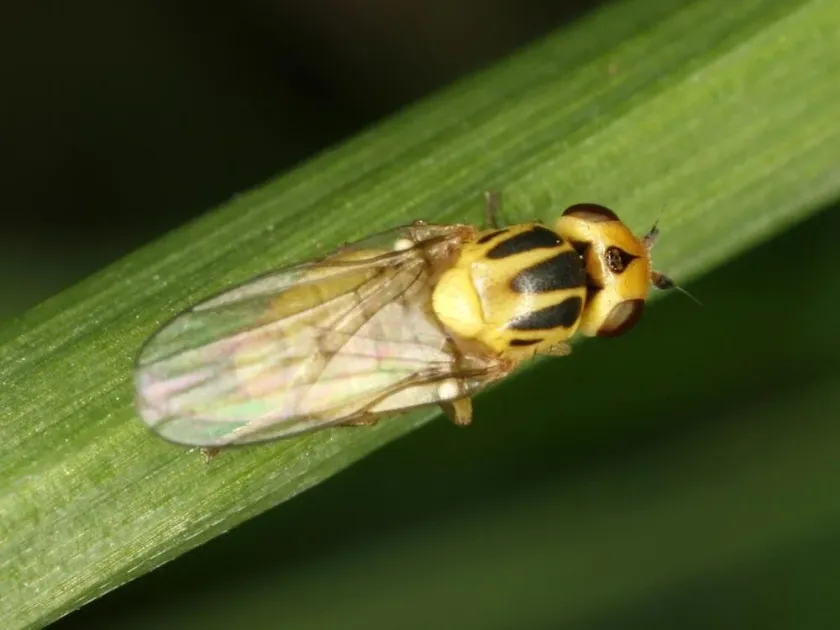
Meromyza pratorum, commonly known as a type of cereal fly, belongs to the family Chloropidae. It is a small dipteran insect, easily recognized by its distinctive bright green eyes, which is its most prominent diagnostic feature.
Adult flies measure between 4 and 5 mm in length. Their body color ranges from yellowish to light green, with three dark longitudinal stripes on the thorax and one on the abdomen. The hind femora are noticeably thickened, a key morphological trait.
The larva is spindle-shaped, legless, and can reach up to 7 mm in length. It is typically whitish or pale green, making it blend in with the inner tissues of the stem. It possesses mouth hooks for feeding on plant sap and tissues.
Eggs are small, elongated, and white with a ribbed surface. Females lay them individually on the leaves or stems of cereal crops, particularly during the tillering stage or as the stem elongates.
The species undergoes a complete metamorphosis. Depending on the geographical region and climate, it can produce between one and three generations per year, necessitating careful monitoring throughout the growing season.
What it damages
This pest primarily infests cereal crops such as wheat, barley, rye, and oats. It can also be found on various wild grasses, which often serve as primary breeding grounds before the flies migrate to cultivated fields.
Damage is caused by the larvae, which bore into the stem, feeding on the soft tissues near the growing point. This feeding disrupts the plant's vascular system, leading to nutritional deficiencies.
In the early tillering phase, larval activity causes the central leaf to wither and eventually die. This results in thinned stands and poor crop establishment, which can significantly reduce final yields.
When the stem is damaged just before heading, the result is "whitehead" or bleached ears. These ears are usually empty, sterile, or contain shriveled grains because the stem can no longer supply nutrients to the developing head.
In years with high pest pressure, Meromyza pratorum can cause substantial losses, affecting both grain quantity and quality. The impact is often more severe in late-sown crops that are still in sensitive stages during the fly's peak activity.
When it appears
The emergence of overwintering adult flies typically occurs in late spring, usually in April or May, depending on the temperature. They become active when daily temperatures reach optimal levels for reproduction.
The flies favor moderate temperatures and humid conditions for mating and egg-laying. Dry, hot weather can suppress their activity and reduce the survival rate of the first generation.
Larval development takes approximately three to four weeks, followed by pupation inside the plant stem. A new generation of flies emerges shortly after to start the next cycle.
Late summer and autumn generations infest volunteer cereals and winter crops. The larvae of these generations often enter diapause inside the stems, where they overwinter to survive the cold season.
Monitoring seasonal activity is essential. Agronomists often use sweep nets to detect the presence of adult flies in the field to determine the optimal timing for protective interventions.
Signs of infestation
The first visual sign of infestation is the yellowing and wilting of the central leaf of young tillers. If pulled gently, the damaged leaf often detaches easily from the stem.
In the field, infested areas may look uneven, with stunted or dying plants scattered throughout the stand. This is often described as "patchy" development, indicating focal infestations.
During the grain-filling stage, the appearance of bright white, empty ears against a backdrop of healthy green plants is a definitive sign of late-stage larval damage.
Inspecting the base of the stem or the node below the ear by slicing it longitudinally will reveal the larva or its feeding tunnel, confirming the presence of Meromyza pratorum.
Sweep net sampling is the standard method for detection. If the number of flies per 100 sweeps exceeds the established economic threshold, it indicates a risk that requires immediate agricultural action.
Control measures
Crop rotation is the most effective preventative measure. Avoiding the sowing of wheat or barley after other cereal crops significantly reduces the overwintering population density.
Mechanical control, such as deep plowing and early stubble cultivation, helps to destroy larvae and pupae residing in plant residues, thereby disrupting the pest's life cycle.
Optimizing sowing dates is crucial. Early sowing of spring cereals and planting winter crops within the recommended window allows plants to reach less vulnerable growth stages before the peak fly population arrives.
Chemical control using insecticides (including pyrethroids or systemic neonicotinoids) is recommended when population thresholds are exceeded. Treatment is most effective during the peak flight of adults.
Maintaining clean fields by removing wild grasses, especially couch grass, eliminates alternative hosts and prevents the build-up of the fly population surrounding the main crop fields.
Taxonomy
- Latin name
- Meromyza pratorum
- Order
- Diptera (flies)
- Family
- Chloropidae
- EPPO code
- MEROPR
Discussion
No discussions yet — be the first.