
American wheat stem maggot
Meromyza americana
Description
How to identify
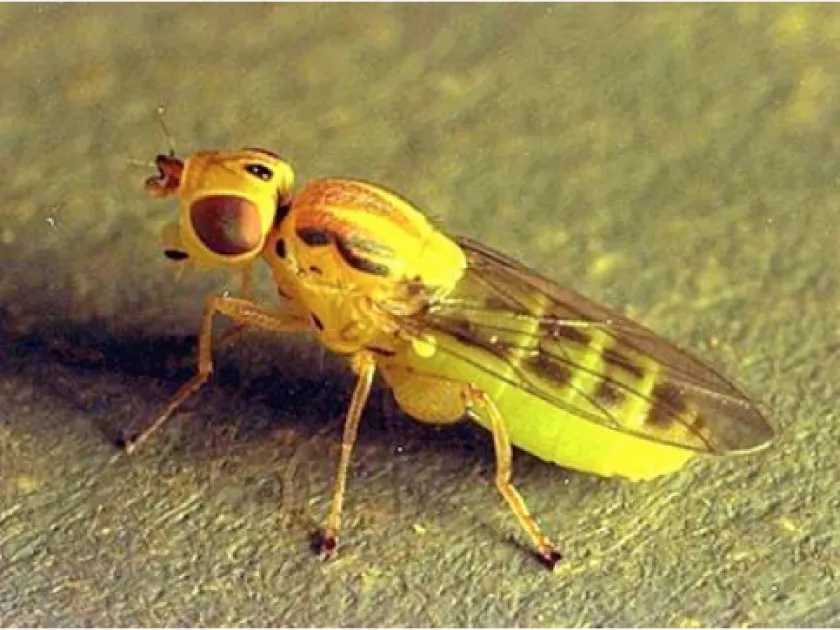
The American wheat stem maggot (Meromyza americana) is a member of the Chloropidae family, order Diptera. These small flies typically measure around 5 mm in length and are recognized by their pale green to yellowish body color.
A distinctive physical feature is the presence of three dark longitudinal stripes on the mesonotum, which helps distinguish them from other closely related species of stem-boring flies.
The larvae are pale green or yellowish, legless, and reach approximately 6–8 mm in length, featuring two dark oral hooks used to feed on the tender tissues of cereal stems.
Adult flies possess golden-green eyes and thickened hind tibiae, which are critical diagnostic characteristics observed under magnification to confirm the species identification.
They are highly active in bright, warm conditions, making them relatively easy to spot during scouting if they are present in high numbers within the wheat field canopy.
What it damages
The primary hosts for this pest include wheat, rye, barley, and oats. Larvae cause the most significant damage during the early stages of plant growth, specifically at the tillering stage.
In addition to cultivated grains, the fly thrives on various wild grasses like quackgrass, which serves as a reservoir for the pest population between crop seasons.
Larvae bore into the center of the stem near the crown or nodes, feeding on internal tissues and severing the vascular bundles, which effectively kills the central shoot.
Later in the season, damage to the developing head leads to the formation of "whiteheads," where the grain head fails to fill, resulting in significant yield losses.
Heavy infestations reduce the overall density of the stand and weaken the crop, making it more susceptible to environmental stress and secondary pathogen infections.
When it appears
The number of generations per year typically ranges from one to three, depending heavily on the geographical location and local temperature profiles throughout the growing season.
The species overwinters as mature larvae inside the stems of winter wheat or wild grasses, completing development and pupating with the arrival of spring temperatures.
Adult flies of the spring generation emerge coinciding with the tillering phase of winter cereals, allowing them to deposit eggs on the stems of young, vigorous plants.
The egg-laying period can be extended depending on weather conditions, leading to staggered larval development that requires persistent monitoring to determine the timing of protection.
Summer generations develop more rapidly, and population levels are often influenced by humidity levels and the availability of succulent host grasses during the mid-summer period.
Signs of infestation
The most reliable sign of an infestation is the yellowing and wilting of the central leaf of the plant, often referred to as "deadheart," which occurs as the primary shoot dies.
During the heading stage, the appearance of bleached, sterile heads—or whiteheads—is a clear symptom that the pest has successfully damaged the developing reproductive structures.
Careful examination of the affected stem will reveal tunnels created by the larva, along with the presence of excrement and the larva itself if the damage is recent.
Infested stems pull out easily from the sheath, and the internal damage is visible upon splitting the stem longitudinally to inspect the feeding tunnels.
- Yellowing of the central shoot leaf.
- Premature death of the central stem.
- Bleached, sterile whiteheads.
- Presence of tunnels inside the stem.
- Ease of removing the central leaf from the whorl.
Control measures
Cultural control strategies, such as crop rotation and the destruction of wild grass hosts on field margins, are the most effective ways to break the pest's lifecycle.
Deep plowing after harvest helps bury and kill larvae remaining in crop residues, thereby reducing the overwintering population for the next season.
Adjusting planting dates to ensure that young crops are not in the most susceptible growth stages during peak adult flight periods is a highly effective preventative measure.
In cases of high pest pressure, systemic insecticides can be applied; however, timing is critical to ensure coverage before the larvae bore into the stems and become protected.
Selecting resistant grain varieties provides an additional layer of protection, limiting the ability of the larvae to establish themselves and reducing the impact on final grain yield.
Taxonomy
- Latin name
- Meromyza americana
- Order
- Diptera (flies)
- Family
- Chloropidae
- EPPO code
- MEROAM
Discussion
No discussions yet — be the first.