
Violet shield bug
Menida violacea
Description
How to identify
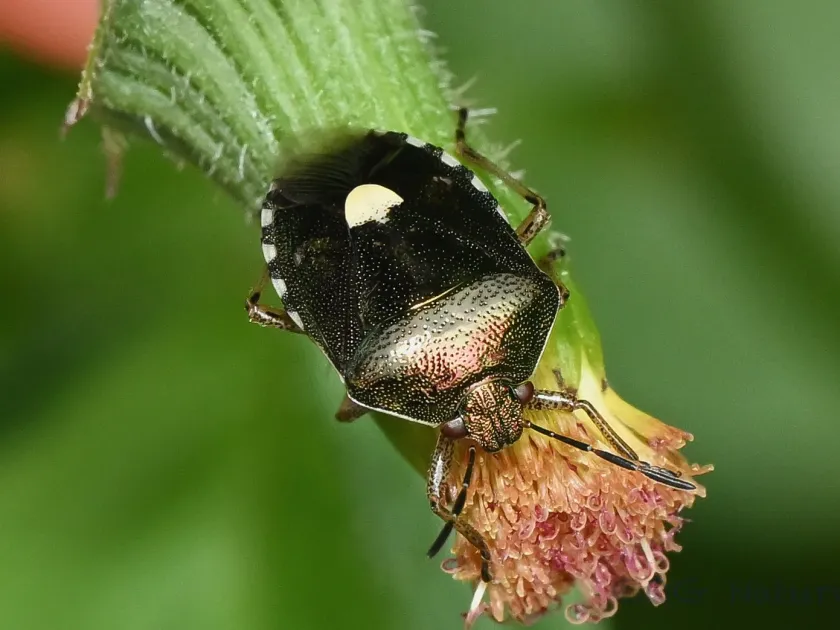
The violet shield bug (Menida violacea) is a species of stink bug belonging to the family Pentatomidae in the order Hemiptera. These insects are recognized for their distinct shield-shaped body, which is a hallmark of the family.
Adult bugs typically measure between 8 and 10 mm in length. Their coloration ranges from dark brown to a striking metallic violet or bronze-violet, which serves as a key visual identifier for field observations.
The dorsal surface of the bug is covered in fine punctures, giving it a textured appearance. The head is relatively small, equipped with five-segmented antennae that are essential for sensory functions during their search for host plants.
Nymphs of this species undergo several developmental stages, or instars. While they lack fully developed wings compared to adults, they share similar body proportions and are often found in clusters on the undersides of leaves.
These insects are well-adapted to various habitats, thriving in agricultural landscapes where they find sufficient food sources and shelter in weeds and nearby vegetation during their developmental cycle.
What it damages
As a polyphagous pest, the violet shield bug feeds on a diverse range of agricultural crops, including cereals, legumes, and various vegetables. Both nymphs and adults are responsible for crop damage.
They utilize their piercing-sucking mouthparts to penetrate plant tissues. By injecting saliva containing digestive enzymes, they soften the plant matter, allowing them to extract essential nutrients and sap from stems, leaves, and fruits.
Feeding activities often result in localized lesions, chlorosis, and the distortion of developing plant organs. Such damage can lead to significantly reduced growth rates and compromised plant health.
The most severe damage occurs when these bugs attack reproductive structures. Infestations during the flowering or seed-filling stage often lead to abscission or the development of shriveled seeds, which drastically lowers overall crop yield.
Furthermore, the physical damage created by the bugs' feeding provides an entry point for secondary bacterial and fungal pathogens, which can lead to further tissue decay and crop losses.
When it appears
Adult violet shield bugs overwinter in protected environments, such as leaf litter, under bark, or within dense vegetation. They rely on these spots to survive cold winter temperatures.
As temperatures rise in the spring, typically reaching 10–12°C, the bugs emerge from hibernation. Their first point of contact is usually wild weeds, where they feed and prepare for the reproductive season.
The migration into agricultural fields occurs as crops reach the vegetative growth stage. During this period, the adults mate, and females lay clusters of eggs on the undersides of host leaves.
The lifecycle, including egg incubation and nymphal development, is heavily influenced by ambient temperature and humidity levels. Under optimal conditions, they can complete their development relatively quickly.
As autumn approaches and temperatures drop, the bugs begin to retreat toward their overwintering sites. This migratory behavior is critical for the survival of the population and ensures the cycle repeats the following year.
Signs of infestation
Identifying an infestation early is vital. Signs of activity are often localized, but careful scouting of fields can reveal the presence of the bugs and the subsequent damage to plant tissues.
- Presence of tiny necrotic spots or light-colored punctures on leaves.
- Wilting or yellowing of foliage in specific parts of the field.
- Deformed fruits or undeveloped seed heads on grain crops.
- Egg clusters found on the underside of plant leaves.
- Adult bugs visible on the stems or seed-bearing parts of the crop.
Control measures
Agricultural management should prioritize cultural practices, including the elimination of weeds in field margins, which reduces the early-season food sources available to the bugs.
Crop rotation and spatial separation from known host habitats are essential components of an Integrated Pest Management (IPM) strategy to minimize the spread of the population.
When the population density exceeds economic damage thresholds, chemical control using systemic or contact insecticides may be necessary to protect the harvest.
Biological control remains a sustainable option. Encouraging natural enemies, such as egg parasitoids belonging to the Scelionidae family, can help regulate bug numbers naturally without excessive chemical intervention.
Regular field monitoring using visual inspection or sweep-net sampling allows agronomists to determine the exact timing for control measures, ensuring high efficacy and minimal environmental impact.
Taxonomy
- Latin name
- Menida violacea
- Order
- Hemiptera (bugs, aphids, leafhoppers)
- Family
- Pentatomidae
- EPPO code
- MENIVI
Discussion
No discussions yet — be the first.