
Rocky Mountain locust
Melanoplus spretus
Description
How to identify
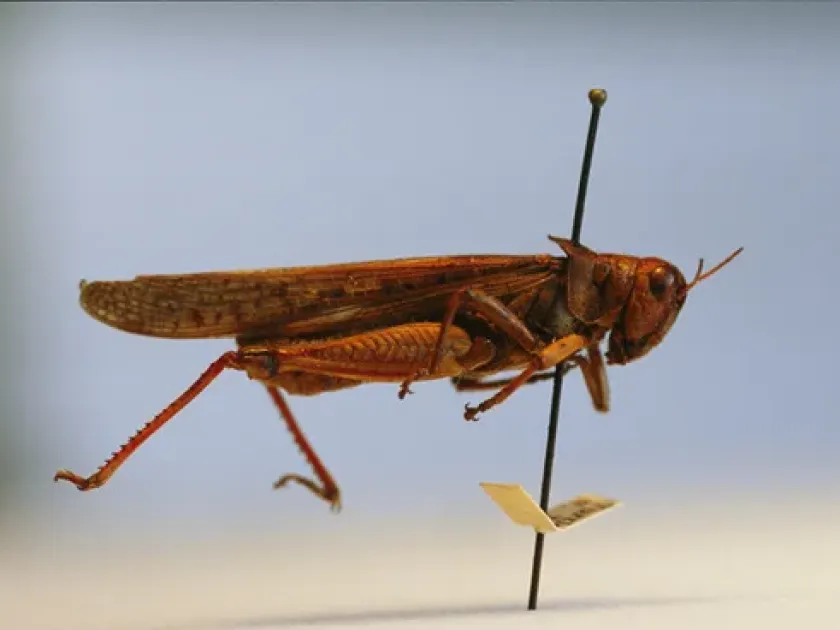
The Rocky Mountain locust (Melanoplus spretus) was a species of short-horned grasshopper that was native to the western United States and Canada. As a member of the Acrididae family, it was biologically adapted to form massive, migratory swarms that were infamous for their destructive behavior.
Adults were characterized by their ability to undertake long-distance flights, which allowed them to move across the continent searching for fresh vegetation. They were structurally similar to other Melanoplus species, featuring strong mandibles for chewing and specialized appendages for laying eggs in hard, undisturbed soil.
The life cycle consisted of a classic egg-to-adult progression, with nymphs emerging in the spring. During the outbreak years, the population density would trigger a phase change, resulting in highly mobile swarms that were nearly impossible to halt with the technology of the 19th century.
Morphologically, these insects were resilient to harsh climatic conditions, which allowed them to thrive in the prairie ecosystems. Their success was tied to their ability to endure temperature fluctuations during the embryonic development stage in the ground.
The species was declared extinct in the early 20th century. The last significant sighting occurred in 1902, and since then, entomologists have relied on historical records and museum specimens to study this remarkable yet devastating insect species.
What it damages
The Rocky Mountain locust was known as the most destructive agricultural pest in North American history. Its swarms were so large that they were estimated to contain trillions of individuals, capable of consuming all green vegetation in their flight path within a very short timeframe.
Primary crops affected included wheat, oats, barley, and corn. Because the swarms moved as a collective unit, they could strip a farm of its entire crop production in minutes, leaving producers with zero yield and causing severe economic distress to frontier communities.
The damage was not limited to grains; the locusts consumed fruit trees, shrubs, and even the wool off grazing sheep. In extreme cases, they reportedly chewed on wooden fence posts and leather equipment, indicating their desperate level of hunger during major migrations.
Economic damage was calculated in millions of dollars, affecting the expansion and settlement of the American West. The frequent loss of crops led to periods of famine, forcing many families to abandon their homesteads and migrate to other regions.
The physical destruction left the land barren, as the insects removed all organic cover. This led to severe soil erosion and negative ecological impacts in the regions where they laid their eggs, further complicating the recovery of the agricultural sector following an outbreak.
Control measures
Traditional methods of control were primitive and largely ineffective during the peak years of the locust swarms. Farmers utilized methods such as digging deep trenches to trap nymphs, or using mechanical "hopperdozers" — large pans filled with kerosene dragged across fields to kill insects on contact.
Small-scale efforts, such as flooding fields or burning vegetation where eggs were laid, provided limited relief but could not scale to the massive swarms. The lack of standardized pest management meant that communities were largely at the mercy of the insect migrations.
Ultimately, the eradication of the species was not the result of human-engineered pesticides but rather the result of intensive farming practices. The plowing of the Great Plains destroyed the egg-laying grounds, which were vital for the completion of the locust's lifecycle.
Modern pest management practices now utilize predictive modeling and early warning systems to detect locust outbreaks. By monitoring weather patterns and soil conditions, contemporary agricultural experts can prevent the formation of swarms before they reach the migratory phase.
Today, integrated pest management (IPM) serves as the primary defense against locust species worldwide. These systems emphasize the use of biological controls and selective insecticides, ensuring that agriculture remains resilient against the threats posed by highly mobile, swarm-forming insects.
Taxonomy
- Latin name
- Melanoplus spretus
- Order
- Orthoptera (locusts)
- Family
- Acrididae
- EPPO code
- MENPSR
Discussion
No discussions yet — be the first.