
Migratory grasshopper
Melanoplus sanguinipes
Description
How to identify
The migratory grasshopper (Melanoplus sanguinipes) is a widely distributed orthopteran pest belonging to the Acrididae family, known for its significant impact on crops.
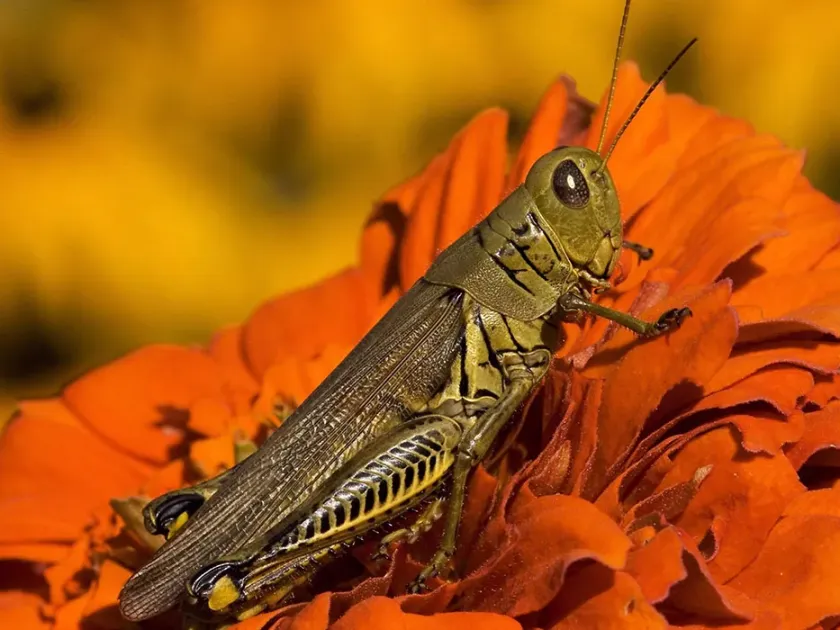
Adult grasshoppers typically measure between 20 and 30 mm in length and exhibit variable coloration, ranging from light gray to reddish-brown.
The species is named for the characteristic reddish-orange tint of the inner surface of its hind legs, which serves as a key diagnostic feature for field identification.
These insects are highly mobile, equipped with powerful jumping hind legs and functional wings that allow them to fly long distances in search of suitable food sources.
Females are biologically adapted to deposit egg pods deep into the soil, which protects the developing embryos from desiccation and extreme temperature fluctuations.
What it damages
As a generalist herbivore, the migratory grasshopper feeds on a vast array of plant species, causing severe economic damage in many agricultural regions.
Primary target crops include various small grains like wheat, barley, and oats, as well as several row crops such as corn, alfalfa, and soybeans.
Vegetable gardens and orchards are also susceptible, as grasshoppers can rapidly strip leaves, stems, and fruits, leading to partial or total crop loss.
Pastures and rangelands often suffer from heavy grazing, which reduces the availability of forage for livestock and degrades the overall quality of grassland.
Feeding damage is particularly critical during the seedling stage, where the loss of foliage can lead to immediate plant death and reduced stand density.
When it appears
The species completes its life cycle in one generation per year in most regions, with the winter being passed in the egg stage deep within the soil.
Hatching occurs in the spring, triggered by rising soil temperatures, and the emerging nymphs begin feeding immediately on the nearest available vegetation.
The insect undergoes several nymphal instars, where it grows in size and gradually develops wings, transitioning into the mobile adult form by early summer.
Adult activity peaks during the hot summer months, during which individuals mate and females lay egg pods for the next season's population.
Environmental conditions, such as warm and dry springs, play a significant role in accelerating development and potentially leading to larger population outbreaks.
Signs of infestation
Initial signs of infestation typically appear as irregular, ragged holes in leaf blades, which may progress to complete leaf tissue removal if populations are dense.
The presence of large numbers of grasshoppers on field margins or disturbed soil areas is a clear indicator that an infestation is developing within the crop.
In cereal fields, signs include damaged florets, chewed stem tissue, and visible signs of defoliation that impact the plant's overall photosynthetic capacity.
Accumulation of fecal pellets on the ground and plant surfaces is another visible symptom, providing evidence of high feeding activity by nymphal or adult stages.
Significant decline in plant stand uniformity and localized patches of stunted growth often follow heavy feeding sessions by these insects during their peak season.
Control measures
Cultural control practices, such as intensive tillage of egg-laying sites in the fall, can help reduce the population by destroying egg pods buried in the soil.
Maintaining clean field borders and managing weed populations effectively can deny the grasshoppers the initial food resources they need to thrive early in the season.
Chemical control using registered insecticides is often necessary when field scouting indicates that populations have exceeded established economic injury thresholds.
Biological control efforts, including the use of fungal pathogens like Beauveria bassiana, offer a sustainable alternative for managing populations in certain environments.
Integrated Pest Management (IPM) programs rely on regular monitoring and timely intervention to prevent the grasshoppers from reaching damaging densities in crop fields.
Taxonomy
- Latin name
- Melanoplus sanguinipes
- Order
- Orthoptera (locusts)
- Family
- Acrididae
- EPPO code
- MENPSA
Discussion
No discussions yet — be the first.