
Nevada sage grasshopper
Melanoplus rugglesi
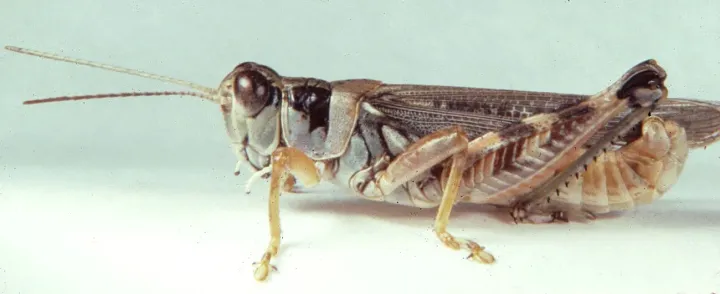
Description
How to identify
The Nevada sage grasshopper (Melanoplus rugglesi) is a member of the family Acrididae within the order Orthoptera. This species is notable for its potential to form swarming populations, which are highly destructive to agricultural environments.
Adults exhibit color variations from olive green to brownish, providing excellent camouflage within dry brush and grasses. During swarm phases, they demonstrate heightened activity and a strong propensity for group movement across landscapes.
The life cycle encompasses egg, nymph, and adult stages. Eggs are deposited in the soil and are highly resistant to environmental stressors, allowing them to overwinter successfully and emerge in sync with early spring vegetation.
Nymphal development follows several instars, with each stage showing increased voracity. As they mature, their wings develop, transitioning them from localized ground feeders to highly mobile swarms capable of rapid migration.
Environmental conditions play a crucial role in population spikes. Warm, dry weather coupled with moderate spring moisture provides the ideal conditions for successful hatching and early survival of nymphs.
What it damages
As a polyphagous insect, this species feeds on a wide range of crops, including small grains, alfalfa, and various forage grasses. Both nymphs and adults possess powerful mandibles that can defoliate entire fields in a short timeframe.
The most severe damage occurs when swarms migrate into productive croplands. They consume everything from leaf blades to stems, often stripping plants down to the root crown, leading to complete crop failure.
Pasture and rangeland areas are particularly vulnerable to these grasshoppers. Excessive grazing by swarms depletes forage availability for livestock and can cause long-term degradation of the grassland ecosystem.
The economic impact is significant due to the sheer number of insects involved in a single swarm. Their ability to move rapidly allows them to exploit new food sources as previous patches become exhausted.
Beyond total consumption, contaminated forage with grasshopper droppings may become unpalatable or unsafe for livestock, potentially leading to further financial losses for farmers during infestation periods.
Signs of infestation
Early identification of an infestation starts with spotting small, active nymphs along field margins or in weed-heavy areas near known egg-laying sites. They often gather in high-density patches during the early morning.
Visible feeding damage, such as large, irregular holes in leaves or shredded plant margins, is a key indicator. In advanced infestations, large areas of the field will appear ragged or completely bare.
The presence of large amounts of frass (droppings) underneath plants is a clear sign that a significant population of grasshoppers has been feeding in that specific area for an extended period.
Swarming behavior is highly noticeable as groups move across the landscape. The sound of thousands of mandibles and legs moving through the vegetation is audible, signaling a major infestation in progress.
An influx of predators, such as birds or predatory insects, in specific sections of the field is often a secondary indicator that a dense concentration of grasshoppers has been established.
Control measures
Effective management begins with scouting and egg-bed mapping. Deep tilling of soil in the fall or early spring can significantly reduce the viability of eggs by exposing them to desiccation and natural predators.
Chemical control is most effective when applied early, targeting the nymphal stages before they develop wings. Contact insecticides are usually applied as barrier sprays or to spot-treat infested breeding sites.
Biological control, such as the use of Nosema locustae or entomopathogenic fungi, offers a more targeted approach, helping to suppress populations while being safer for non-target species in sensitive habitats.
Cultural control involves managing field edges by removing host weeds and maintaining healthy plant competition. This makes the environment less attractive for oviposition and early nymph development.
- Monitor hatching sites regularly to determine the timing of insecticide applications.
- Utilize baits and attractants to concentrate populations for more efficient management.
- Coordinate regional control efforts with local agricultural agencies to prevent swarm migration.
Taxonomy
- Latin name
- Melanoplus rugglesi
- Order
- Orthoptera (locusts)
- Family
- Acrididae
- EPPO code
- MENPRU
Discussion
No discussions yet — be the first.