
Migratory grasshopper
Melanoplus mexicanus
Description
How to identify
The Migratory grasshopper (Melanoplus mexicanus) is a significant agricultural pest belonging to the order Orthoptera and the family Acrididae.
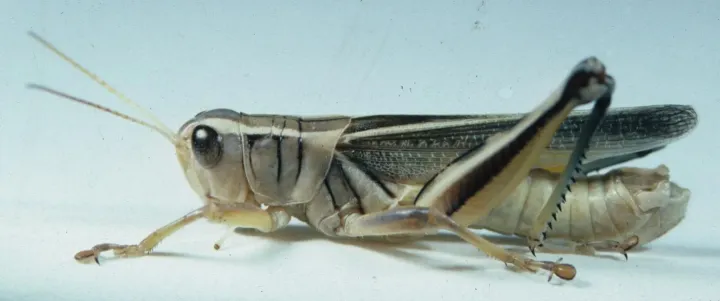
Adults typically measure between 25 and 30 mm in length and display a coloration ranging from greyish-brown to yellow, often with dark patterns on their bodies.
A key physical characteristic is their long, well-developed wings, which extend well beyond the tip of the abdomen, facilitating their migratory behavior.
Eggs are deposited in clusters inside soil pods, specifically in areas with sparse vegetation, making early detection a significant challenge for farmers.
Nymphs undergo several molting stages, gradually increasing in size and mobility until they reach the adult stage, at which point they become highly destructive.
What it damages
This species is a generalist feeder that impacts a vast array of crops, including wheat, corn, barley, oats, and various vegetable species.
The grasshoppers consume leaves, stems, and reproductive parts of plants, which, during outbreaks, can lead to total crop failure and severe economic losses.
In addition to cereal grains, they cause significant damage to alfalfa fields and rangelands, reducing the quality and availability of forage for livestock.
During extreme drought conditions, these pests often swarm from depleted rangelands into irrigated fields, causing rapid devastation to healthy plants.
The wounds inflicted by the grasshoppers also serve as entry points for various bacterial and fungal pathogens, further weakening the plant's health.
When it appears
The species generally completes one generation per year, overwintering as eggs encased in protective soil pods buried a few centimeters underground.
Hatching typically occurs in the spring when soil temperatures rise, coinciding with the early growth stages of most major field crops.
Nymphal development takes several weeks, during which the insects are highly localized but eat voraciously, gradually preparing for the adult stage.
Adult activity peaks during the warm summer months, when they are capable of long-distance flights and intense reproductive behavior.
As autumn temperatures drop, the adult population dies off, leaving the next generation as eggs in the soil to restart the cycle the following year.
Signs of infestation
Early symptoms of infestation include ragged leaf edges and small holes in plant foliage, indicating the presence of early-stage nymphs.
Massive infestations are marked by the complete stripping of foliage and stems, leaving only the vascular structure of the plant visible in the field.
Clusters of nymphs are often observed in sunny areas, field margins, or roadside verges during the morning hours as they bask to regulate body temperature.
The presence of frass (small dark droppings) scattered on the soil surface or beneath plants is a clear indicator of localized feeding activity.
Visible flushing or the sudden movement of swarms when walking through a field is a definitive sign of high population density in the area.
Control measures
Tillage operations, particularly deep plowing in late autumn, are highly effective in destroying egg pods by exposing them to desiccation and frost.
Controlling weeds and maintaining clean field margins reduces the suitability of the landscape for egg-laying, limiting the next season's population.
Chemical control involving the timely application of insecticides is most effective when targeted at the nymphal stages before the insects develop wings.
Regular monitoring using sweep nets or density counting allows farmers to determine the economic injury level and apply targeted pest management.
Biological control agents, including entomopathogenic fungi like Beauveria bassiana, offer a promising and sustainable method for managing grasshopper outbreaks.
Taxonomy
- Latin name
- Melanoplus mexicanus
- Order
- Orthoptera (locusts)
- Family
- Acrididae
- EPPO code
- MENPME
Discussion
No discussions yet — be the first.