
Melanoplus infantilis
Melanoplus infantilis
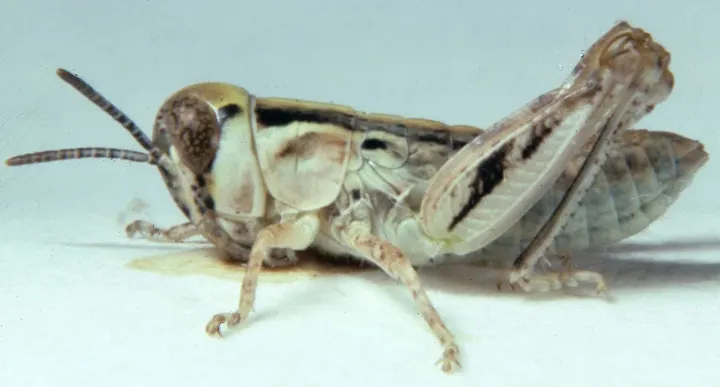
Description
How to identify
Melanoplus infantilis is a species of short-horned grasshopper belonging to the family Acrididae, subfamily Melanoplinae.
The adult insect exhibits a typical appearance for the Melanoplus genus, characterized by a relatively small body size and specific coloration that provides effective camouflage in grassland habitats.
A key identification feature of this species is the structure of the male genitalia and a distinct color pattern on the hind femora, which helps entomologists accurately distinguish it from similar species.
Like most members of the genus, this pest possesses strong, muscular hind legs adapted for jumping across significant distances.
The insect prefers open areas, including dry prairies, pastures, and field edges, where it finds optimal conditions for feeding and reproduction.
What it damages
This grasshopper species is polyphagous, meaning it has the capability to feed on a wide variety of cultivated and wild plant species.
It causes significant damage to cereal crops, including wheat, barley, and oats, as well as various forage grasses grown for hay and grazing.
During outbreaks, these insects can migrate to vegetable crops and young seedlings of technical plants, causing substantial losses in agricultural production.
Both nymphs and adults contribute to crop damage, displaying high feeding intensity throughout the warm summer months.
Severe infestations reduce the photosynthetic capacity of plants, which leads to significant yield losses and lower quality of green forage.
When it appears
The life cycle of Melanoplus infantilis is closely tied to seasonal temperature fluctuations and moisture levels in its habitat.
The pest overwinters primarily in the egg stage, with females laying eggs in the soil in late summer or early autumn.
Nymph emergence occurs in the spring as the soil warms up, often coinciding with the early growth stages of spring cereals.
Development proceeds through several molting stages, and by mid-summer, the population reaches the adult stage, which is the most active feeding phase.
Typically, only one generation is produced per season, though population density is heavily influenced by the weather conditions of the previous year.
Signs of infestation
The primary sign of infestation is the appearance of ragged notches on the edges of leaf blades, which is characteristic of grasshopper feeding.
When infestation levels are high, bare patches in fields and mass movement of insects during field operations become noticeable.
On sunny days, adults can be easily detected by their distinct jumping behavior and the sound of stridulation, which increases in intensity during midday.
Frass (insect excrement) on the leaf surface is a secondary sign confirming active feeding by the pest population.
Field margins often show the highest concentrations, indicating that the grasshoppers migrate from adjacent uncultivated lands into the crops.
Control measures
The primary control method is cultural, involving timely soil tillage to disrupt and destroy grasshopper egg beds.
Deep plowing of fallow land and field borders, where insects prefer to lay eggs, is an effective strategy for reducing future populations.
When the economic threshold of damage is reached, broad-spectrum chemical insecticides are applied, targeting younger nymph stages.
Biological control measures focus on preserving populations of natural predators, such as birds and predaceous insects, which help limit grasshopper expansion.
- Regular monitoring of insect density using an entomological net.
- Rigorous weed management on field edges to reduce food sources.
- Barrier spraying of field perimeters to prevent migration into the crop.
Taxonomy
- Latin name
- Melanoplus infantilis
- Order
- Orthoptera (locusts)
- Family
- Acrididae
- EPPO code
- MENPIN
Discussion
No discussions yet — be the first.