
Red-legged grasshopper
Melanoplus femurrubrum
Description
How to identify
The red-legged grasshopper (Melanoplus femurrubrum) is a common pest species belonging to the family Acrididae, widely distributed across North America.
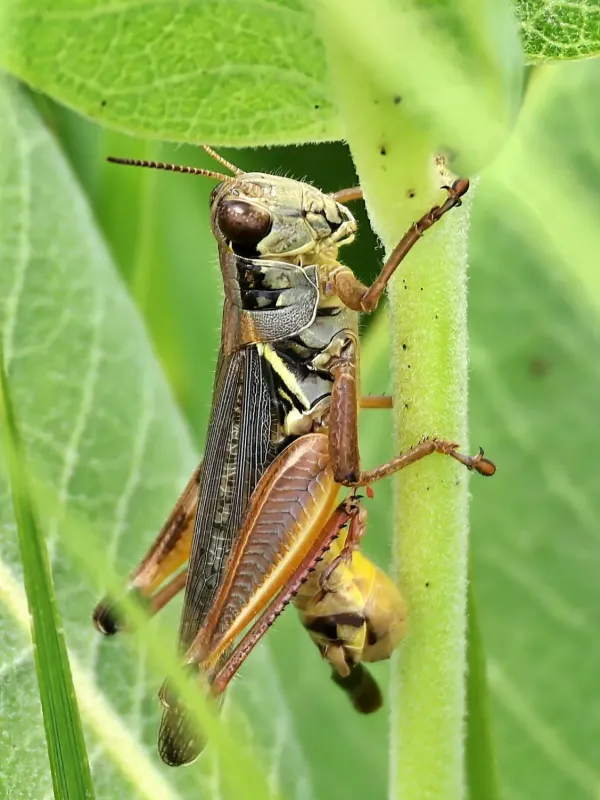
Adult insects typically measure between 20 to 25 mm in length, with females being generally larger than males, which is a standard trait for the genus.
The most distinctive morphological feature is the bright red or reddish-pink color of the hind tibiae, which provides the common name for this insect.
Their body coloration usually ranges from olive-green to tan or brown, providing effective camouflage against various plant backgrounds and soil textures.
The wings are well-developed and extend slightly beyond the tip of the abdomen, enabling these grasshoppers to migrate across fields in search of food.
What it damages
As a polyphagous species, the red-legged grasshopper feeds on a vast array of plant species, including various economic crops and wild weeds.
They cause significant damage to small grains such as wheat, oats, and barley, as well as row crops like corn, soybean, and alfalfa.
Vegetable crops, including beans, beets, and potatoes, are also susceptible to severe feeding damage, which can lead to yield losses and reduced crop quality.
Nymphs begin feeding immediately after hatching, often destroying seedling stands and necessitating costly replanting in heavily infested areas.
In cases of high infestation, these insects can strip entire plants of their foliage, leaving only stems and major veins, which inhibits proper plant development.
When it appears
The life cycle of this species includes overwintering in the egg stage, with eggs deposited in the soil by females during late summer and autumn.
Hatching typically occurs in late spring or early summer, depending on soil temperatures, which triggers the onset of feeding by the first-instar nymphs.
The development through five nymphal stages takes approximately several weeks, leading to the emergence of flight-capable adults by mid-summer.
Adults remain active throughout the remainder of the summer and early fall, engaging in intensive feeding and reproductive activities across the fields.
There is typically one generation per year, although the exact timing of the life cycle can fluctuate slightly based on regional weather patterns and seasonal heat.
Signs of infestation
Evidence of infestation is usually detected by observing notched or ragged edges on the leaves, which are characteristic of grasshopper feeding patterns.
Upon entering the field, one will notice adults jumping or flying away in large numbers when disturbed, signaling a high population density.
Patches of barren or severely defoliated areas in a field often indicate established colonies that have concentrated their feeding efforts in specific zones.
Damage to the reproductive structures of crops, such as the heads of small grains or silks of corn, represents the most economically critical sign of damage.
Visible presence of fecal pellets on leaves and stems serves as an additional diagnostic sign of localized high populations feeding within the crop canopy.
Control measures
Cultural control practices, such as tillage after the egg-laying season, can help destroy egg pods in the soil, reducing the population for the next year.
Managing weed growth along field borders, ditches, and fencerows is crucial, as these areas serve as primary nesting and early-stage feeding sites.
Chemical control should be targeted at the nymphal stages, as younger insects are more susceptible to insecticides and lack the mobility of adults.
Regular field scouting is essential to identify hotspots, allowing for spot-treatment strategies rather than applying chemicals across the entire field.
- Monitor population levels using sweep net sampling.
- Apply contact insecticides when nymphs are in early development stages.
- Maintain field edges free of excessive vegetation to reduce harborages.
- Encourage natural predators like birds and spiders to help suppress numbers.
Taxonomy
- Latin name
- Melanoplus femurrubrum
- Order
- Orthoptera (locusts)
- Family
- Acrididae
- EPPO code
- MENPFE
Discussion
No discussions yet — be the first.