
Differential grasshopper
Melanoplus differentialis
Description
How to identify
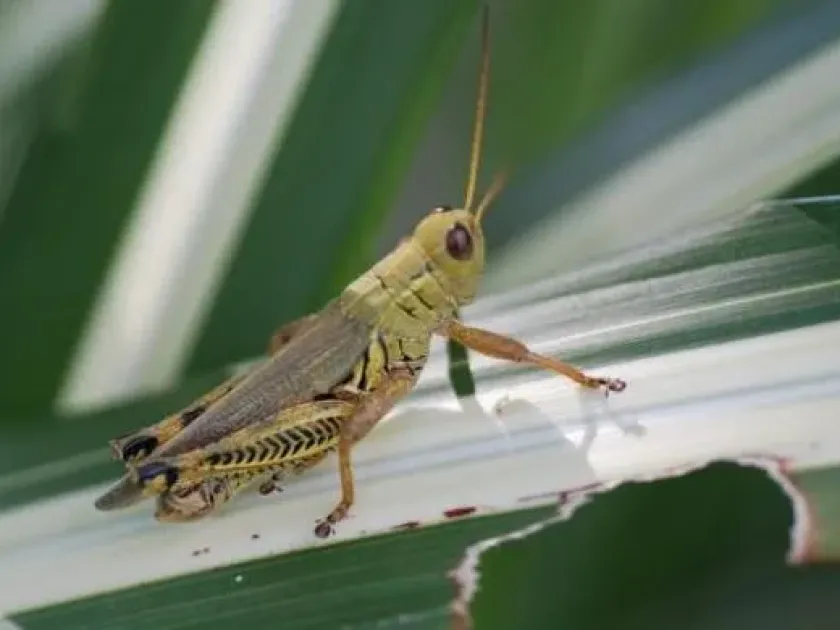
The differential grasshopper (Melanoplus differentialis) belongs to the order Orthoptera and the family Acrididae. It is a large insect, with adult body lengths often reaching 40 millimeters.
The coloration of adults typically ranges from olive-yellow to brown. A diagnostic feature of this species is the presence of distinctive black chevron-like markings on the hind femurs.
Nymphs resemble smaller, wingless versions of the adults. They undergo five distinct developmental stages (instars) before reaching maturity and developing fully functional wings.
As highly mobile insects, adults can travel significant distances, making them a major concern for wide-area agricultural management and crop protection.
The species overwinters in the egg stage, with females depositing egg pods into the soil, which allows them to survive cold winters and emerge in the following spring.
What it damages
The differential grasshopper is a voracious polyphagous pest capable of causing extensive damage to a wide variety of cultivated crops and wild vegetation.
It prefers cereal crops, such as corn, wheat, and sorghum. Feeding usually starts on the leaves, but during severe infestations, the insects can consume entire plants.
Leguminous crops like soybeans and alfalfa are also highly susceptible. In years of peak population density, they can devastate large areas of commercial farmland.
Both nymphs and adults possess powerful chewing mouthparts, allowing them to rapidly defoliate crops, which negatively impacts plant photosynthesis and overall grain yield.
Beyond direct consumption, the damage caused by these grasshoppers often makes plants more vulnerable to secondary fungal and bacterial infections.
When it appears
The biological cycle begins in the spring when rising temperatures trigger the hatching of nymphs from overwintering eggs buried in the soil.
Nymphal development continues through early summer. During this time, they remain concentrated in areas where vegetation is lush and readily available for feeding.
Adult grasshoppers typically appear by mid-summer. The period of maximum population density and peak damage occurs during the hottest months of July and August.
As autumn approaches, adult females begin laying eggs in compacted soil, typically along field borders, fence lines, and ditch banks, which serve as overwintering sites.
This species produces one generation per year, but their high reproductive rate means that even small initial populations can explode under favorable climatic conditions.
Signs of infestation
The earliest signs of infestation are ragged leaf edges and the appearance of small holes in the foliage caused by feeding nymphs.
As the infestation progresses, leaves may become heavily skeletonized, leaving only the midribs and main veins intact, which significantly weakens the plants.
Visual observation is effective; when walking through a field, one can easily see the grasshoppers jumping or flying away from the disturbed vegetation.
Large quantities of fecal matter (frass) on the soil surface under the crop canopy are another clear indicator of a high local population density.
During the peak of the season, their characteristic chirping can be heard, signaling that the population is mature and actively seeking mates and egg-laying sites.
Control measures
Integrated Pest Management (IPM) is essential for effective control, starting with regular scouting to detect nymphs before they reach the adult stage.
Cultural control methods, such as deep tillage of field borders in the autumn, can help destroy the egg pods and reduce the population for the next season.
Chemical control involving the use of registered insecticides is recommended when population numbers exceed established economic thresholds for specific crops.
Barrier treatments or perimeter spraying can be highly effective in preventing the migration of grasshoppers from nearby non-crop areas into the main field.
Maintaining weed-free margins and reducing favorable egg-laying habitats on the perimeter of farmland are key long-term strategies for managing this pest.
Taxonomy
- Latin name
- Melanoplus differentialis
- Order
- Orthoptera (locusts)
- Family
- Acrididae
- EPPO code
- MENPDI
Discussion
No discussions yet — be the first.