
Devastating grasshopper
Melanoplus devastator
Description
How to identify
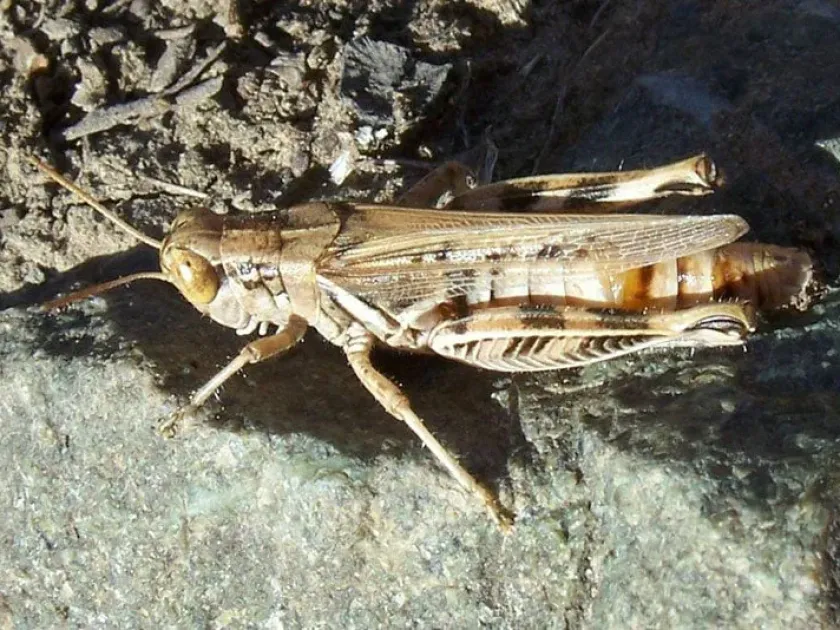
The devastating grasshopper (Melanoplus devastator) is a member of the order Orthoptera and the family Acrididae. It is a medium-sized insect characterized by its strong, muscular hind legs adapted for jumping.
Their coloration typically ranges from grayish to brownish with darker spots, providing excellent camouflage against dry soil and vegetation. They possess a robust head with powerful chewing mouthparts designed for feeding on plant tissues.
The life cycle is incomplete, consisting of egg, nymph, and adult stages. Females deposit eggs into the soil in late summer or autumn, where they overwinter, protected from environmental extremes.
Nymphs emerge from the soil in spring and undergo several molts. During this period, they feed actively, growing rapidly and gradually developing adult features such as wings.
Adults appear in mid-summer and remain active until late autumn. The species typically completes one generation per year, though high fecundity can lead to rapid population outbreaks in suitable habitats.
What it damages
This grasshopper is a significant polyphagous pest, feeding on a wide variety of crops. It is particularly known for attacking cereal grains, including wheat, barley, and oats, which are essential for food security.
Pastures and rangelands are heavily impacted by this pest, as they consume massive amounts of forage, leading to significant losses in livestock productivity and decreased farm revenue.
The pest also targets broadleaf crops such as corn, sunflowers, and various vegetables. During periods of high infestation, they can devastate young seedlings in a very short time.
Orchards and ornamental shrubs are also susceptible. Adults may consume leaves, young shoots, and even bark, which weakens the plants and reduces their long-term health and fruit production capacity.
Both nymphs and adults contribute to the damage, with older nymphs and adults being the most destructive due to their increased appetite and higher metabolic requirements.
When it appears
The activity season begins in spring when soil temperatures rise enough to trigger embryonic development. Nymph emergence usually coincides with the germination and early growth stages of crops.
Summer, especially during hot and dry spells, represents the peak period for adult activity and dispersion. Favorable weather conditions promote rapid metamorphosis and migration of the insects.
Maximum populations of adults are typically observed during July and August. At this time, they are highly mobile and can travel significant distances to locate fresh food sources.
Activity gradually declines with the onset of autumn frosts. However, until temperatures drop significantly, the insects continue to feed aggressively to accumulate energy for the winter period.
The life cycle is tightly coupled with regional climate patterns, meaning that dry and warm regions are particularly susceptible to severe outbreaks compared to more humid areas.
Signs of infestation
The primary sign of infestation is the presence of irregular defoliation patches in the field. Cereal leaves often show ragged edges, and in severe cases, only the central leaf vein remains.
Young nymphs can be detected by inspecting the field edges and ground level. They tend to congregate in groups, leaving visible patches of destroyed vegetation as they feed.
Adults are easily spotted as they leap away when approached. A mass "flight" or jumping response when walking through the field is a reliable indicator of a high pest population.
In broadleaf crops, signs include numerous holes in the leaf blades, which expand rapidly as the insects feed, eventually causing the leaves to look shredded.
Accumulation of fecal pellets on the soil surface and beneath the foliage is a secondary indicator that points to the presence of an established population in a specific area.
Control measures
Integrated management begins with cultural practices like deep plowing in late autumn, which destroys egg pods in the soil and disrupts the life cycle.
Maintaining crop rotation and controlling weeds in surrounding non-crop areas reduces the availability of sheltered sites and supplemental food sources for the grasshoppers.
Biological control options include using entomopathogenic fungi or encouraging natural predators like insectivorous birds, spiders, and parasitic wasps, which can help regulate population growth.
Chemical control is employed when population density exceeds the economic threshold. Applications are most effective when targeted at early-instar nymphs before they become highly mobile.
- Apply contact and systemic insecticides such as pyrethroids or organophosphates.
- Conduct regular monitoring using sweep nets to assess the density of nymphs and adults.
- Treat bordering vegetation and fallow land adjacent to crops to prevent mass migration into the fields.
Taxonomy
- Latin name
- Melanoplus devastator
- Order
- Orthoptera (locusts)
- Family
- Acrididae
- EPPO code
- MENPDE
Discussion
No discussions yet — be the first.