
Humpbacked fly
Megaselia rufipes
Description
How to identify
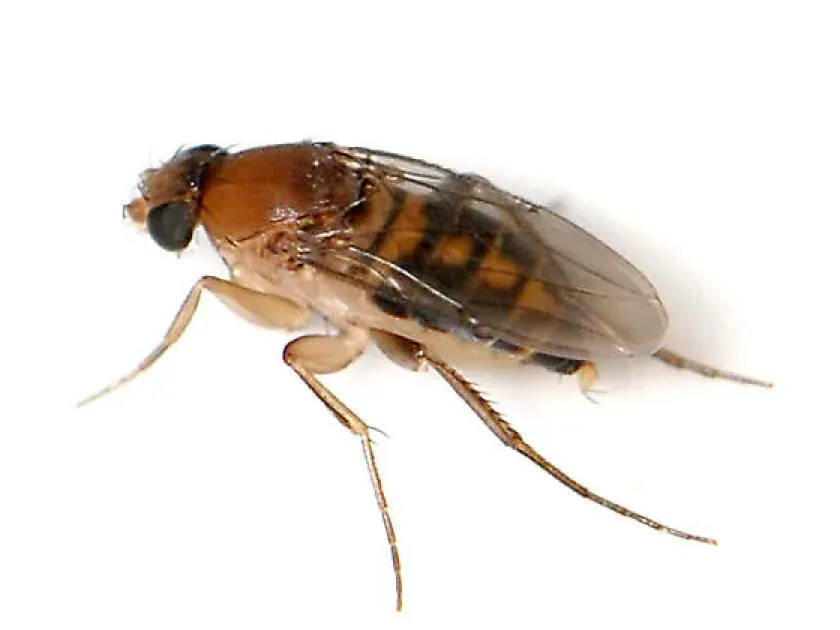
The humpbacked fly (Megaselia rufipes) belongs to the Phoridae family. Adult flies are small, measuring 2–3 mm in length, and are easily recognized by the distinctly arched, humped appearance of their thorax.
Their bodies typically range in color from brownish-black to yellowish-brown. They possess thickened hind femurs, which gives them a distinctive jumping movement rather than a simple walking gait.
The larvae are small, legless, and white or cream-colored, typically reaching up to 5 mm in length. They are highly active and capable of rapid movement through decaying organic matter or soil.
Pupation usually occurs in the soil or within the substrate where the larvae have fed. These flies are cosmopolitan and highly resilient to various environmental conditions.
They are known for their ability to thrive in indoor settings such as greenhouses, mushroom farms, and food storage facilities, where they find abundant organic resources.
What it damages
The damage is primarily caused by the larvae, which are generalist feeders. They infest mushroom beds, including button mushrooms and oyster mushrooms, consuming the mycelium and sporocarps, causing tissue breakdown.
In vegetable production, they are significant pests of germinating seeds and young seedlings. Larvae penetrate seeds such as cucumbers and tomatoes, often destroying the embryo before emergence.
Stored crops like root vegetables, bulbs, and tubers are susceptible to infestation, especially if they are already damaged or exhibit signs of early decay.
These flies act as vectors for various bacterial and fungal pathogens, facilitating the spread of infections that lead to rapid rot in both crops and stored produce.
Due to their high reproductive rate, a small infestation can escalate into a major economic loss in greenhouses or commercial warehouses within a very short timeframe.
When it appears
In temperature-controlled environments like greenhouses or storage facilities, the humpbacked fly breeds year-round, provided that the temperature remains above 20°C and humidity is high.
In outdoor environments, their activity typically begins in late spring and continues through the early autumn, depending on local climate conditions.
The life cycle is rapid, often completing in just two to three weeks under optimal conditions, allowing for multiple generations during a single growing season.
Adult flies are most active during the warmer parts of the day and during irrigation cycles, which provide the moisture necessary for their survival and egg-laying.
Overwintering usually occurs in the pupal stage, buried in the soil or protected in decaying vegetation, allowing them to emerge as soon as temperatures rise in the spring.
Signs of infestation
The presence of adult flies is the first indicator; they are often seen running rapidly on the surface of soil, growing media, or near produce boxes.
Visible signs on fungi include small entry holes in the stalks and caps, often accompanied by a soft, mushy texture and a foul, putrid odor caused by secondary bacterial decay.
In sown fields, poor germination rates and the discovery of hollowed-out seeds upon inspection of the soil indicate larval activity.
Small mounds of waste material, which consist of excrement and larval debris, can often be found near the points of infestation on the substrate surface.
Wilting of seedlings without apparent root disease is another common sign, often indicating that larvae have consumed or damaged the stem base or roots.
Control measures
The most important control measure is maintaining high levels of sanitation, such as removing decaying plant material, cleaning equipment, and properly disinfecting storage areas.
Yellow sticky traps are highly effective for monitoring and managing adult populations, helping to break the reproductive cycle before larvae damage the crops.
Biological control, such as the application of entomopathogenic nematodes, is an effective and environmentally friendly way to reduce larval populations in the substrate.
If chemical control is necessary, select insecticides must be used in strict accordance with the product labels and pre-harvest intervals to ensure safety and regulatory compliance.
- Screening ventilation systems to prevent adult migration.
- Heat treatment or pasteurization of soil and growing media before use.
- Regular monitoring of crop health and immediate disposal of infested items.
Taxonomy
- Latin name
- Megaselia rufipes
- Order
- Diptera (flies)
- Family
- Phoridae
- EPPO code
- MGASRU
Discussion
No discussions yet — be the first.