
Green marsh grasshopper
Mecostethus parapleurus
Description
How to identify
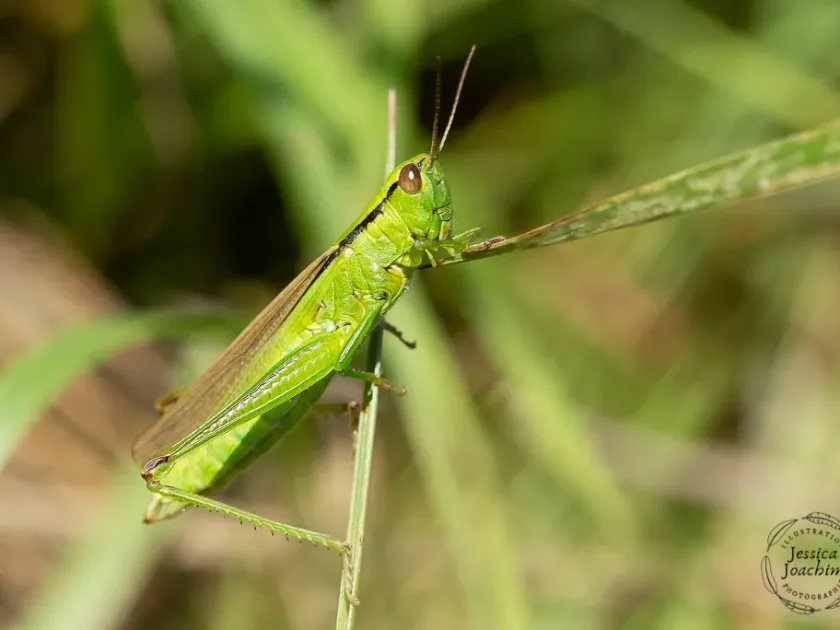
The Green marsh grasshopper (Mecostethus parapleurus) is a member of the Acrididae family, within the order Orthoptera. It is characterized by a bright green or yellowish-green color, providing excellent camouflage in lush vegetation.
Adults typically measure between 20 to 30 mm in length. They are distinguished by a pale lateral stripe on the sides and a well-developed pronotum. Their strong wings allow for significant movement and colonization of new agricultural areas.
The grasshopper possesses robust chewing mouthparts designed for feeding on tough plant tissues. They thrive in humid environments, which is why they are frequently found in meadows, river floodplains, and around marshy land.
Nymphs resemble smaller, wingless versions of the adults. They undergo several molting stages, gradually increasing in size while remaining in proximity to their hatching sites, which are usually moist, sheltered areas.
This species is well-adapted to changing environmental conditions. Its ability to thrive in both wild grassy habitats and cultivated field edges makes it a consistent pest in regions with temperate climates.
What it damages
This pest poses a threat to various cereal crops, including wheat, barley, oats, and rye. It also causes damage to grasslands, significantly reducing the yield and quality of pasture forage.
Both adults and nymphs feed by devouring leaf tissue. They typically start from the edges of leaves, moving inward, which severely limits the plant's ability to perform photosynthesis and stunts its growth.
In cases of high infestation, the pests can strip a plant down to the stem, leading to complete crop failure on heavily affected patches. This is particularly devastating during the early growth stages of cereals.
Beyond leaf damage, they often attack reproductive organs such as ears and heads. This results in empty or poorly filled kernels, causing a massive reduction in the final harvest quantity and quality.
Infestations can lead to secondary damage, as the weakened plants become susceptible to fungal infections and bacterial blight introduced through the open wounds left by the insects' feeding.
When it appears
The Green marsh grasshopper has a univoltine lifecycle, meaning it completes one generation per year. The winter is spent in the egg stage, buried in the soil or thick plant litter.
Nymphs hatch in late spring, usually correlating with the period of cereal tillering. This timing is critical, as young plants are particularly vulnerable to the initial feeding pressure.
The nymphal development stage lasts for 30 to 45 days, spanning the month of June. During this time, they exhibit high growth rates and increased appetite, making it a critical time for monitoring.
Adults emerge mid-summer, typically in July. They continue to feed and reproduce throughout August, before the females lay eggs back into the soil to ensure the survival of the next generation.
Dry and hot weather during the summer months often exacerbates the damage, as local wild vegetation dries up, forcing the grasshoppers to migrate into lush, irrigated, or well-fertilized agricultural fields.
Signs of infestation
Initial signs of infestation appear as jagged, uneven edges on leaf blades. Unlike caterpillar damage, which may be localized, grasshopper feeding often looks like the leaves have been "trimmed" by scissors.
Observation of high insect activity is a key indicator. Walking through the field will trigger visible jumps of grasshoppers, which are easily detected in the morning or evening when they are most active.
The presence of small, dark, granular frass (excrement) on the soil beneath the plants is a clear sign that a population has established itself and is actively feeding on the crop.
Patches of chlorotic or yellowed plants indicate high feeding intensity. If left unchecked, these patches expand quickly as the insects move to find fresh, succulent plant tissue.
In mature cereal crops, damaged heads or missing spikelets provide evidence that the grasshoppers have migrated to the upper strata of the plants, requiring immediate pest management intervention.
Control measures
Effective management begins with sound agronomic practices. Deep plowing of fields after harvest helps destroy egg pods embedded in the soil, preventing the next generation from hatching in the spring.
Maintaining clear field margins is essential. Mowing weeds and clearing ditches reduces the breeding grounds where grasshoppers congregate before spreading into the main crop area.
Biological control, including the use of entomopathogenic fungi, can be very effective in humid regions. These natural agents help suppress the population density without the need for synthetic chemicals.
When the economic threshold of infestation is exceeded, chemical control with targeted insecticides is necessary. Treatments should be applied during the early morning when the insects are least mobile.
Integrated Pest Management (IPM) requires regular scouting. By focusing on identifying early hotspots, farmers can use spot-treatments rather than blanket field sprays, protecting beneficial insects and reducing costs.
Taxonomy
- Latin name
- Mecostethus parapleurus
- Order
- Orthoptera (locusts)
- Family
- Acrididae
- EPPO code
- MCOSPA
Discussion
No discussions yet — be the first.